
















Choosing a technology partner is one of the crucial decisions a business can make.
The right one won’t slow your product, your business, inflate costs, or create technical debt a year from now. Founders and executives often wonder how to choose software development company partners they can truly rely on. The real answer lies in experience, transparency, and the ability to think beyond the spec.
Since 2017, Peiko has been working with startups, scale-ups, and established companies across fintech, blockchain, SaaS, and enterprise software — delivering solutions that are built to last, not just to launch.
We know — budget, quality, and commercial outcomes all matter
What are the requirements for a reliable vendor? In short: a good software development service provider is experienced, transparent, technically skilled, process-driven, and accountable for both short-term delivery and long-term success.
Key Takeaways
Choosing a software development company in 2026 requires more than comparing portfolios and hourly rates. The right partner should demonstrate relevant technical expertise, a reliable delivery process, strong security practices, transparent communication, and the ability to use AI responsibly in software development.
Before signing a contract, compare at least three vendors against the same criteria: relevant experience, technical capabilities, development methodology, security practices, communication model, pricing, team structure, and post-launch support.
For AI-enabled products, also verify how the company handles AI-generated code, data privacy, model integration, testing, monitoring, and human review. AI can accelerate development, but it does not replace engineering processes and technical accountability. DORA’s research describes AI as an amplifier of an organization’s existing strengths and weaknesses, while Stack Overflow’s 2025 survey found that 84% of respondents were using or planning to use AI tools in development.
Best approach: choose the company that provides the strongest combination of technical fit, delivery reliability, security, communication, and long-term ownership — not simply the lowest quote.
How to Choose the Right Software Development Company
Choosing a software development company should be based on more than price, location, or a polished portfolio. The right partner should have experience with products similar to yours, a delivery process that matches your requirements, the technical expertise needed for your architecture, and clear responsibilities throughout development and post-launch support.
A practical way to evaluate vendors is to compare them against the same criteria. This makes it easier to identify meaningful differences between companies and avoid choosing a provider simply because it offers the lowest initial estimate.
Before selecting a software development partner, it’s worth questioning the assumption that a traditional dev agency is the default answer. Not every product, stage, or business model requires the same engagement structure. Different delivery models solve different problems — and choosing the wrong one can create more complexity than it removes.
The real decision is not “which vendor is best?” but “which delivery model fits our maturity, risk tolerance, and strategic goals?”
Some models prioritize control, others speed, others cost efficiency, and others scalability. Each comes with trade-offs that directly affect risk, governance, and long-term sustainability.
Below is a high-level comparison of the main engagement models:
| Evaluation criterion | What to check | Red flags |
|---|---|---|
| Relevant experience | Similar products, industries, integrations, technologies | Only generic portfolio examples |
| Technical expertise | Architecture, backend, frontend, cloud, DevOps, QA, security | Technology list without real examples |
| Product understanding | Ability to discuss business goals and requirements | Talks only about development hours |
| Development process | Discovery, estimation, sprints, QA, releases, reporting | No clearly defined process |
| Team structure | Named roles, seniority, responsibilities and availability | Unclear who will actually build the product |
| Communication | Meetings, documentation, reporting, response times | Communication depends on one salesperson |
| Security | Secure SDLC, access control, testing, vulnerability management | Security discussed only after development |
| AI capabilities | AI-assisted development, AI integration, testing and governance | Claims “AI-powered development” without explaining how |
| Pricing transparency | Rate structure, assumptions, scope and change management | Extremely low quote with vague scope |
| Post-launch support | Maintenance, monitoring, bug fixes and SLA options | No support model after launch |
If you’re researching how to choose software development company options, focus on more than hourly rates. Look at how teams think, how they communicate, and how they manage risk. Ask how they’ve handled failures — not just successes; this is the real test for your product.
When talking with potential partners, here’s a practical breakdown that helps answer how to choose the right software development company — especially for complex tech initiatives like blockchain, fintech or SaaS:
| Evaluation Category | What to Check / Questions to Ask | Why It Matters |
| Reputation & Trust | Analyze reviews on Clutch, GoodFirms, Trustpilot, Upwork, G2. Spot red flags. Ask for references. | Ensures reliability, past performance, and client satisfaction. |
| Flexible Cooperation Models | Can the provider adjust team size, priorities, or engagement models? | Allows scaling resources to meet deadlines efficiently. |
| Portfolio & Work Samples | Review case studies, public accounts (GitHub, Dribbble, Behance). Are the projects similar in scope and complexity to yours? | Shows experience and quality of past work. |
| Attitude & Communication | How responsive are they? Can you contact the team directly or only PM? How about proactive problem-solving? | Smooth communication avoids delays and misunderstandings. |
| Personalization & Custom Solutions | Do they tailor solutions to your needs? Are solutions truly custom-built? | Ensures the provider adapts to your business priorities. |
| Efficient Work Process | What development methodology is used (Agile, Scrum, Kanban)? Tools for project management? | Efficient processes reduce risk, improve delivery, and maintain quality. |
| Delivery Standards | How does a company handle sprint planning, backlog grooming, and retrospectives? How are requirements documented and validated? What is your definition of “done”? | Vendors without delivery standards sell talent. Vendors with delivery standards deliver outcomes. |
| Up-to-Date Technology & AI | Are they aware of modern tech trends? Reasonable AI usage? | Keeps your product competitive and future-proof. |
| Estimation & Resource Seniority | Is the estimated scope, cost, and timeline clear? Seniority of developers assigned? | Prevents hidden costs and ensures experienced hands are on your project. |
| Discovery Phase | Is there a Discovery phase to clarify requirements, optimize costs, and reduce risk? | Minimizes misunderstandings, speeds up development, and improves decision-making. |
| Technical Stack Understanding | Does the stack fit your project needs, not just the provider’s skills? | Ensures technology choices support your product effectively. |
| Reliable Deadlines | Are timelines realistic? Can you plan confidently? | Builds trust and avoids project delays. |
Choosing the right strategic partner goes surely beyond checking boxes.
A truly reliable software development company becomes an extension of your own team and business — offering insight, proactive solutions, and guidance throughout the project lifecycle. From discovery phase and architecture to development, testing, and post-launch support, your ideal partner should balance technical expertise with business understanding.
By carefully evaluating experience, process maturity, and communication, you increase the likelihood that your project will be delivered on time, within budget, and designed to evolve alongside your business.
How to Evaluate a Software Development Company’s Technical Expertise
A portfolio can show what a software development company has built, but it does not always demonstrate how well the company can solve your particular technical challenges. Before selecting a vendor, evaluate the engineering capabilities behind its previous projects.
Start with architecture. Ask the company to explain how it would approach your application’s scalability, integrations, data storage, security, observability, and deployment. You do not necessarily need a final architecture before signing a contract, but a strong development partner should be able to explain the main technical trade-offs and identify potential risks early.
Next, evaluate the actual engineering team. Find out who will be responsible for architecture, development, QA, DevOps, and project management. Ask whether the people presented during presales will remain involved after the project starts.
Technology expertise should also match the product rather than follow a generic technology checklist. For example, a real-time application may require strong experience with WebSockets and event-driven architecture, while a data-heavy platform may need expertise in databases, data processing, cloud infrastructure, and security.
In 2026, AI capabilities should also be part of technical due diligence. Ask how the team uses AI coding assistants, automated testing, AI integrations, retrieval-augmented generation (RAG), agents, or model APIs where relevant. More importantly, ask how AI-generated code and outputs are reviewed. Stack Overflow’s 2025 Developer Survey found that AI adoption is widespread, but developers also report significant concerns about output accuracy, making human review and engineering controls important.
A good software development company should be able to explain not only what technology it uses, but why that technology is appropriate for your product.
How Much Does It Cost to Hire a Software Development Company in 2026?
The cost of working with a software development company depends on the product’s complexity, team composition, technology stack, location, project duration, and engagement model. A simple MVP can require a relatively small development team, while a complex SaaS platform, marketplace, fintech product, or AI-enabled application may require specialists in architecture, DevOps, QA, security, and data engineering.
Do not compare software development companies using hourly rates alone. A lower rate does not necessarily mean a lower total project cost. An inexperienced team may require more development time, create technical debt, or underestimate integrations and maintenance requirements.
Instead, compare vendors using the total cost of delivery:
- discovery and business analysis;
- UX/UI design;
- software development;
- quality assurance;
- DevOps and cloud infrastructure;
- project management;
- third-party integrations;
- security and compliance;
- maintenance and post-launch support.
For an initial comparison, ask each vendor to provide the same information: estimated team size, timeline, assumptions, deliverables, hourly rates or fixed price, excluded work, and expected ongoing maintenance costs.
| Project type | Typical complexity | Main cost drivers |
| MVP | Low–medium | Core features, UX/UI, backend, QA |
| SaaS platform | Medium–high | Multi-tenancy, integrations, security, scalability |
| Marketplace | High | Payments, user roles, search, messaging, moderation |
| Fintech application | High | Security, payments, compliance, integrations |
| AI-powered product | Medium–very high | AI APIs/models, data pipelines, RAG, evaluation, infrastructure |
| Enterprise platform | High | Integrations, permissions, scalability, legacy systems |
Software Development Company Evaluation Checklist
| Question to ask | What a strong answer looks like |
| Have you built similar products? | Specific examples with comparable functionality |
| Who will work on the project? | Named roles, responsibilities and seniority |
| How will you estimate the project? | Discovery, assumptions, WBS/backlog and estimates |
| How do you manage scope changes? | Defined change-control process |
| How do you ensure code quality? | Code review, automated testing and QA |
| How do you handle security? | Secure SDLC, access controls and security testing |
| How do you use AI? | Clear AI policy with human review and data controls |
| How will the application scale? | Architecture designed around expected workloads |
| What happens after launch? | Maintenance, monitoring and support options |
| What happens if the project goes wrong? | Clear escalation and risk-management process |
10 Red Flags When Choosing a Software Development Company
If a software development company cannot clearly explain how work is planned, executed, and controlled, your project is already at risk. Vague language like “we’re flexible,” “we adapt as we go,” or “we customize per client” often hides the absence of real delivery standards. Without defined processes for planning, estimation, quality control, risk management, and accountability, delivery becomes reactive instead of predictable.
Commercially, unrealistic pricing and vague contracts should raise immediate concern.
Low-cost offers with unclear scope definitions, no change management process, no SLAs, and no exit or knowledge-transfer clauses almost always convert into cost overruns, delays, and disputes.
Culturally, be wary of vendors who always say “yes,” resist scrutiny, deflect responsibility, and avoid hard questions. Delivery culture predicts delivery outcomes. Behavior patterns matter more than pitch decks.
Finally, the most strategic red flag: a focus on features instead of business outcomes. If a company talks only about implementation and technology but shows no understanding of your business model, market, users, or product strategy, you will get code — not a product.
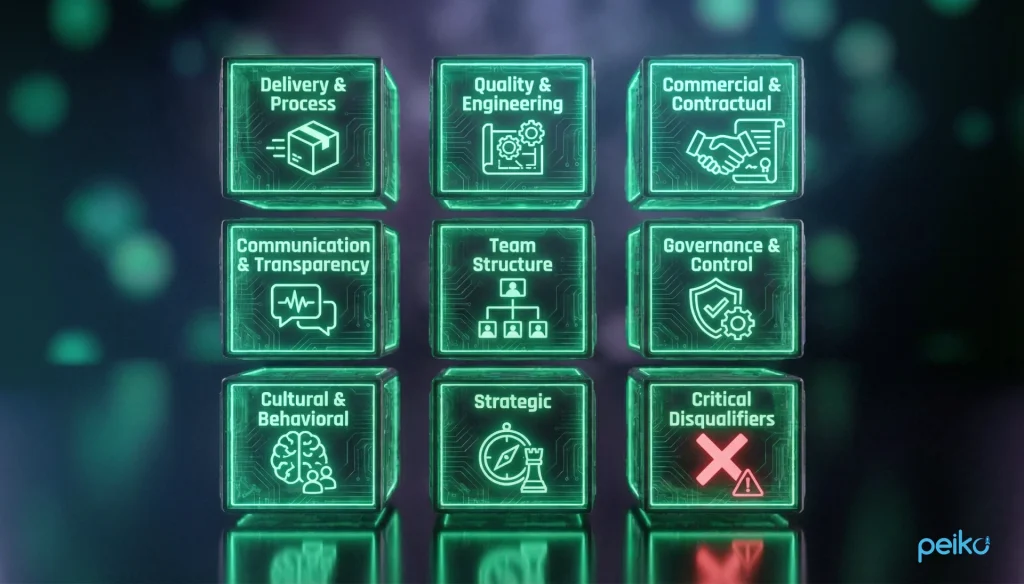
Below is a structured overview of the most critical red flags — a clear, practical framework for identifying delivery risk before it becomes project failure:
| Category | Red Flags | Why It Matters |
| Delivery & Process | No defined methodology; no sprint structure or milestones; vague planning & estimation; no documented process; “we adapt as we go” instead of governance | No structure = unpredictable timelines, budget overruns, and delivery chaos |
| Quality & Engineering | No code reviews; no automated testing; QA as “final phase only”; no documentation standards; no technical debt ownership | Guarantees bugs, rework, instability, and long-term system fragility |
| Commercial & Contractual | Unrealistically low pricing; vague scope; no change management; no SLA/SLOs; no exit or knowledge transfer clauses | Cheap contracts turn into expensive failures |
| Communication & Transparency | No reporting cadence; no dashboards; no artifact access; sales overpromise/execution underdelivers; sales disconnected from delivery | You can’t manage what you can’t see |
| Team Structure | High turnover; no delivery owner; junior teams sold as senior; talent swapping post-signing; no continuity plan | Your project becomes a training ground |
| Governance & Control | No risk management; no escalation model; unclear decision authority; no accountability framework | Problems grow until they become crises |
| Cultural & Behavioral | Always saying “yes”; defensiveness; blame-shifting; no proactive improvement | Culture predicts delivery outcomes |
| Strategic | Feature-focus only; no business understanding; no product thinking; no scalability vision | You get code, not a product |
| 🚨 Critical Disqualifiers | Refuses transparency; no repo access; no ownership clarity; no documentation; no governance; no accountability | Immediate failure risk |
| AI Risk | Promise AI will replace engineering work | AI coding tools can improve developer productivity, but they do not remove the need for technical oversight |
Let’s Build What Matters!
Whether you’re launching an MVP, rebuilding legacy software, or scaling a high-load system, Peiko brings clarity to complexity. As a custom software development company, we don’t sell templates — we build solutions tailored to your goals, users, and constraints.
If you’re looking for a reliable partner among software development companies, Peiko is ready to help you build what’s next — with confidence, transparency, and results that scale.
Many software development companies promise results. Peiko proves them through process. We start every engagement by understanding your business model, risks, and long-term roadmap — not just features. This approach is critical for teams that want more than a vendor and are serious about how to choose the right software development company for sustainable growth
We stay focused, senior-driven, and accountable. That’s why many clients who have worked with multiple software development companies ultimately stay with us long-term.
Why Peiko?
Peiko works as a software development service company that covers the entire product lifecycle — from discovery and architecture to post-launch support. Outsourcing can feel risky — but with Peiko, the search gets simpler. Peiko ranks at the top of Clutch’s Blockchain Leaders Matrix, standing out among more than 5,800 companies. In an industry where trust matters more than promises, this recognition reflects what counts most: consistent delivery and proven results.
While blockchain is our core strength (5 years in a row as Top Blockchain developers), Peiko also delivers high-quality solutions across fintech, SaaS, marketplaces, mobile apps, and eCommerce. Additional recognition includes awards for Next.js, financial applications, business intelligence, and eCommerce development, as well as being named a top software development company Europe.
Peiko’s work is also recognized by Manifest, Tech Behemoths, Upwork, TopDevelopers, and GoodFirms, reinforcing a reputation built on quality, reliability, and long-term partnerships.
As a custom software development company, we focus on tailored architectures rather than one-size-fits-all solutions. Unlike many small software development companies, Peiko combines agility with mature processes and senior technical leadership.
A good software development company doesn’t just write code — it takes responsibility for decisions, risks, and long-term product success. The team is frequently selected by clients looking for the best offshore software development company without sacrificing quality or communication. Our teams operate with clear documentation, overlapping work hours, and direct access to senior engineers and decision-makers. No black boxes. No surprises. Moreover, we provide our clients:
How to Choose a Software Development Company: Quick Checklist
To choose a software development company in 2026, compare vendors across eight areas: relevant experience, technical expertise, team structure, development process, security, AI capabilities, pricing transparency, and post-launch support.
Start by defining your business and technical requirements. Shortlist three to five companies with relevant experience, ask each for the same information, compare their teams and delivery approaches, review technical proposals, check references or case studies, and clarify ownership, pricing, intellectual property, security, and support before signing a contract.
The best partner is not necessarily the cheapest or the largest company. It is the one that understands your business problem, can explain the technical solution clearly, manages risks transparently, and can support the product beyond the initial development phase.
Trust Your Instincts in Technology: Conclusion
After thorough research, interviews, and detailed evaluations, one final piece of advice stands out: trust your instincts. Data, case studies, and technical expertise matter, but your intuition often reveals what numbers can’t. If everything checks out on paper but something doesn’t feel right, it probably isn’t.
At Peiko, we see technology partnerships as more than a business transaction — they’re a collaboration built on trust and shared vision and goals. You’re not just hiring a team to develop software; you’re choosing a partner who helps shape the future of your business. Whether it’s web development, automating business processes, or integrating cutting-edge technologies, the right partner should feel like a natural extension of your team.
True collaboration goes far beyond technical skills or consulting expertise. The best software development company is your ally. With the right people in your corner, there’s no limit to what your business can achieve.
No comments yet. Be the first to comment!