















The financial landscape is shifting in a very exciting way — we are moving past the early, volatile days of crypto and entering a mature era focused on real utility. In 2026, the biggest opportunity isn’t just about digital currencies; it’s about unlocking the immense value tied up in traditional markets like real estate, private credit, and commodities.
Building an rwa tokenization platform is your bridge into this new economy. It is a chance to modernize how assets are owned and traded. However, we know that merging traditional finance with blockchain can feel complex. It requires balancing innovative tech with the safety and compliance that investors expect.
If you are exploring how to digitize assets, think of this guide as a friendly roadmap. We will walk through how to build a scalable, compliant product that brings the best of DeFi to the stability of the real world.
Key Takeaways
- RWA tokenization converts rights or claims associated with real-world assets into digital tokens recorded on a blockchain or distributed ledger.
- Tokenization can be used for real estate, funds, bonds, private credit, commodities, art, infrastructure and other assets, depending on the legal and economic structure.
- A token does not automatically equal direct legal ownership of the underlying asset. The token may instead represent shares, units, debt, contractual rights or another claim.
- A production RWA platform requires more than smart contracts. It typically combines identity verification, KYC/AML, custody, legal entities, asset records, token issuance, compliance rules, payments and blockchain infrastructure.
- Regulation depends on the asset, rights attached to the token, offering structure and jurisdiction. In the EU, financial instruments are outside the scope of MiCA and remain subject to applicable financial-services legislation.
- The strongest RWA platforms connect off-chain legal and financial infrastructure with on-chain ownership or transfer records rather than trying to put every part of the asset lifecycle on-chain.
- In 2026, tokenization is moving beyond theoretical use cases into institutional experimentation around tokenized funds, securities and settlement infrastructure. The FCA, BIS and major market infrastructures are actively developing frameworks and pilots in this area.
What is RWA Tokenization? The Mechanism Behind the Shift
RWA tokenization is the process of representing ownership, economic interests, or contractual claims related to a real-world asset as digital tokens on a blockchain or distributed ledger. The underlying asset can be physical, financial, or contractual, while the token defines what rights the holder receives.
The critical point is that tokenization does not remove the need for legal ownership structures, custody, compliance, valuation, or asset servicing. Instead, blockchain becomes part of the infrastructure used to record, transfer, automate, and potentially settle those rights.
At its core, real world asset tokenization is the process of creating a digital representation of a tangible or intangible physical asset on a blockchain.
This is not merely about creating a token; it is about creating a legal and technical bridge. When you tokenize real world assets, you are wrapping the ownership rights (or debt obligations) into a digital vehicle that can be traded, fractionated, and programmed.
The mechanism generally involves three layers:
- Off-chain Asset: The physical asset (e.g., a commercial building) held in custody or a special purpose vehicle (SPV).
- Information Bridge: Oracles and data feeds that verify the asset’s status and valuation.
- On-chain Token: The programmable token that represents the claim to that asset.
How RWA Tokenization Works: From Asset to Token
Tokenizing a real-world asset involves both legal/financial infrastructure and blockchain technology. The blockchain is only one component of the process.
A typical RWA tokenization lifecycle looks like this:
1. Identify the asset
The issuer determines what asset will be tokenized, who owns it, how it is valued, and what economic rights investors should receive.
2. Create the legal structure
Depending on the jurisdiction and asset, ownership may be structured through an issuer, special-purpose vehicle (SPV), fund, trust, partnership, or another legal entity.
3. Verify and custody the asset
The platform needs reliable evidence that the underlying asset exists and is controlled by the relevant entity. For physical assets, this can involve custodians, registries, appraisers, auditors, or other independent parties.
4. Define token rights
The platform specifies what the token represents. It could represent equity, debt, fund units, revenue rights, or another contractual claim.
5. Implement compliance rules
Investor eligibility, KYC/AML checks, jurisdiction restrictions, transfer rules, holding limits, and other requirements are defined before tokens are issued or transferred.
6. Create and issue the token
Smart contracts create the tokens and enforce the rules defined by the platform.
7. Distribute tokens
Eligible investors can purchase or receive tokens through the platform. Payment, allocation, ownership records, and investor information are connected to the token lifecycle.
8. Manage the asset after issuance
The platform may need to process income distributions, reporting, corporate actions, redemptions, transfers, valuations, and other asset-servicing activities.
9. Support transfers or secondary trading
If permitted by the legal structure, eligible holders may transfer or trade tokens through a compliant secondary marketplace.
Simplified RWA tokenization flow
Real-World Asset
→ Legal Structure / Issuer
→ Custody & Verification
→ Investor Eligibility
→ Token Issuance
→ Blockchain
→ Primary Distribution
→ Secondary Transfers / Trading
→ Redemption / Settlement
This makes it clear that token issuance is only one stage of RWA tokenization.
Why Launch an RWA Platform in 2026?
RWA tokenization is moving from a primarily experimental concept toward practical applications in financial markets, asset management, private markets and settlement infrastructure.
BIS research highlights potential efficiency gains from tokenization, including reduced reconciliation and more programmable settlement, while also emphasizing that interoperability, governance and risk management remain important challenges.
The institutional focus is also becoming more concrete. In 2026, the FCA published guidance supporting fund tokenization, while BIS Project Agorá demonstrated a prototype for tokenized commercial bank deposits and central bank reserves in cross-border wholesale payments.
For businesses, the potential value of RWA tokenization can include:
- fractional access to certain assets
- programmable ownership and transfer rules
- automated distributions
- faster settlement
- improved transaction traceability
- reduced reconciliation between parties
- broader digital distribution
- new secondary-market models
- integration with blockchain-based financial infrastructure
However, tokenization does not automatically create liquidity or reduce costs. Those benefits depend on the asset, legal structure, market design, investor demand, custody model and supporting infrastructure. BIS specifically notes that many potential benefits remain subject to trade-offs and are not guaranteed.
Types of Assets Suitable for Tokenization
Not every asset needs to be on the blockchain. The best candidates for real world assets tokenization are those with high value, low liquidity, and complex administrative requirements.
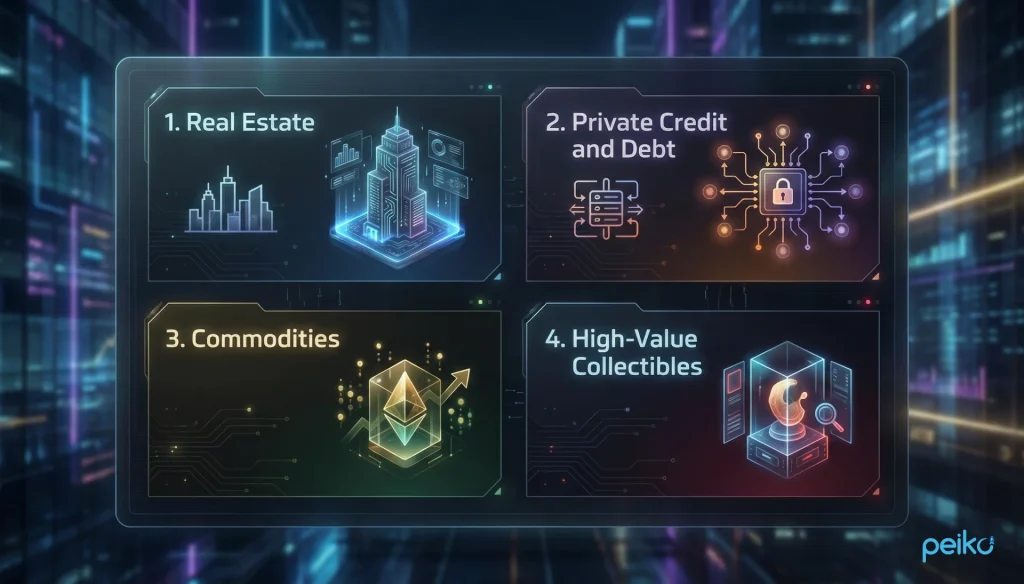
| RWA Category | What Can Be Tokenized | Typical Token Representation | Key Considerations |
| Real Estate | Residential, commercial and industrial property | Ownership interest, SPV shares or fund units | Property law, valuation, custody and investor eligibility |
| Government Bonds | Treasury and sovereign debt instruments | Tokenized security or beneficial interest | Securities regulation, settlement and custody |
| Corporate Bonds | Corporate debt | Debt/security token | Issuer disclosure, transfer restrictions and settlement |
| Private Credit | Loans and credit portfolios | Debt claims or fund interests | Underwriting, servicing, KYC/AML and risk management |
| Investment Funds | Fund units and interests | Tokenized fund units | Fund regulation, transfer restrictions and NAV |
| Commodities | Gold and other commodities | Claim or ownership interest | Custody, proof of reserves and redemption |
| Infrastructure | Energy, transport and infrastructure projects | Equity/debt/fund interest | Project governance and regulatory structure |
| Art & Collectibles | Artwork and high-value collectibles | Ownership interest or claim | Provenance, custody, valuation and transfer rules |
Tokenization suitability depends not only on the value of an asset but also on whether its ownership, economic rights, valuation, custody and transfer rules can be represented clearly in a legally enforceable structure.
Real-World Case Study: 14 Small Electric Chairs, a Work by Andy Warhol
In 2018, a blockchain platform called Maecenas partnered with a London art gallery to tokenize a painting by Andy Warhol titled “14 Small Electric Chairs”, valued at approximately $5.6 million at the time.
How it worked:
- The Asset: A physical Andy Warhol painting.
- The Process: They launched a beta auction to sell 31.5% of the artwork’s value to the public.
- The Result: They raised $1.7 million in cryptocurrency (Bitcoin and Ethereum) from over 100 investors.
- The Outcome: Instead of one wealthy collector owning the entire piece, a group of investors owned digital shares (tokens) representing a fraction of the painting. This allowed them to benefit from the appreciation of the art market without needing millions of dollars to enter.
Why this matters: It proved that high-value assets could be successfully fractionalized and sold to a global audience in a compliant way, validating the entire RWA model for collectibles.
What Does an RWA Token Actually Represent?
One of the most important decisions when building an RWA platform is defining the legal and economic relationship between the token and the underlying asset.
A token can represent different types of rights:
| Token Structure | What the Investor Receives | Example |
| Direct ownership | Legal ownership interest in the asset | Fractional ownership of an eligible asset |
| Equity interest | Shares in an entity that owns the asset | Shares in an SPV holding real estate |
| Debt claim | Right to repayment and potentially interest | Tokenized private credit |
| Fund interest | Units or shares in an investment vehicle | Tokenized real-estate fund |
| Revenue claim | Contractual right to a defined revenue stream | Revenue-sharing structure |
| Beneficial interest | Economic rights without direct legal title | Trust or similar arrangement |
Why this distinction matters
The blockchain can record who holds a token, but the token’s legal meaning comes from the underlying legal and contractual structure.
For example, if a property is owned by an SPV and the token represents shares in that SPV, purchasing the token does not necessarily mean that the investor directly owns part of the property title. The investor may instead own an interest in the entity that owns the property.
This affects:
- investor rights
- transfer restrictions
- distributions
- taxation
- custody
- redemption
- insolvency treatment
- regulatory classification
Therefore, legal structuring should happen before smart-contract development, not after it.
Essential Features of a Robust RWA Tokenization Platform
When we architect an rwa tokenization platform, we focus on modularity. Your system must handle the entire lifecycle of the asset, not just the minting phase.
| Feature | Purpose |
| Investor Onboarding | Register investors and businesses |
| KYC/KYB | Verify identity and business information |
| AML Screening | Detect financial-crime risks |
| Asset Onboarding | Register and verify assets |
| Legal Entity Management | Connect assets with issuers, SPVs or funds |
| Token Issuance | Create and distribute asset-backed tokens |
| Permissioned Transfers | Restrict transfers according to eligibility rules |
| Wallet Management | Connect external or managed wallets |
| Payments | Process subscriptions, purchases and distributions |
| Custody Integration | Connect custodians and asset-holding infrastructure |
| Asset Valuation | Maintain current asset/NAV information |
| Oracle Integration | Bring trusted external data on-chain |
| Investor Dashboard | Show holdings, transactions and distributions |
| Reporting | Generate investor and regulatory reports |
| Secondary Marketplace | Enable compliant transfers or trading |
| Redemption | Support asset/token redemption workflows |
| Audit Trail | Track issuance, transfers and corporate actions |
| Admin & Compliance Console | Manage platform operations and compliance |
The Token Lifecycle Manager
The platform must allow the admin to mint, burn, pause, and blacklist tokens. If a user loses their private key, the administrator must have the power to “force transfer” the tokenized real world asset to a new wallet to satisfy legal ownership rights.
Investor Dashboard
Investors need transparency. They should see:
- Real-time valuation of their portfolio.
- Accrued dividends or interest payments (distributed in stablecoins).
- Legal documentation (PDFs of the prospectus/offering memo) linked to the token.
Secondary Market Integration
Liquidity is the product. Your platform should either have an internal bulletin board for trading or integrate with established decentralized exchanges (DEXs) and permissioned liquidity pools.
Automated Reporting
For compliance, the system must generate reports on who owns what, dividend distributions, and tax withholdings.
Compliance: KYC/AML, Securities Laws, and Jurisdiction Strategy
Compliance for an RWA tokenization platform cannot be reduced to KYC and AML checks. The legal treatment depends on the underlying asset, the rights attached to the token, the issuer structure, how the token is offered and transferred, and the jurisdictions involved.
In the EU, for example, MiCA does not apply to crypto-assets that qualify as financial instruments. Tokenized securities can therefore remain subject to existing financial-services legislation rather than simply being treated as ordinary crypto-assets under MiCA.
In the UK, regulators are actively developing frameworks for fund and market tokenization. The FCA’s 2026 policy statement supports the use of DLT for fund tokenization within the existing regulatory framework.
In the US, the regulatory treatment depends on the specific structure and rights involved. The SEC has continued to develop its approach to tokenized securities and crypto assets in 2026, including proposals and exchange initiatives involving securities represented in tokenized form.
Compliance Architecture
| Area | Typical Requirement |
| KYC/KYB | Identity and business verification |
| AML | Transaction monitoring and risk controls |
| Sanctions | Screening against applicable sanctions lists |
| Investor Eligibility | Jurisdiction, accreditation or other eligibility checks where required |
| Securities Compliance | Determine whether the token represents a regulated financial instrument |
| Custody | Define how the underlying asset and digital assets are held |
| Data Protection | Protect personal and sensitive information |
| Transfer Restrictions | Prevent prohibited or ineligible transfers |
| Reporting | Investor, regulatory and asset-level reporting |
| Audit Trail | Maintain reliable records of issuance, transfers and distributions |
Technology cannot make an otherwise non-compliant financial product compliant. The legal structure, offering model, investor rights and jurisdictional requirements should be defined with qualified legal and compliance professionals before the technical architecture is finalized.
Tech Stack: Blockchain, Smart Contracts, Custody, Oracles
To build a platform that institutional investors trust, you must use battle-tested technology.
- Blockchain Layer: Most RWA tokenization platforms utilize EVM-compatible chains (Ethereum, Polygon, Avalanche) due to their robust developer ecosystem and common token standards (ERC-20, ERC-3643, ERC-1400).
- Custody: Institutional investors won’t manage private keys on a browser extension. You need integration with qualified custodians or MPC (Multi-Party Computation) wallet providers like Fireblocks or Coinbase Prime.
- Oracles: To update the price of the asset (e.g., the current value of gold or a property appraisal), you need reliable data feeds like Chainlink to inject off-chain data into the on-chain environment.
RWA Tokenization Platform Architecture: On-Chain and Off-Chain Components
A production RWA platform usually combines blockchain infrastructure with conventional financial and enterprise systems.
The objective is not to put every piece of information on-chain. Instead, the architecture should determine which data and processes require blockchain-based verification and which are better handled off-chain.
| Layer | Typical Components | Purpose |
| User Interface | Web/mobile application | Investor, issuer and administrator workflows |
| Identity & Compliance | KYC/KYB, AML, sanctions screening | Verify participants and enforce eligibility |
| Backend | APIs, business logic, databases | Coordinate platform workflows |
| Asset Registry | Asset records, ownership documents, valuations | Maintain off-chain asset information |
| Tokenization Engine | Issuance, allocation, redemption | Connect legal/business rules with token operations |
| Smart Contracts | Token standards, permissions, transfers | Enforce on-chain rules |
| Blockchain | EVM or other suitable network | Record transactions and token ownership |
| Custody | Custodian, wallet infrastructure, key management | Protect assets and digital credentials |
| Oracles | Price, NAV, asset and external data | Bring trusted external information on-chain |
| Payments | Bank rails, stablecoins or payment providers | Handle subscriptions, purchases and distributions |
| Monitoring | Logs, alerts, transaction monitoring | Detect operational and security issues |
What should stay off-chain?
Personal information, large documents, detailed KYC records, private financial information and many operational records are generally better handled off-chain.
The blockchain can instead store:
- token ownership
- transaction records
- asset identifiers
- hashes or references to documents
- compliance status indicators where appropriate
- smart-contract state
- distribution and redemption events
This approach can improve privacy, reduce blockchain costs, and make the system easier to maintain.
RWA Tokenization Platforms: Common Risks and Mistakes
| Risk | What Can Go Wrong | Mitigation |
| Legal mismatch | Token rights do not match legal ownership | Define legal structure before token design |
| Regulatory misclassification | Token is treated under the wrong regulatory framework | Obtain jurisdiction-specific legal analysis |
| Weak asset verification | Tokenized asset cannot be reliably verified | Use custody, valuation and verification processes |
| Oracle failure | Incorrect external data reaches smart contracts | Use trusted sources, validation and fallback logic |
| Smart-contract vulnerability | Unauthorized transfers or asset loss | Testing, review and independent audit where appropriate |
| Key compromise | Administrative wallets are compromised | Strong key-management and access-control architecture |
| Poor KYC/AML | Ineligible users gain access | Integrate appropriate identity and screening controls |
| Illiquid market | Tokens cannot easily be sold | Design realistic distribution and secondary-market strategy |
| Interoperability | Tokens or data cannot move between systems | Define network and integration strategy early |
| Privacy leakage | Sensitive investor information becomes public | Keep personal/sensitive data off-chain where appropriate |
| Custody failure | Underlying assets are not properly controlled | Use qualified custodial/asset-control arrangements |
| Over-engineering | Too much functionality is built before validation | Start with a focused MVP |
Instead of focusing on what can go wrong, let’s look at the four pillars that define the most successful RWA projects.
- Proactive Liquidity Planning: Tokenization creates the technical capacity for trading, but a business strategy creates the volume. Successful founders don’t just build the platform; they partner with market makers and have a clear distribution plan to ensure their assets find eager buyers.
- Regulatory Confidence: Think of compliance as your competitive advantage, not a hurdle. Launching with a clear legal opinion letter gives you stability. When you align with regulators from day one, you build a sustainable business that institutional investors trust.
- Asset Assurance: In the world of RWA, trust is physical. Top-tier platforms incorporate insurance and regular physical audits into their protocol. This reassures investors that, no matter what happens, the digital token is backed by a protected, tangible asset.
- Future-Proof Standards: Choosing the right technology early saves time later. By using permissioned token standards (like ERC-3643) instead of basic ones, you automate compliance directly in the code, making your platform ready for institutional scale from the very first transaction.
RWA Tokenization Platform Business Models
| Model | Description | Best For |
| White-Label Platform | Technology platform customized for a financial institution or asset issuer | Banks, funds, asset managers |
| Issuance Platform | Enables issuers to tokenize and distribute assets | Asset owners and investment firms |
| Investor Marketplace | Connects eligible investors with tokenized assets | Private-market platforms |
| Fund Tokenization Platform | Digitizes fund units and investor administration | Asset managers |
| Asset-Specific Platform | Focused on real estate, credit, commodities or another asset class | Specialized operators |
| Institutional Infrastructure | APIs and infrastructure for other financial platforms | Banks, custodians and fintechs |
RWA Tokenization Platform Development Cost and Timeline
The cost of an RWA tokenization platform depends on the asset class, legal structure, investor workflows, blockchain architecture, compliance requirements, integrations, and whether the platform includes secondary-market functionality.
A useful way to estimate the project is by scope:
| Platform Scope | Typical Features | Indicative Timeline | Relative Cost |
| Tokenization MVP | Asset onboarding, KYC, token issuance, basic investor dashboard | 3–5 months | $$ |
| Production Platform | Compliance, custody, payments, smart contracts, admin, reporting | 5–9 months | $$$ |
| Institutional Platform | Advanced compliance, custody, multi-asset support, integrations | 9–15+ months | $$$$ |
| Full Marketplace | Issuance + investor marketplace + secondary trading + settlement | 12–18+ months | $$$$+ |
What increases the cost?
The largest cost drivers are usually:
- number and complexity of asset classes
- legal/compliance requirements
- smart-contract complexity
- custody architecture
- KYC/AML integrations
- payment integrations
- blockchain selection
- secondary-market functionality
- investor and issuer workflows
- external data/oracles
- security requirements
- number of jurisdictions
- mobile and web applications
Important:
These are planning ranges, not fixed market prices. A simple tokenization platform for one asset class can require substantially less work than a multi-jurisdiction institutional marketplace. A proper estimate should be based on product scope, regulatory assumptions and architecture rather than the tokenization label alone.
No comments yet. Be the first to comment!