
















Building a DApp on Ethereum is a practical way to enter Web3. It lets you work with decentralization, immutability, and smart contracts in a real product.
Our guide explains what a DApp is, and walks you through setup, development, and launch.
Best Ethereum Networks for DApp Development
| Network | Avg. Gas Fee | TPS | Finality | Best For | EVM Compatible |
|---|---|---|---|---|---|
| Ethereum Mainnet | High | 15-30 | ~12 min | Maximum security | ✅ |
| Arbitrum | Low | 4,000+ | <2 min | DeFi, Gaming | ✅ |
| Optimism | Low | 4,000+ | <2 min | Consumer Apps | ✅ |
| Base | Very Low | 2,000+ | <2 min | Mass Adoption | ✅ |
| Polygon PoS | Very Low | 7,000+ | ~2 sec | NFT, Payments | ✅ |
Why is it worth creating a DApp on Ethereum?
A DApp (decentralized application) runs on a blockchain like Ethereum instead of centralized servers. It uses smart contracts to handle logic in a transparent, trustless way.
Building DApps on Ethereum is a great blockchain business idea due to its strong security, decentralized structure, and expansive Ethereum ecosystem. This provides a global platform with reduced risk of censorship and the ability to create transparent, trustless solutions that will attract users.
There are already 3,000+ DApps on Ethereum, with more in development. Platforms like DappRadar track leading apps, including their users and transaction volumes.
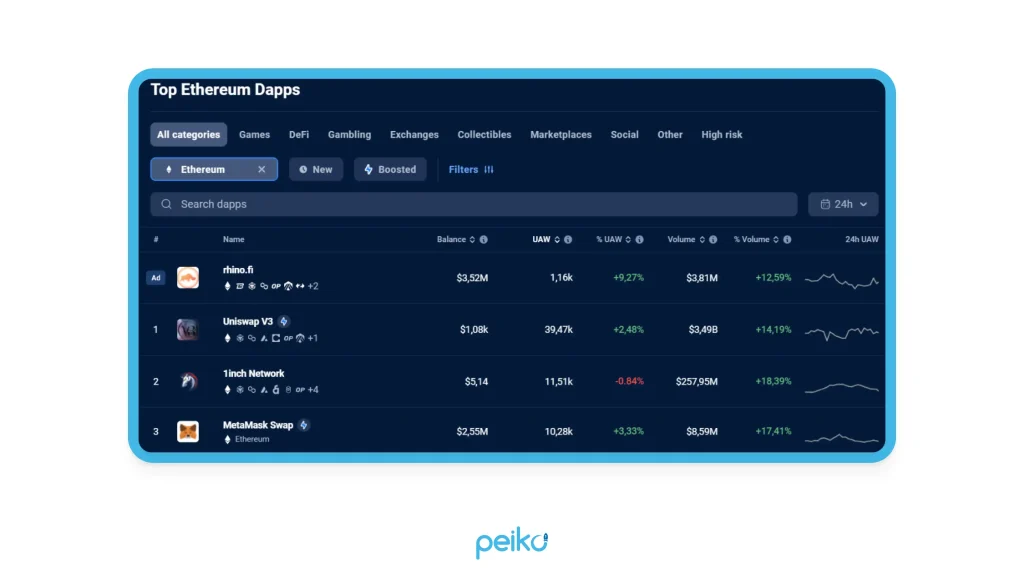
Here are some prominent and widely used examples of decentralized apps built on Ethereum:
| DApp | Category | Stack | Architecture | Description |
| Uniswap | DeFi (DEX) | Solidity, React, Ethers.js | AMM (Automated Market Maker) | A decentralized exchange that allows users to swap tokens directly from their wallets without intermediaries using liquidity pools. |
| OpenSea | NFT Marketplace | Solidity, Node.js, React, IPFS | Hybrid (on-chain + off-chain storage) | One of the largest NFT marketplaces where users can buy, sell, and mint digital assets such as art, collectibles, and domain names. |
| Aave | DeFi Lending | Solidity, React, The Graph | Liquidity pools | A decentralized lending platform where users can lend and borrow cryptocurrencies with algorithmically determined interest rates. |
| ENS | Identity | Solidity, React, IPFS | Registry + resolver system | A decentralized naming system that maps human-readable names (like .eth) to wallet addresses and other data. |
| MakerDAO | Stablecoin (DeFi) | Solidity, Oracles, React | Multi-contract governance system | A protocol that issues the DAI stablecoin, backed by crypto collateral and governed by decentralized voting. |
| Curve Finance | DeFi (DEX) | Solidity, Vyper, React | Optimized AMM for stable assets | A decentralized exchange optimized for low-slippage trading of stablecoins and similar assets. |
| Blur | NFT Marketplace | Solidity, Next.js, Wagmi | High-performance trading engine | A professional NFT trading platform designed for advanced users with fast execution and analytics tools. |
| Compound | DeFi Lending | Solidity, JavaScript, Web3.js | Algorithmic interest model | A lending protocol where users earn interest or borrow assets, with rates automatically adjusted based on supply and demand. |
| Decentraland | Metaverse | Solidity, Unity, IPFS | Virtual world + NFT ownership | A virtual world where users can buy land, build experiences, and monetize content using NFTs and tokens. |
| Axie Infinity | GameFi | Solidity, Ronin (L2), Unity | Layer 2 + game economy | A blockchain-based game where players collect, breed, and battle NFT creatures, earning tokens within the ecosystem. |
Prerequisites and tools you need
Eager to build DApp on Ethereum? Take a glance at the market to explore different use cases of Ethereum DApps and gain insights into the purpose and functionality of your own DApp. Consider the problem it addresses or what it has to offer for users. An experienced blockchain creation agency like Peiko will help you define the goals and DApps development plan.
What to do next? To start building DApps on Ethereum, you will need to configure the right environment and install the necessary tools to streamline the development process. Here is a brief overview of the essentials:
| Category | Tool | Purpose | When to Use |
| Runtime | Node.js & npm | Runs JavaScript tools and manages dependencies | Required for all DApp projects |
| Language | Solidity | Main programming language for smart contracts | Writing on-chain logic |
| Dev Framework | Hardhat | Compile, test, deploy smart contracts | Standard development workflow |
| Dev Framework | Foundry | Fast testing, scripting, fuzzing | Advanced development & performance |
| Local Blockchain | Hardhat Network | Simulates Ethereum locally | Development & debugging |
| Local Blockchain | Anvil (Foundry) | High-performance local node | Fast testing & simulations |
| Wallet | MetaMask | Wallet + transaction signing | Default user interaction |
| Wallet Layer | WalletConnect | Multi-wallet connectivity | Mobile & multi-device support |
| Wallet UI | RainbowKit | Prebuilt wallet UI components | Faster frontend integration |
| Web3 Library | Ethers.js | Blockchain interaction library | Stable & widely used |
| Web3 Library | Viem | Type-safe and faster alternative | Modern production apps |
| React Web3 | Wagmi | React hooks for Web3 integration | Frontend development |
| RPC Provider | Alchemy | Access Ethereum nodes via API | Production infrastructure |
| RPC Provider | Infura | Alternative RPC provider | Backup & redundancy |
| Storage | IPFS | Decentralized file storage | NFTs, metadata, assets |
| Storage | Arweave | Permanent decentralized storage | Long-term data persistence |
| Indexing | The Graph | Query blockchain data efficiently | Fast UI & analytics |
| Security | OpenZeppelin | Audited smart contract templates | Secure contract development |
| Testing | Mocha & Chai | Unit testing frameworks | Basic testing |
| Testing | Foundry | Advanced testing & fuzzing | Security & edge cases |
Building a DApp on Ethereum goes far beyond deploying smart contracts. Modern production systems require deep architectural decisions across frontend performance, indexing, UX abstraction, scalability, and security.
dApps should not be understood as applications, but as distributed systems composed of four layers:
| Layer | Description | Technologies | Trends in 2026 |
| Execution layer | Handles core business logic, transactions, and state changes on-chain (EVM or L2). | Solidity, Vyper, Hardhat, Foundry, OpenZeppelin | Modular contracts, upgradeable proxies, account abstraction |
| Interaction layer | Provides user interface and manages communication with blockchain via wallets. | React, Next.js, Wagmi, Viem, MetaMask, WalletConnect, RainbowKit | Wallet abstraction, embedded wallets, improved UX |
| Data layer | Optimizes data access using indexing and decentralized storage. | The Graph, Substreams, IPFS, Arweave | Real-time indexing, hybrid storage, off-chain computation |
| Trust layer | Ensures security, privacy, and identity through cryptography and verification systems. | zk-SNARKs, zkSync, StarkNet, ENS, World ID | Zero-knowledge proofs, decentralized identity (DID), privacy-first apps |
Each layer solves a distinct problem in the system design. Let’s go one layer deeper.
Setting up your development environment
Your first step in this journey will be configuration of the development environment. It involves installing the necessary dependencies and organizing your project workspace.
Installing and understanding dependencies
Your goal here is not just installing tools — it’s establishing a repeatable, team-ready environment where any developer can clone the repo and start building without setup friction or ambiguity.
1. Standardize the runtime (Node.js + npm)
Node.js is your base runtime for all tooling and scripts in the Ethereum stack.
In practice, CTOs enforce:
- a fixed Node version (via
.nvmrc), - no “it works on my machine” setups.
This ensures consistency across dev, CI, and production-like environments.
2. Use Hardhat as the core development framework
Hardhat is your smart contract build and orchestration layer (compile, test, deploy, local chain).
In real teams, Hardhat is treated as:
- the contract build system,
- the testing runner,
- the deployment engine.
Rule of thumb: if it’s not in Hardhat config or scripts, it’s not part of the system.
3. Local blockchain for development
Use Hardhat’s built-in local network for most cases. It replaces the need for separate tools in modern setups.
Ganache is only relevant if:
- you are maintaining legacy pipelines,
- or integrating with older enterprise workflows.
Otherwise, keep the stack minimal.
4. Standardize contract interaction layer
Choose Ethers.js as default for most teams:
- simpler API,
- better TypeScript support,
- lighter and more modern than Web3.js.
Web3.js is only needed for legacy compatibility.
5. Use OpenZeppelin as your security baseline
OpenZeppelin is not optional — it’s your default contract foundation.
CTO rule:
- never reimplement ERC standards manually,
- always extend audited contracts.
This reduces risk and accelerates delivery.
6. Testing is a release gate, not a formality
Use Hardhat’s testing stack (Mocha + Chai under the hood) to enforce:
- contract logic correctness,
- edge case coverage,
- revert behavior validation.
No contract should reach testnet without passing full test coverage.
7. Environment configuration discipline
All sensitive values (keys, RPC URLs, APIs) must be:
- stored in
.env - documented in
.env.example - injected via CI/CD, never hardcoded.
This is a basic security requirement, not a best practice.
A proper Ethereum dev environment should behave like a production system from day one:
- deterministic setup,
- minimal manual steps,
- consistent tooling across the team,
- security and testing enforced early.
If onboarding a new engineer takes more than a few commands, the setup is not production-ready.
We will help you with all the development stages.

Creating a workspace
1. Create a project workspace (version-controlled from the start)
Start by creating a dedicated repository and initializing it properly:
mkdir my-dapp
cd my-dapp
git init
npm init -y
At this stage, CTO-level practice is to immediately define:
.gitignore(node_modules, .env, artifacts).env.example(never commit secrets)- README with architecture overview
This prevents “prototype chaos” from entering early development.
2. Initialize Hardhat with deterministic structure
Install and initialize Hardhat:
npm install --save-dev hardhat
npx hardhat
Choose: Create a Javascript project
This generates:
package.jsonhardhat.config.js/contracts/scripts/test
CTO note: At scale, treat this as your on-chain backend service structure, not just a dev tool.
3. Define a production-grade folder architecture
A real DApp should separate concerns clearly. Extend the default structure:
/contracts        → Solidity smart contracts
/test             → contract tests (Hardhat + Mocha/Chai)
/scripts          → deployment + automation scripts
/tasks            → reusable Hardhat tasks (CI-friendly)
/frontend         → React/Vue app (or Next.js)
/backend (optional) → indexing, APIs, event listeners
/deploy           → deployment configs per network
/docs             → architecture, specs
Why this matters:
This prevents frontend-backend-contract coupling, which is one of the most common scaling failures in Web3 teams.
4. Configure Hardhat for multi-environment deployment
Edit hardhat.config.js to support real environments (local, testnet, mainnet-ready):
require("@nomicfoundation/hardhat-toolbox");
require("dotenv").config();
module.exports = {
solidity: "0.8.24",
networks: {
hardhat: {},
localhost: {
  url: "http://127.0.0.1:8545"
},

sepolia: {
  url: process.env.SEPOLIA_RPC_URL,
  accounts: [process.env.PRIVATE_KEY]
}
},
paths: {
sources: "./contracts",
tests: "./test",
cache: "./cache",
artifacts: "./artifacts"
}
};
Production practices here:
- Never hardcode secrets → use
.env, - Separate RPC URLs per environment,
- Prepare for CI/CD deployment pipelines earl.
5. Set up frontend as a first-class product module
If your DApp includes UI, treat it as a product layer, not a demo folder.
npx create-next-app frontend
cd frontend
npm install ethers
Then define integration layers:
services/→ blockchain interaction (ethers.js/web3.js)hooks/→ reusable wallet + contract hooksabi/→ contract ABIs synced from Hardhat artifacts
CTO-level principle:
Frontend should never directly “guess” contract logic—it should consume a typed interface layer.
6. Add developer automation early (non-negotiable at scale)
Add scripts in package.json:
"scripts": {
  "compile": "hardhat compile",
  "test": "hardhat test",
  "node": "hardhat node",
  "deploy:local": "hardhat run scripts/deploy.js --network localhost",
  "deploy:testnet": "hardhat run scripts/deploy.js --network sepolia"
}
This is what enables:
- onboarding new devs in minutes
- CI/CD pipelines (GitHub Actions, GitLab CI)
- reproducible deployments.
7. Prepare for multi-network deployment from day one
Even in early stages, structure deployment logic properly:
/deploy/01_deploy_core.js
/deploy/02_deploy_oracles.js
/deploy/03_configure_roles.js
A well-structured workspace should:
- scale across multiple devs,
- support multiple networks,
- separate concerns cleanly,
- be CI/CD ready from day one.
If this foundation is weak, everything built on top of it becomes expensive to fix later.
Writing your first smart contract
Smart contracts automate core operations such as payments, escrow, and asset management, while ensuring that execution is immutable and auditable once deployed. On Ethereum, they are most commonly written in Solidity, which provides the tooling and security model required to implement production-grade decentralized systems.
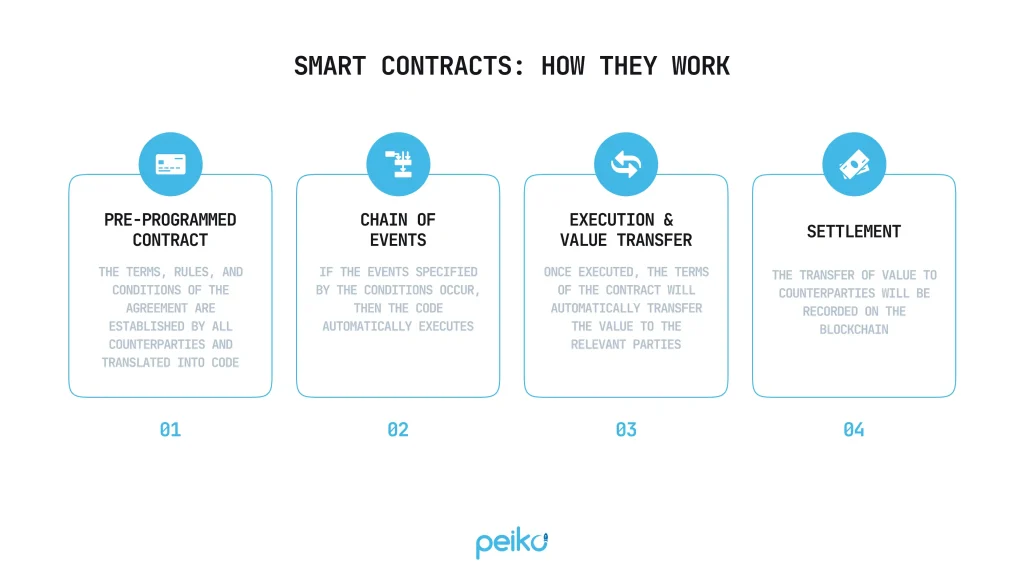
Core components of smart contracts:
- State variables: These store data on the blockchain, such as user balances or other important information.
- Functions: Functions define the logic that powers your contract. They can facilitate tasks like transferring tokens or modifying balances.
- Gas fees: Every transaction execution on Ethereum requires gas, which is paid to validators to process and confirm operations.
- Events: Events allow contracts to log data that external applications can track and respond to, typically used for updating user interfaces.
Coding the contract
Let’s go through the steps of creating a basic smart contract, a vital step in decentralized app development. In this example, we will use Solidity to create a basic ERC-20 token, which is a standard for fungible tokens on Ethereum.
- Prepare your setup: Make sure you installed the mandatory tools for development from above;
- Create your very first smart contract: Here is an example of a fungible token (ERC-20) smart contract:
// SPDX-License-Identifier: MIT
pragma solidity ^0.8.0;

import "@openzeppelin/contracts/token/ERC20/ERC20.sol";

contract MyToken is ERC20 {
    constructor(uint256 initialSupply) ERC20("MyToken", "MTK") {
        _mint(msg.sender, initialSupply);
    }
}
After you are finished with this, the next step is to compile it using Hardhat. Compilation transforms your Solidity code into bytecode, making it executable on EVM-based networks.
At Peiko, we provide top smart contract development services, so you can turn to us for help.
Testing your smart contract
Once smart contracts are written, they must be validated through a structured testing pipeline. In production-grade Web3 systems, testing is not a final step — it is an integral part of the development lifecycle that ensures security, correctness, and economic efficiency before deployment.
| Stage | What You Test | Tools | Why It Matters |
| Local Testing Environment | Contract logic execution in simulated blockchain | Hardhat Network, Foundry (Anvil) | Enables fast iteration and deterministic debugging without real ETH costs |
| Unit Testing | Functions, state changes, edge cases | Mocha, Chai, Foundry tests | Ensures each contract component behaves correctly in isolation |
| Edge Case Testing | Zero values, max values, invalid inputs | Hardhat / Foundry | Prevents unexpected failures in production scenarios |
| Access Control Testing | onlyOwner, role-based permissions | Hardhat / custom tests | Protects against unauthorized actions and privilege escalation |
| Revert & Error Handling | require, revert logic | Mocha / Foundry | Ensures contract fails safely and predictably |
| Gas Optimization Testing | Execution cost per function | Hardhat gas reporter | Reduces transaction costs and improves UX |
| Security Static Analysis | Vulnerability detection | Slither | Detects common smart contract security issues early |
| Deep Security Analysis | Attack simulation (reentrancy, overflow, etc.) | Mythril | Identifies low-level vulnerabilities in contract logic |
| Fuzz Testing | Randomized input testing | Foundry Fuzzing | Finds edge cases that deterministic tests may miss |
| Testnet Deployment | Real network simulation (Sepolia) | MetaMask + RPC (Alchemy/Infura) | Validates behavior under real blockchain conditions |
| End-to-End Testing | Full system flow (UI → wallet → contract) | Cypress / Playwright + Hardhat | Ensures frontend + blockchain integration works seamlessly |
| Pre-Mainnet Checklist | Final validation before deployment | Manual + CI pipeline | Prevents critical production failures |
Testing in Ethereum development is not just validation. It is risk engineering. A well-tested smart contract reduces financial risk, prevents exploits, and ensures predictable system behavior in a trustless environment.
Deployment Checklist in 2026
In 2026, deployment is no longer a “final step”—it is a controlled release of financial infrastructure.
| Category | Check | What “Done” Means in Practice | Risk If Skipped |
| Testing | Unit + Integration + Fork Tests | 100% critical flows covered, including mainnet-fork simulations | Contract failures under real liquidity/MEV conditions |
| Security | Static + Manual Review | Slither clean, no high/critical issues, audited dependencies | Exploits, drain attacks, irreversible loss of funds |
| Gas Optimization | Execution profiling completed | Gas benchmarks recorded and optimized across key functions | Excessive user cost, poor adoption, failed scaling |
| Testnet Deployment | Full staging validation | Contracts deployed on testnet with identical config to mainnet | Misconfigured deployments, broken logic in production |
| Frontend Integration | End-to-end UX validation | Wallet → contract → state update flow fully working | Broken UX, failed transactions, user drop-off |
| Access Control | Role & permission audit | Admin/owner roles verified, least privilege enforced | Unauthorized upgrades or fund access |
| Configuration | Environment parity check | Same ABI, addresses, RPC structure across environments | Mismatch between testnet and mainnet behavior |
| Monitoring Setup | Event logging enabled | On-chain events indexed + alerts configured | No visibility into failures or attacks |
| Upgrade Strategy (if applicable) | Proxy validation tested | Upgrade path tested on testnet | Broken upgrades or irreversible deployment mistakes |
| Dependency Freeze | Locked versions | Smart contracts + frontend dependencies versioned | Unexpected breaking changes in production |
Common Mistakes in Production Deployments (2026)
Most production failures in modern Web3 systems are not random—they are repeatable engineering gaps in testing strategy, system design, and deployment discipline.
| Mistake | What Teams Commonly Do | What Goes Wrong in Production | CTO-Level Fix |
| Happy-path testing only | Tests cover only successful transactions and expected inputs | Contracts fail under edge cases (reverts, invalid states, race conditions) | Enforce edge-case test matrices (negative testing, fuzzing, revert scenarios) |
| Skipping testnet validation | Deploying directly to mainnet or treating testnet as optional | Configuration mismatches, broken deployments, incorrect contract addresses | Require full staging deployment parity (same configs as mainnet) |
| Ignoring gas costs during development | Focus only on correctness, not execution cost | Users face high fees; contracts become economically unusable at scale | Add gas benchmarking early and continuously optimize storage + execution paths |
| Unrealistic user simulation | Testing only with dev wallets and scripted flows | Real users trigger unexpected flows (wallet switching, retries, dropped txs) | Simulate real-world UX patterns (multiple wallets, failures, retries, latency) |
| Weak access control design | Assuming admin/owner logic is “safe by default” | Unauthorized upgrades, fund drains, privilege escalation risks | Explicit role-based access control review + least-privilege enforcement |
| Missing mainnet-fork testing | Only using local blockchain without real state simulation | Failures appear when interacting with real liquidity, tokens, or oracles | Use mainnet-fork tests for realistic contract behavior validation |
| Incomplete integration testing | Testing contracts in isolation | Frontend/backend mismatch, broken contract interactions in real flows | End-to-end tests across wallet → contract → state updates |
| Hardcoded environment assumptions | Using fixed addresses or configs per environment | Deployment breaks across networks or CI pipelines | Use environment-driven configuration with strict separation (dev/test/prod) |
Common Challenges When Building Ethereum DApps
Before launching an Ethereum DApp, teams often face technical, architectural, and operational challenges that affect scalability, security, user experience, and long-term maintenance. The table below summarizes the most common issues and proven solutions used in production-grade applications.
| Challenge | When It Happens | Business Impact | Technical Cause | Recommended Solution | Best Practice |
|---|---|---|---|---|---|
| High Gas Fees | Mainnet congestion | Expensive transactions and lower user retention | Limited block space and network demand | Deploy on Layer 2 (Arbitrum, Base, Optimism) | Support multiple networks |
| Slow Transaction Confirmation | Network traffic spikes | Poor UX and delayed operations | Block confirmation time | Display pending status and confirmations | Use optimistic UI updates |
| Smart Contract Vulnerabilities | Development and deployment | Loss of funds or exploits | Logic bugs, reentrancy, overflow | Security audits, OpenZeppelin libraries, automated testing | Follow secure coding standards |
| Wallet Connection Issues | User onboarding | Users abandon the application | Browser compatibility and wallet differences | Integrate WalletConnect and multiple wallets | Support MetaMask, Rainbow, Coinbase Wallet |
| Scalability Limitations | Rapid user growth | Performance bottlenecks | On-chain computation and storage | Offload heavy logic to backend or Layer 2 | Minimize on-chain operations |
| Poor Frontend Performance | Large applications | Lower engagement and conversions | Excessive RPC requests | Cache blockchain data and optimize rendering | Use Viem, React Query, pagination |
| RPC Provider Downtime | Production environment | Service interruptions | Single infrastructure dependency | Configure multiple RPC providers | Use Alchemy + Infura fallback |
| Indexing Delays | Displaying blockchain data | Outdated balances and transaction history | Slow blockchain scanning | Use The Graph or custom indexers | Cache frequently accessed data |
| Inefficient Smart Contract Design | During development | Higher gas costs | Redundant storage writes and loops | Optimize storage layout and contract logic | Benchmark gas usage before deployment |
| Private Key Management | Backend services | Critical security risk | Exposed secrets or poor key storage | Use HSM, multisig wallets, or managed custodians | Never store private keys in source code |
| Upgrade Management | After mainnet launch | Difficult feature releases | Immutable contracts | Use proxy patterns (UUPS or Transparent Proxy) | Plan upgradeability from day one |
| Regulatory Compliance | Public launch | Legal and operational risks | Missing KYC/AML or regional restrictions | Integrate compliance providers when required | Review local regulations before launch |
Enterprise Best Practices for Ethereum DApps
Building a proof of concept is relatively straightforward, but developing an enterprise-grade Ethereum DApp requires a different approach. As user numbers grow and transaction volumes increase, teams must prioritize security, scalability, monitoring, deployment automation, and operational resilience.
The following best practices are commonly adopted by companies building production-ready decentralized applications.
Enterprise Best Practices for Ethereum DApps
Building a proof of concept is relatively straightforward, but developing an enterprise-grade Ethereum DApp requires a different approach. As user numbers grow and transaction volumes increase, teams must prioritize security, scalability, monitoring, deployment automation, and operational resilience.
The following best practices are commonly adopted by companies building production-ready decentralized applications.
| Area | Best Practice | Business Benefit | Recommended Tools |
|---|---|---|---|
| Smart Contracts | Use audited, modular contracts | Reduce security risks | OpenZeppelin, Slither |
| Access Control | Implement role-based permissions | Protect administrative actions | OpenZeppelin AccessControl |
| Wallet Management | Support multiple wallets | Improve user adoption | WalletConnect, MetaMask, Coinbase Wallet |
| Infrastructure | Deploy redundant RPC providers | Increase application availability | Alchemy + Infura |
| Monitoring | Track transactions and contract events | Detect issues early | Tenderly, Grafana, Prometheus |
| CI/CD | Automate testing and deployment | Faster and safer releases | GitHub Actions, Hardhat |
| Testing | Combine unit, integration, and fork tests | Improve code reliability | Hardhat, Foundry |
| Upgradeability | Use proxy contracts when appropriate | Release new features without redeployment | OpenZeppelin Upgrades |
| Data Indexing | Store blockchain events efficiently | Faster dashboards and APIs | The Graph, Subsquid |
| Disaster Recovery | Maintain backups and rollback plans | Reduce downtime | Cloud snapshots, automated backups |
| Compliance | Apply KYC/AML where required | Meet regulatory obligations | Sumsub, Chainalysis |
| Documentation | Maintain architecture and API documentation | Simplify onboarding and maintenance | Swagger, Notion, Confluence |
Enterprise Architecture Layers
| Layer | Responsibility | Example Technologies |
|---|---|---|
| Frontend | User interface | React, Next.js |
| Wallet Layer | User authentication and signing | WalletConnect, MetaMask |
| Smart Contracts | Business logic | Solidity, OpenZeppelin |
| Blockchain | Transaction processing | Ethereum, Base, Arbitrum |
| Backend Services | APIs, notifications, business workflows | Node.js, NestJS |
| Database | Off-chain application data | PostgreSQL, Redis |
| Event Indexer | Blockchain data synchronization | The Graph, Subsquid |
| Monitoring | Performance and security monitoring | Tenderly, Grafana |
| Cloud Infrastructure | Hosting and scaling | AWS, GCP, Azure |
Operational Best Practices
As Ethereum DApps evolve beyond the MVP stage, operational excellence becomes just as important as smart contract development. Mature teams automate deployments, continuously monitor blockchain activity, maintain multiple RPC providers, and establish clear incident response procedures. Regular dependency updates, infrastructure monitoring, and security reviews help ensure long-term stability and minimize operational risks.
Enterprise projects also separate on-chain and off-chain responsibilities whenever possible. Smart contracts handle only trust-critical operations, while application logic, analytics, notifications, and reporting are processed off-chain. This architecture reduces gas costs, improves performance, and simplifies future updates without compromising decentralization where it matters.
| Requirement | MVP | Production | Enterprise |
|---|---|---|---|
| Smart Contract Audit | Optional | ✓ | ✓ |
| Automated CI/CD | Optional | ✓ | ✓ |
| Multi-RPC Infrastructure | No | Recommended | ✓ |
| Monitoring & Alerts | Basic | ✓ | ✓ |
| Multi-Wallet Support | Basic | ✓ | ✓ |
| Disaster Recovery Plan | No | Recommended | ✓ |
| Infrastructure Auto Scaling | No | Optional | ✓ |
| Role-Based Access Control | Basic | ✓ | ✓ |
| Compliance Integration | Optional | Optional | ✓ |
| Documentation & Runbooks | Basic | ✓ | ✓ |
Building the front-end interface
The frontend of your DApp is the interface that users directly engage with. To create an intuitive and The frontend of a decentralized application acts as the interaction layer between users and blockchain systems, translating user actions into signed transactions and rendering on-chain state in real time.
Modern Frontend Stack for DApps:
| Component | Tools | Role in System |
| Frontend Framework | Next.js / React | Builds scalable UI and application structure |
| Blockchain Interaction | Viem / Wagmi | Type-safe communication with smart contracts |
| Wallet Layer | MetaMask / WalletConnect / RainbowKit | Handles authentication and transaction signing |
| Styling Layer | Tailwind CSS | Provides responsive and modular UI design |
How the Frontend Interacts with the Blockchain, 2026
A decentralized frontend follows a strict interaction flow:
- User connects wallet (MetaMask, WalletConnect, etc.),
- Frontend reads blockchain state via RPC (Viem / Wagmi),
- User initiates an action (e.g., transaction or contract call),
- Wallet signs and broadcasts transaction to the network,
- Blockchain updates state and emits events,
- Frontend updates UI via RPC refresh or indexed data (e.g., The Graph).
Wallet Integration Layer
Wallet connectivity is a critical component of any DApp:
- MetaMask — most widely used browser wallet,
- WalletConnect — protocol for mobile and cross-device connections,
- RainbowKit — UI abstraction layer for seamless wallet UX.
Without wallet integration, users cannot sign transactions or interact with smart contracts.
dApp Frontend Integration with Viem
While the UI defines user interaction, it must communicate with smart contracts through a structured and type-safe client layer. Modern Ethereum applications increasingly rely on Viem due to its performance, lightweight architecture, and strong TypeScript safety.
We choose Viem because it reduces runtime errors in transactional flows and improves developer experience through strict typing.
import { createPublicClient, http, formatUnits } from 'viem';
import { base } from 'viem/chains';

const client = createPublicClient({
  chain: base,
  transport: http('https://mainnet.base.org')
});

async function fetchOrderAnalytics(orderId: bigint) {
  const data = await client.readContract({
    address: '0xYourEscrowAddress',
    abi: escrowAbi,
    functionName: 'orders',
    args: [orderId],
  });

  return {
    buyer: data[0],
    amount: formatUnits(data[2], 18),
    status: data[3],
    isLocked: data[4]
  };
}
This flow ensures that the frontend remains a stateless interface layer, while the blockchain acts as the source of truth.
Frontend Best Practices
Production dApp interfaces must handle blockchain constraints explicitly:
- Cache blockchain data to reduce RPC calls,
- Handle loading and pending transaction states,
- Display clear transaction status updates (pending / confirmed / failed),
- Implement retry logic for unstable RPC responses,
- Use type-safe libraries (Viem / Wagmi) to reduce runtime errors.
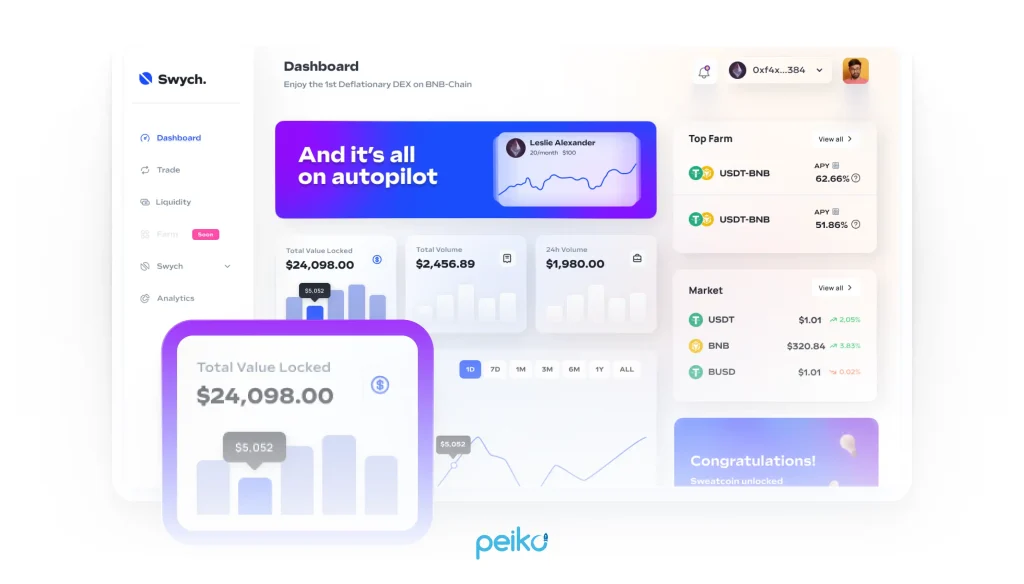
At Peiko, we design outstanding user interfaces for blockchain projects like Swych, for example. For this decentralized exchange project, we blended inspiration from PancakeSwap with our client’s creative ideas to craft a one-of-a-kind and visually stunning interface. The design process began by translating the original concepts from Figma into Visual Basic code, which laid the foundation for the front-end development.
Integrating with Web3 (Ether.js)
To enable communication between your front end and the Ethereum blockchain, you need to integrate a library like Web3.js or Ethers.js. These libraries allow your DApp to send and receive data from the Ethereum network, interact with smart contracts, and handle transactions.
Establishing user interactions
Make sure to integrate a wallet service like MetaMask to facilitate user interactions with the Ethereum network.
Security considerations and best practices
When building DApps on Ethereum, prioritizing security is essential to protect users’ data and assets.
Below, we mentioned some security measures to implement:
- Smart contract protection: Make sure your smart contracts are well-secured by following best practices to avoid risks like reentrancy attacks and overflow errors. Rigorous testing will help identify potential problems early on.
- User interaction safety: Use reputable wallet services, such as MetaMask or WalletConnect, for secure user authentication, and avoid collecting sensitive information directly from users to reduce the risk of phishing.
- Data security: Encrypt any sensitive data and refrain from storing personal details on the blockchain. Add access controls to restrict data access to authorized users only.
- Ongoing monitoring and updates: Continuously monitor your DApp after deployment for any suspicious activity and apply necessary updates. A bug bounty program can help engage the community to report potential security flaws.
- RPC and infrastructure redundancy: Avoid relying on a single RPC provider such as Alchemy or Infura. Use multiple providers and implement fallback logic to ensure uptime and protect against outages or rate limits. This is critical for maintaining a stable frontend and preventing service disruptions.
- Transaction simulation and pre-validation: Before sending transactions, simulate them locally or via RPC (e.g., eth_call) to detect failures in advance. This improves user experience by preventing failed transactions, saving gas costs, and reducing friction in user interactions.
| Layer | Recommended Stack |
|---|---|
| Frontend | React js, Next.js |
| Smart Contracts | Solidity |
| Framework | Hardhat / Foundry |
| Wallet | MetaMask, WalletConnect |
| Blockchain Library | Viem |
| RPC | Alchemy |
| Storage | IPFS |
| Database | PostgreSQL |
| Backend | Node.js |
| Monitoring | Tenderly |
By following such security practices, you can ensure that your code remains safe, reliable, and secure for users on the Ethereum network.
Preparing for mainnet deployment
Before launching your DApp on the Ethereum mainnet, careful preparation is essential. The mainnet is where real users will engage with your application using actual funds, so ensuring that everything functions correctly is crucial to a successful deployment.
Conduct a final smart contract audit
Prior to mainnet deployment, conduct a thorough audit of your smart contracts to catch any security vulnerabilities, inefficiencies, or bugs. You may want to hire third-party auditors or use automated tools, but manual review is also recommended for a more comprehensive evaluation.
Optimize gas efficiency
Mainnet transactions incur real costs, so optimizing the gas usage in your smart contracts is essential. Review the contract logic and use the best solidity practices to minimize gas consumption, helping users avoid high transaction fees.
Deploy to testnet first
Even if your DApp passes local tests, it’s important to deploy to a test network first. This simulates a real-world environment without risking actual assets. Use the testnet to validate contract functionality and UI/UX before going live.
Implement robust security measures
Double-check that all security measures are in place to prevent attacks such as reentrancy or integer overflow. Consider using multi-signature wallets and time-locks for sensitive functions to enhance security.
Prepare for user onboarding
To ensure a smooth launch, make sure your users have a clear understanding of how to interact with your application. Provide intuitive navigation, helpful FAQs (frequently asked questions), and reliable customer support to assist users during the initial phase.
Post-launch monitoring
After deploying to the mainnet, set up continuous monitoring systems to track smart contract behavior, transactions, and user activities. This will assist you in quickly detecting and addressing any issues that arise in real time.
Maintenance and future improvements
Once your project is live on the Ethereum mainnet, ongoing maintenance, and continuous improvement are necessary to ensure its longevity and success. What do you do to keep your software up-to-date and revenue-driving?
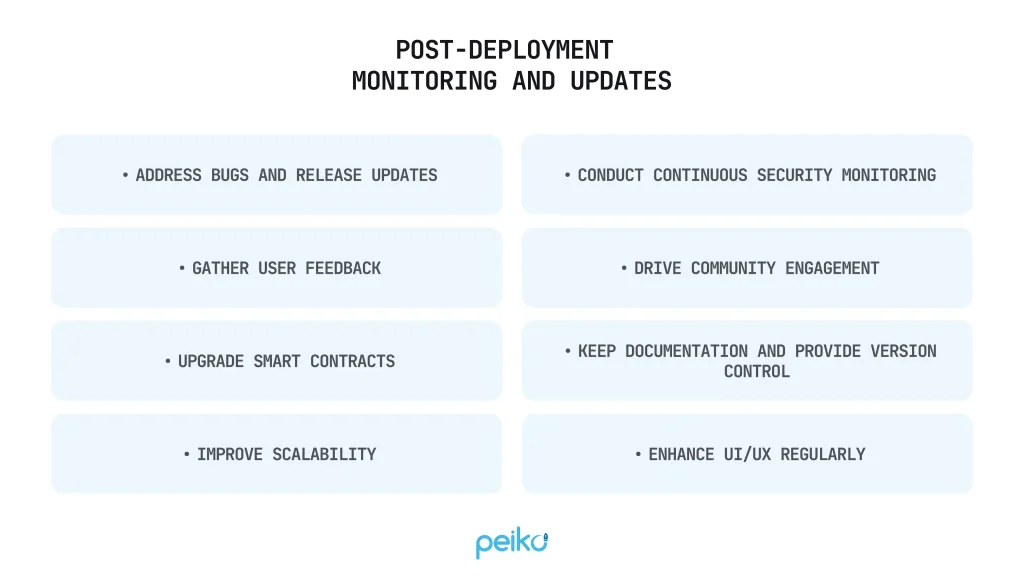
Address bugs and release updates
Bugs can appear even after a successful deployment, so regular monitoring is crucial. Set up a system for fixing bugs quickly and releasing updates to improve your DApp’s functionality and performance.
Gather user feedback
Engage with your users to obtain feedback on their experience. This will help you identify pain points and prioritize features that users want, enabling you to improve the functionality based on their needs and preferences.
Upgrade smart contracts
Ethereum smart contracts cannot be modified once deployed, but using upgradeable contract patterns, such as proxies, allows you to add features or improve security without losing the state of your contract.
Improve scalability
Planning to create a DApp? As user traffic grows, consider implementing scaling solutions like layer-2 protocols (e.g., Optimistic Rollups or zk-Rollups) to handle more transactions and reduce gas fees.
Ethereum’s own data-availability layer has also become significantly cheaper for L2s to build on. The Fusaka upgrade (December 2025) introduced PeerDAS, which scales blob capacity roughly 8x without requiring nodes to store all the data — this alone cut fees on rollups like Arbitrum, Optimism, and zkSync by an estimated 50–70%. Ethereum continues to raise blob capacity gradually through lightweight Blob-Parameter-Only (BPO) forks rather than full network upgrades, so L2 costs keep dropping even between major releases. Keep an eye on Ethereum’s scaling roadmap (Fusaka → Glamsterdam) and adapt your infrastructure choices as blob capacity and L2 fee economics keep shifting.
Web3 Full-Stack Architecture Overview
To better understand how these scalability and architectural decisions fit together in real-world systems, here is a simplified production-grade stack overview:
| Tech Stack Component | Peiko’s Recommendation | Business Advantage |
| Blockchain Layer | Base / Arbitrum / Polygon | 99% fee reduction compared to L1 |
| Account Logic | ERC-4337 + EIP-7702 (Account Abstraction) | Login via Email/FaceID, upgrade existing wallets without changing addresses, gasless transactions |
| Privacy Layer | zk-SNARKs / zk-STARKs | Protection of trade secrets on public ledgers |
| Data Layer | The Graph + IPFS/Arweave | Web2-like interface performance and speed |
Since the Pectra upgrade activated on Ethereum mainnet in May 2025, account abstraction has a second path: EIP-7702. Unlike ERC-4337, which requires a full smart contract wallet, EIP-7702 lets a regular EOA temporarily “borrow” smart contract code for the duration of a transaction — giving users batched transactions, sponsored gas, and session keys without migrating to a new address or losing their wallet’s history and reputation. As of mid-2026, EIP-7702 is already supported by MetaMask, Coinbase Wallet, and Trust Wallet, so DApp UX layers should be designed to support both standards, not ERC-4337 alone.
Conduct continuous security monitoring
Stay vigilant about security risks. Regularly audit your DApp and smart contracts, engage in penetration testing, and run a bug bounty program to identify vulnerabilities and fix them before they can be exploited.
Drive community engagement
Keep users engaged by sharing updates, releasing new features, and maintaining open communication channels. A strong community can help your DApp grow and thrive, so invest time in marketing and fostering a loyal user base.
Keep documentation and provide version control
Ensure that all code updates are tracked using version control systems and that thorough documentation is available. This makes it easier for your team to manage updates and ensures smooth transitions when new versions are released.
Enhance UI/UX regularly
User experience is crucial to retaining users. Regularly assess and improve the design and usability of your DApp to meet evolving user expectations and stay ahead of industry trends.
Adopt these practices, and your Ethereum DApp will remain secure, efficient, and responsive to user needs over time. Regular maintenance, user-driven improvements, and proactive scalability solutions will help ensure that your DApp continues to grow and succeed.
Our team is here to help.
No comments yet. Be the first to comment!