
















The prediction markets as products have boosted significantly within the last few years. With the success of decentralized platforms and the clarity on regulations from bodies like the CFTC and MiCA in 2026, building a prediction market is no longer just a game theory monetization attempt; it is a software engineering challenge.
Whether you are building a Web2 internal forecasting tool for enterprise business intelligence or a Web3 decentralized application (dApp) for retail traders, the architecture of the platform is a key to the market prediction platform’s success. Architecture is crucial since the very beginning because prediction markets rely heavily on the Users’ trust, absolute atomic settlement, liquidity, and high-frequency scaling during volatile real-world events that will be the objects of the trade.
In this technical guide, we will deeply analyze and describe the best approaches to set up a prediction market platform architecture for 2026, detailing the core modules, data flows, liquidity models, and backend design required to launch a production-ready system.
Core Building Blocks of a Prediction Market Platform
A scalable prediction market consists of several isolated but heavily integrated modules. The proper development and configuration of these components ensures that a high increase in frontend traffic during an election or major sports event does not crash your calculation engines.
Frontend Layer (Web + Mobile)
The User side of the application must be highly responsive and provide the Users with a perception of as high performance as could be expected. State management is critical here, as odds change dynamically by less than a second.
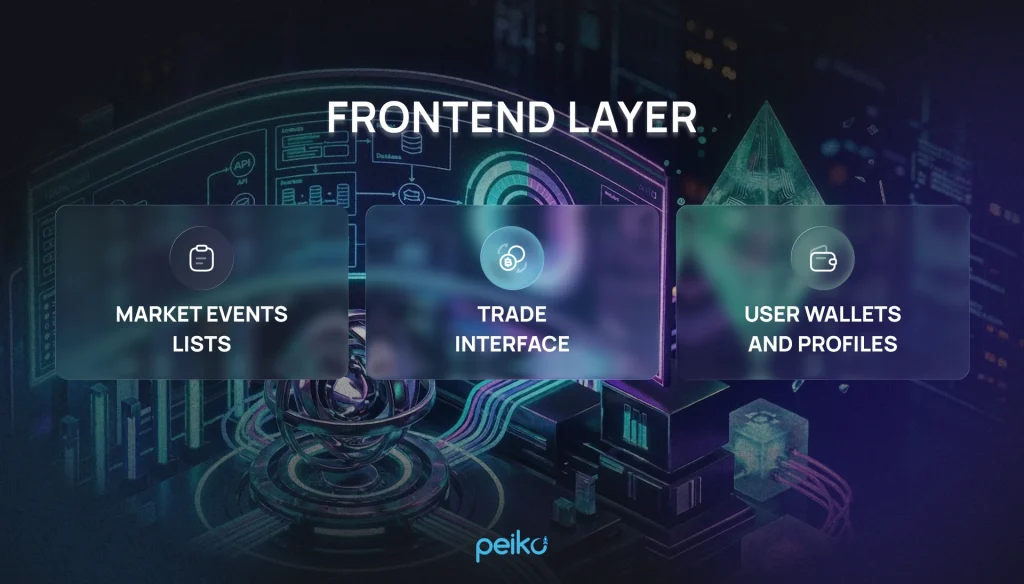
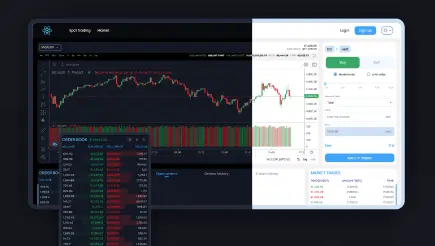
- Market Events Lists: Grid or list views shall contain real-time WebSocket subscriptions to dynamically update odds and event information without requiring manual page refreshes.
- Trade Interface: The widget providing the trade executions. It is important to take into account instant validation of User balances and real-time slippage calculations.
- User Wallets and Profiles: A secure interface displaying the current and previous positions, historical P&L, and deposit/withdrawal flows.
Backend Layer (Core Services)
The backend acts as the conductor of the whole process. In 2026, different business domains are handled by modern platforms using modular monoliths or microservices.
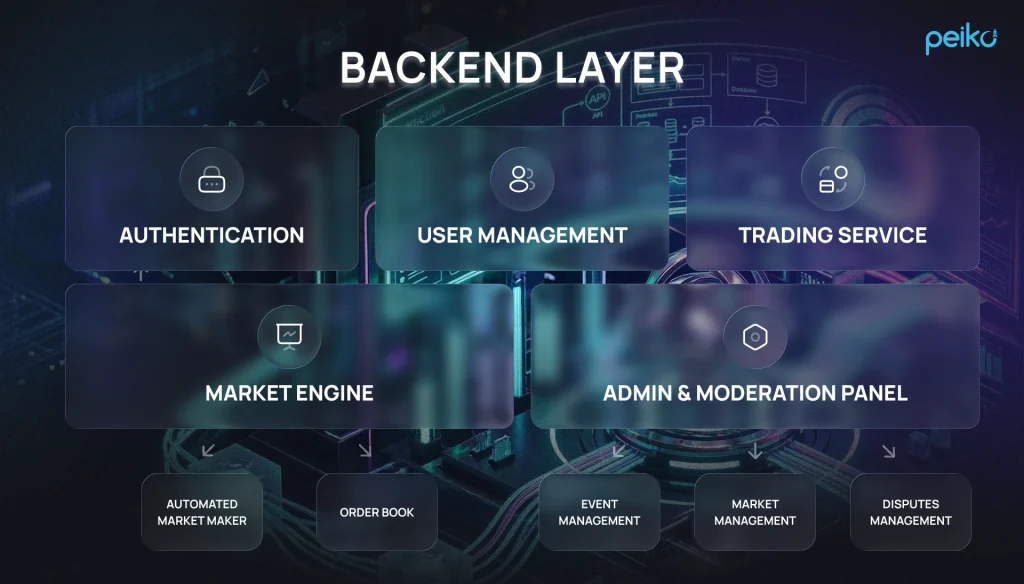
- Authentication: User access on the high-level security protocol, handling JSON Web Tokens, or verifying cryptographic signatures for Web3 wallets.
- User Management: The platform’s monitoring of the KYC/AML statuses, risk scoring, and geographic restrictions, which are necessary for the legal requirements.
- Trading Service: The main part and the core functionality. It checks if the market is active, if the User has sufficient funds, and routes the order to the market engine.
- Settlement Services: The financial backbone of the platform. It manages the movement of funds from escrow/pools to winning Users after the resolution.
Market Engine (Pricing + Matching)
The market engine is the root of the financial mathematics within a product. The engine processes incoming trade requests and defines the exact price of a share.
- Overview: Based on your liquidity model, the market engine will either be an Automated Market Maker (AMM) that calculates prices via algorithms or an Order Book that pairs discrete bids and asks.
Admin & Moderation Panel
An internal toolset for operational control and management by the Admins and the Support Team (when added).
- Event Management: Allows the creation of the event, defining the market parameters, trading rules, and resolution criteria.
- Market management: Allows updating metadata or stopping the trade in case of anomalies.
- Disputes Management: Provides an Admin interface for moderators (support team) to review challenged resolutions and finalize outcomes proactively (based on external events) or reactively (based on the Customer’s requests).
Market Lifecycle (End-to-End Data Flow)
To understand the architecture, it is worth explaining the process of how data flows through the system during a market’s lifespan.
Market Creation
- Event Definition: The Admins are able to define the exact question, the underlying asset (e.g., USDC), and the oracle source.
- Outcomes Configuration: Binary (Yes or No) or Categorical (Candidate 1, 2, 3) tokens are minted or conceptually allocated.
- Trading Rules Management: The engine sets the initial liquidity, maximum trade sizes, and fee structures.
- Timestamps Management: The database records when trading is opened and the hard timestamp for when trading halts.
Trading Phase
- Order Placement (or AMM Swaps): The User submits a payload containing market ID, outcome choice, and stake.
- Fees: The trading service deducts protocol and liquidity provider fees.
- Liquidity: The market engine processes the trade, adjusting the AMM curve or updating the order book, and persists the new state to the database and frontend via WebSockets.
Event Resolution
- Oracle / Manual Resolution: Once the event occurs, an external API (also known as Oracle) or manual Admin triggers a state change payload indicating the winning outcome.
- Disputes: The platform enters a temporary “Challenge Period.” If flagged, the resolution is escalated to arbitration. If clear, it proceeds to settlement.
Settlement & Payouts
- Payouts: The settlement service queries the database for all Users holding the winning outcome shares and executes batch transfers to their wallets.
- Edge Cases Refund Management: If the market is cancelled, the system executes a rollback, returning original stakes rather than resolving at current market prices.
Liquidity & Pricing Architecture
In the architecture of the prediction market, the most important choice the team will make is how to price shares. The choice usually is between the Automated Market Maker (AMM) and the Order Book.
Automated Market Maker Prediction Market
AMMs use mathematical formulas to price assets based on the ratio of tokens in a liquidity pool. Commonly used formulas in prediction markets include the Logarithmic Market Scoring Rule (LMSR) and Constant Product Market Makers (CPMM).
- Advantages: Provides Users with instant execution; bootstraps the market with just one initial liquidity provider (the platform).
- Disadvantages: High slippage in large trades that results in inefficient use of capital.
- Where to use: A perfect fit for newly created platforms, long-tail niche markets, and MVP stages where liquidity is at a low level.
Order Book Prediction Market
A traditional matching engine that pairs limit orders from buyers and sellers.
- Advantages: Has a high capital efficiency with zero algorithmic slippage. Attractive to institutional market makers and professional traders.
- Disadvantages: Requires higher volumes of development time and team resources due to high engineering complexity; requires enhanced logic of matching algorithms. Is a part of the “cold start” problem if there is an insufficient number of active market makers.
- Where to use: The best option in terms of scalability and complex decisions for established platforms with high volume, strict regulatory environments, and institutional players.
Hybrid Models
Hybrid models are an intensively growing trend in 2026. AMMs are used by platforms to absorb retail flow and bootstrap initial liquidity. Professional market makers can tighten spreads by placing concentrated limit orders on top of the AMM liquidity curve.
| Model | Complexity | Liquidity Requirements | UX | Best For |
| AMM | Medium | Low (Easy to bootstrap) | Instant trades, but high slippage on size | Startups, niche events, Web3 native |
| Order Book | High | High (Needs market makers) | Precise pricing, risk of unfilled orders | High-volume events, Pro traders |
| Hybrid | Very High | Medium | Best of both worlds | Enterprise-scale scaling |
Backend Architecture (Services & Data Model)
A monolithic backend with microservice architecture is recommended to cope with the extremely rising traffic volumes of prediction markets (the example of such events could be a political market on election night).
Prediction Market Backend Design: Suggested List
- User Service: Handles profiles, KYC/AML logic and process statuses, and session tokens.
- Market Service: Manages the CRUD operations for events and metadata.
- Trading Service: The high-throughput processor for buy/sell logic.
- Wallet/Balance Service: A highly secure, isolated service managing internal ledgers with double-entry accounting.
- Settlement Service: An asynchronous worker service that processes mass payouts.
- Oracle Service: A daemon that continually polls external APIs or blockchain nodes for event outcomes.
- Notification Service: Pushes emails and in-app alerts for trade executions and resolutions.
- Analytics Service: Aggregates volume, P&L, and platform health metrics.
Database & Storage Layer
- Postgres: The absolute source of truth for transactional data. Relational integrity is non-negotiable for financial balances.
- Redis: Crucial for caching market odds, session states, and order book depth charts to reduce database load.
- Event Sourcing (Optional): Storing every state change as an immutable event stream allows you to reconstruct balances flawlessly in case of disaster.
- Audit Logs: Append-only tables tracking every Admin action and resolution change for compliance.
Real-Time Layer
- WebSockets: Essential for pushing live odds and portfolio updates to the client.
- Pub/Sub: For internal microservice communication, ensuring the Trading Service can broadcast price changes to the WebSocket gateways efficiently.
API Layer
Your API is the main constant bridge between the frontend and the complex backend logic on the platform.
Prediction Market App API Design
While GraphQL is excellent for frontend flexibility (allowing clients to fetch exactly the market data they need), REST remains the industry standard for strict, cacheable transactional endpoints.
- Endpoints Examples:
- GET /api/v1/markets (Cached aggressively)
- POST /api/v1/trades (Strictly authenticated)
- GET /api/v1/Users/portfolio
- Rate Limiting: Mandatory on all trading and authentication endpoints to prevent API abuse and DDoS attacks.
- Idempotency for Trades: A crucial financial safeguard. Every trade POST must include a unique idempotency key from the client to ensure that a network retry does not result in accidental double-spending.
Smart Contracts Architecture (Optional Web3 Layer)
While building a decentralized prediction market platform, the backend logic shifts to on-chain smart contracts.
Prediction Market Smart Contracts Modules
- Market Factory: Deploys new individual market contracts dynamically.
- Trading Contract (AMM): Holds the LMSR/CPMM logic and executes swaps between the underlying asset (e.g., USDC) and outcome tokens.
- Settlement Contract: Holds escrowed funds and permits claiming of funds only when the market is flagged as Resolved.
- Fee Contract: Routes protocol and LP fees to the treasury.
- Token Vault: A secure contract storing User collateral.
On-Chain vs Off-Chain Trade Execution
- Fully On-Chain: Maximum transparency, but high gas costs and slower speeds. Vulnerable to front-running.
- Off-Chain Matching (Rollups/AppChains): A hybrid Web3 approach in 2026. Trades are matched off-chain in a centralized or decentralized sequencer for instant execution and settled on-chain in batches. This offers the speed of Web2 with the custody security of Web3.
Oracle Integration & Dispute Resolution
The competitive advantage of a prediction market product depends entirely on its resolution functionality.
Prediction Market Oracle Integration
An oracle integration allows fetching real-world data and bringing it into the system.
- Data Sources: JSON APIs from trusted providers (for political events: Associated Press; for sports events: Sportradar).
- Oracle Providers: the decentralized, consensus-based data fetching service providers like Chainlink or UMA allow for
- Latency Issues: During development, the engineers must ensure that the platform pauses trading slightly in advance of the event resolution to prevent latency arbitrage, where traders with faster API access buy winning shares milliseconds before the oracle updates.
Dispute Resolution System
Considering the potential risks in the outcomes data and the human factor, the system requires specific approaches and applications to be implemented:
- Obligatory Challenge Period: After the suggested outcome from an oracle, the system includes a 12-24 hour period where Users can stake capital to dispute the result.
- Arbitration Logic: If disputed, the market goes to a higher tribunal (a DAO vote or a centralized compliance team).
- Admin Fallback: Even decentralized platforms often maintain a multi-sig Admin fallback for critical oracle failures.
Security, Compliance, and Trust
To ensure the constantly growing Users’ conversion and the smoothness in the deposit flow, if Users do not trust your infrastructure, they will not deposit capital.
Security Requirements
- Double Spending / Balance Consistency: Implement database row-level locking or optimistic concurrency control during trade execution. Without this safeguard, concurrent transaction requests could artificially inflate balances, leading to catastrophic financial discrepancies. This is especially critical in high-throughput environments where milliseconds matter, and data integrity must be guaranteed.
- Reentrancy (Web3): If utilizing smart contracts, strictly adhere to the Checks-Effects-Interactions pattern to prevent malicious contracts from draining liquidity pools. This pattern ensures that all internal state changes are finalized before external calls are made. Incorporating automated security scanning tools into your Agile CI/CD pipeline adds another layer of defense against such vulnerabilities.
- Anti-Manipulation: Sybil resistance, maximum position limits, and monitoring for wash trading. These mechanisms protect the integrity of the market by preventing bad actors from artificially inflating volume or cornering the market. Advanced anomaly detection algorithms should be employed to flag suspicious behavior in real-time, ensuring a fair trading environment for all participants.
- Audit Logs: Comprehensive tracking of all fund movements for financial reconciliation. The implementation of an event-sourcing architecture can naturally provide this level of historical traceability, allowing business analysts to construct accurate financial narratives.
Compliance Notes in 2026
Disclaimer: The information below is not legal advice. Always consult with a certified legal professional who specializes in digital assets and regional financial regulations before launching your product to align with strategic compliance OKRs.
- KYC/AML: If handling fiat or operating in regulated jurisdictions, identity verification integrations (e.g., Sumsub, Onfido) must be implemented at the gateway. This process should be designed with Lean UX principles in mind to optimize the user journey, minimizing friction during onboarding while strictly adhering to anti-money laundering protocols. A tiered verification system can help balance compliance with user conversion rates.
- Geo Restrictions: IP blocking and hard-coded state/country exclusions based on evolving CFTC and local gaming commission rules. As regulatory frameworks continue to evolve globally, maintaining a dynamic, easily updatable rules engine for jurisdictions is crucial. This prevents the business from inadvertently accepting capital from restricted territories, which could result in severe legal consequences, including fines and even a ban on the platform.
- Disclaimers: Clear UI signposting regarding the risks of capital loss. These warnings should not be just mentioned in a long-read Terms of Service document. By integrating them contextually during the trading flow, you not only satisfy consumer protection rights but also build a transparent relationship with your users built on mutual trust.
Scalability & Performance Considerations
Prediction markets experience massive traffic spikes. For example, for political event prediction markets, an election might be quite low in trades for months, then experience 10,000x normal volume in a single 4-hour window. Anticipating these massive spikes requires a proactive expert approach to capacity planning, moving beyond simple reactive auto-scaling. Stress testing the platform’s infrastructure ensures the product can gracefully handle these sudden issues without sacrificing the core user experience.
- High-Frequency Events: The database will bottleneck. Implement in-memory databases (Redis) to handle the order queue and asynchronously flush settled trades to Postgres.
- Caching Strategy: Cache market metadata at the CDN level. By offloading static and semi-static data requests to edge servers globally, you significantly reduce the load on your origin servers. This approach significantly improves time-to-first-byte (TTFB) rate for users distributed across different geographic regions, leading to higher engagement metrics.
- Scaling WebSockets: Use a pub/sub backplane (like Redis PubSub) to horizontally scale WebSocket servers, ensuring millions of clients receive price updates simultaneously. This decoupling allows you to spin up additional WebSocket nodes seamlessly as concurrent connections rise. It is a proven mental model for real-time applications, ensuring that no single node becomes a single point of failure during peak market volatility.
MVP Architecture
To avoid the common mistakes, it is highly suggested to avoid building the entire microservices scope on day one.
- MVP Scope: The safest and most optimized approach is a monolithic backend (Node.js/Go) + Postgres database, using a simple AMM for liquidity. Instead of complex oracles, the manual Admin resolution could be used.
- The Deprioritized Scope for MVP: For MVP, some enhancements can be excluded from the initial scope — order books, automated dispute tribunals, decentralized oracles, and heavy microservice management (Kubernetes).
- MVP Architecture Timeline: A focused development team can deliver a secure and functioning architecture MVP in a range of 10 to 14 weeks.
Conclusion
Delivering a prediction market platform architecture in 2026 requires balancing financial precision with high-performance scalability. By structuring a backend, choosing the right liquidity model (AMM vs Order Book), and implementing a stable settlement and oracle integrations, it is possible to build a system that Users can trust with their capital.

Whether you need an AMM-based MVP or an enterprise-grade order book matching system, Peiko’s experienced software development team can build an MVP or production-ready system tailored to your business goals.
No comments yet. Be the first to comment!