
















Building a prediction market platform is an ambitious plan and a complex project. Among the successful examples existing on the market are the giants like Polymarket and Kalshi, and it is a promising idea to capture a niche in e-sports, local politics, or specialized tech forecasting. However, the road from a bright idea to a launched product is full of abandoned projects that spent about 20 months building the perfect order book, only to run out of funding before user testing.
As a business owner, investor, product manager, or technical lead, the main goal is validation. It is crucial to have a clear, actionable path to launch. In this guide, we will analyze and describe the ultimate prediction market MVP (Minimum Viable Product) checklist. This is a practical, product- and engineering-friendly breakdown of what is recommended to be built to get live, test the core hypotheses, and avoid the trap of “perpetual development.”
What a Prediction Market MVP Actually Needs
To build an MVP, the first step required is to find the definition of the prediction market. At its core functionality, a prediction market is an exchange where the individual users trade shares based on the outcomes of future events. The price of these shares reflects the probability of the event occurring.
However, the prediction market platform, like Polymarket, is not an MVP. A production-ready giant has millions of dollars in liquidity, complex centralized and decentralized oracles, and a massive subgraph architecture. Your MVP’s primary objective is simple: to successfully execute the complete cycle of “trade → resolve → payout.” If a user cannot buy a “Yes” share, see the event resolve, and receive their payout smoothly, the platform does not perform its basic functions. The rest of the features, like DAOs, governance tokens, dispute tribunals, and dynamic fee tiers, are the add-ons and partially a distraction at this stage.
MVP Scope (What to Build vs What to Skip)
A successful MVP should be based on a strict prioritization. This is the clear separation of what should go on the backlog and what you need for the initial launch.
Must-Haves (MVP Launch Priority):
- Basic Authentication: Authentication via basic credentials (Email/password), phone number, or simple Web3 wallet connect (e.g., MetaMask, WalletConnect).
- Market Listing: A clean UI displaying events, “Yes/No” options, and current pricing.
- Core Trading Engine: An Automated Market Maker (AMM) to handle immediate buys/sells.
- Admin Resolution Mechanism: A trusted admin panel where the product management team manually resolves the market based on public links.
- Automated Payouts: Smart contracts or backend scripts that distribute funds to winning accounts the moment the market resolves.
- Cancel Scenario: The ability to refund users if an event is canceled or becomes fundamentally unresolvable.
Out of Scope (Lower Priority, for the next versions)
- Order Book Matching: Too complex to bootstrap liquidity; requires dedicated market makers.
- Decentralized Oracles: Excellent for trustless scaling, but overkill for validating user interest: UMA, Chainlink.
- Dispute Resolution: Wait until you have enough volume to justify community disputes.
- Complex Tokenomics: Governance tokens and staking mechanics detract from the core product experience.
- Social Trading/Chat: for the transaction first; community features focus is a later enhancement.
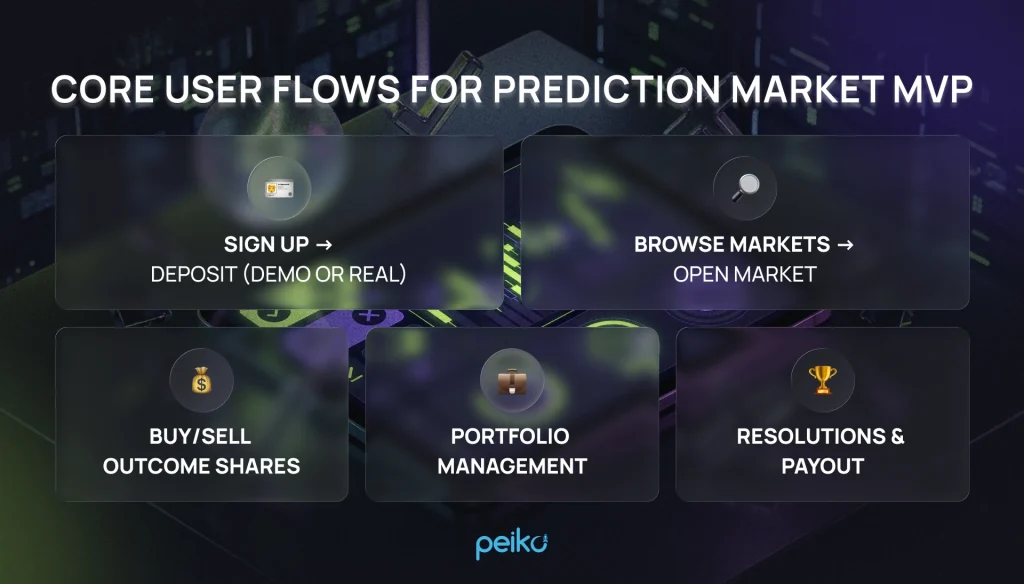
Core User Flows for Prediction Market MVP
The product design should revolve around 4-5 core user flows. If the examples below are developed, your MVP can be defined as ready.
- Sign Up → Deposit (Demo or Real): The users register their accounts and fund their balances. The demo is more than enough at this step, as using “demo money” or a testnet token completely sidesteps early regulatory hurdles and allows you to test the UX without financial liability.
- Browse Markets → Open Market: From the Homepage, the Users can find the event markets, filter by category (e.g., “Politics”, “Sports”), and click on an active market card to view details, odds, and liquidity.
- Buy/Sell Outcome Shares: The users shall be able to enter a trade amount, review the expected slippage and fees, and submit the transaction. Their balance shall be updated instantly.
- Portfolio Management: A dashboard with basic statistics where the users can view their active positions, current unrealized profit/loss, and historical trades.
- Resolutions & Payout: An admin triggers the market resolution. The system evaluates all holdings and credits the winning users’ wallets automatically.
MVP Features Checklist (Main Part)
Below you can find a detailed list of the features required to support the core user flows.
Accounts & Authentication
- Sign Up and Login: The simpler, the better; sign in via magic links, Google Auth, or a single Web3 wallet connector.
- Sessions: Secure, persistent login states so users don’t have to re-authenticate every time they want to check their portfolio.
- Basic Profile: A user ID, balance display, and a transaction history log.
Markets (Event Listing)
- Market Cards: The UI element displaying the question, current probability, and total volume.
- Categories/Tags: Simple filtering tags to help users find what they care about.
- Close Time: A hard timestamp indicating when trading halts, regardless of when the event officially resolves.
- Search: A basic text search bar for specific market titles.
Market Page UI
- YES/NO Price: Clear display of current share prices (which represent the market’s perceived probability).
- Volume/Liquidity Indicator: Shows how much capital is locked in the pool, building trust for the trader.
- Trade Widget: An intuitive input box to buy or sell. It must clearly state, “You pay [X], you get [Y] shares.”
- User Position Summary: A module directly on the market page showing the user’s current holdings for this specific event.
Trading (Buy/Sell)
- Market Buy/Sell: Instant execution against the liquidity pool.
- Slippage Preview: Crucial for user trust. Show the user how their trade size will impact the price before they confirm.
- Fees: A flat transaction fee (e.g., 1-2%) taken during the trade or upon winning payout. Even if optional for MVP, the logic must be wired into the architecture.
- Trade Confirmation: A clear success modal and an immediate update to the user’s available balance.
Liquidity Mechanism (MVP Recommendation)
To launch swiftly, it is worth choosing how trades are matched. Commonly, there are two primary options: Automated Market Makers (AMM) and Order Books.
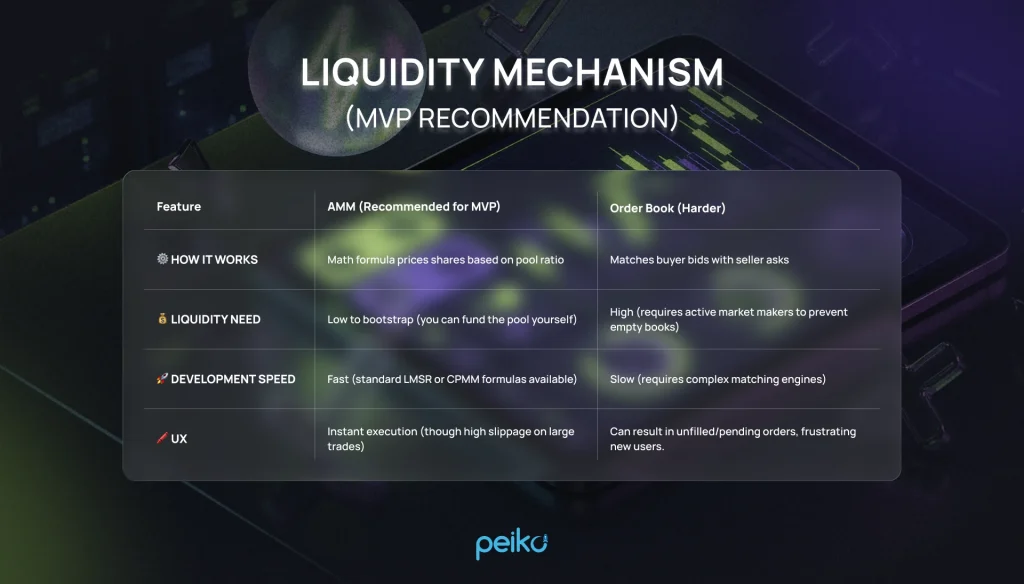
Recommendation: For an MVP, we suggest using an AMM. That would ensure a user can always execute a trade (even at a slightly worse price), which is better than them staring at an empty order book.
Market Resolution
The difference between “betting” and “trading shares” legally and structurally often relies on how outcomes are settled. Thus, the market resolution logic is the main and most important part of the platform.
Who decides the outcome:
For an MVP, centralized admin resolution is highly recommended. It is faster to build and easier to fix and scale.
- Sources (Links): Every market must have a hardcoded “Source of Truth” URL in its description so users know exactly how the resolution will be judged.
- Admin Resolution for MVP: A secure backend endpoint where an admin inputs the winning outcome (YES or NO).
- Market Statuses: The system must support strictly defined states: Active (trading open), Closed (waiting for an event to happen), Resolved (outcome decided, payouts pending/done), and Cancelled.
Payout & Settlement
- Payout Rule: The math shall be kept simple, at least at the MVP stage. For example, 1 winning share = $1 (or 1 unit of the dedicated currency).
- Auto Payout: When the admin clicks “Resolve to YES”, a script must iterate through all YES shareholders and credit their accounts.
- Handling Cancelled Markets: What if an event is fundamentally unresolvable? (e.g., a sports match is permanently canceled). The system shall allow setting a Cancel function that refunds all users their original input capital, not their current share value.
Admin Panel
- Market Management: Covers the admin’s abilities to create, edit, and activate markets. Form to input title, rules, dates, and seed initial liquidity.
- Event Management: resolvement and cancelation of the market events.
- Audit Log (Basic): A basic database table logging which admin performed what action and when. This part, at least at the general level, is crucial for internal security.
Analytics (Minimum)
- Users (accounts) Management: The list of unique active wallets/accounts and the details of each User.
- Volume per Market Data: To see which topics gain the most traction.
- Conversion Funnel: Tracking sign-ups to first deposits to first trades. An optional feature, but has strategic benefits.
Common MVP Mistakes
Do not let the overwhelming features at the initial steps to ruin your launch schedule. Avoid these mistakes to build an MVP of the prediction market:
- Building the order book first: Creating an order book from scratch is a high risk for both sides. In the absence of market makers, users abandon the platform after placing limit orders that never fill.
- Unclear Resolution Rules: If you don’t explicitly define what constitutes a “yes,” you will face furious users and reputational damage. For example, at the political event, Candidate X must be sworn in, not just projected to win by the media, to ensure the rule is strict.
- The absence of the cancel scenario: Considering you work with real-life events, there could be unpredictable postponements, cancellations, or structural changes. If you cannot revert trades and refund the exact original stakes, user funds will be trapped forever.
- The absence of the anti-manipulation system logic: Even in an MVP, the basic rate limits and maximum trade sizes are needed to prevent a single whale from breaking your AMM pricing curve.
- Overcomplicated tokenomics: Designing a secondary governance token to incentivize traders before you even know if people want to trade on your platform is a massive waste of the development resources at the MVP stage.
Suggested MVP Roadmap (in 2-3 iterations)
Building a complex product in iterations protects your budget. Here is a proven rollout sequence:
- MVP – V0: Demo balances, admin market resolution, core AMM trading. Focus entirely on UI/UX and ensuring the math is correct.
- MVP – V1 (Public Beta): Real deposits and withdrawals (fiat or crypto), live markets, and basic analytics. Launch to a closed group of early adopters.
- MVP – V2 (Growth Stage): Introduction of decentralized oracles, community dispute mechanisms, and advanced charting.
Final Checklist
Use this checklist for your next sprint planning:
- Define the Target Audience and 1 specific market niche.
- Implement basic User Authentication via email or wallet.
- Build the Market Creation admin form.
- Ensure every market has a definitive “Source of Truth” link.
- Implement 4 Market Statuses for tracking: Active, Closed, Resolved, Cancelled.
- Build an AMM pricing formula (LMSR or simple CPMM).
- Build UI for Market Cards (title, odds, liquidity).
- Build UI for Trade Widget (buy/sell input, slippage preview).
- Implement flat-fee logic in the trading or payout contract.
- Create a User Portfolio view (open positions, P&L).
- Build a centralized admin resolution tool.
- Implement auto-payout logic (1 winning share = 1 currency unit).
- Implement market cancellation logic (refund original capital).
- Add simple admin audit logs.
- Set up basic tracking (volume per market, unique traders).

Generally, keep the basic but crucial strategic hints that would help you to build a successful MVP of your prediction market platform:
- Start with admin-resolved markets.
- Do not over-engineer trustless systems until you have users who actually care about trustless systems.
- Ship the full loop first and ensure a user can trade, win, and get paid.
- Then add payments, oracles, and disputes.
Conclusion
Building a successful prediction market platform is not about predicting future trends; it is about engineering trust and liquidity. The roadmap from a concept to a functioning product is often cluttered with unnecessary complexity, such as DAOs, decentralized oracles, and governance tokens, that can drain resources before a single user places a trade.
As described in this article, the most effective strategy is to focus on the core value functionality: enabling users to take a position on an event and ensuring they get paid when they are right. By adhering to a strict MVP scope that prioritizes an Automated Market Maker (AMM) model and centralized resolution, you reduce technical risk and accelerate your time-to-market. The main suggestion here is to remember that the goal of an MVP is not to be perfect; it is to be live, gathering real data, and validating your product-market fit.
Partner with Peiko to Launch Your Prediction Market as a secure, scalable blockchain solution, where the main strategic decision is to have a partner who understands the business logic behind the technology.
At Peiko, we specialize in Web3 development, smart contract auditing, and building complex trading environments. Whether you are looking to initiate a Discovery Phase to finalize your SRS or need a dedicated engineering team to build your AMM architecture, we are here to ensure your launch is successful.
Contact us today to discuss your prediction market idea, and let’s turn your vision into a live product!
No comments yet. Be the first to comment!