

















Globalization has changed how IT teams are built — probably forever. Skilled professionals are now spread across countries, time zones, and entirely different cultural realities. In that kind of environment, cross-cultural communication stops being a “soft skill” you list on a resume and becomes an actual operational capability — one that directly shapes delivery timelines, client relationships, and whether your team stays together or quietly falls apart.
In IT outstaffing, this is felt more acutely than anywhere else. The specialist exists in two corporate worlds simultaneously: the company that employs them, and the company they actually work with every day.
Key Takeaways:
Cross-cultural communication in IT outstaffing is the structured management of differences in communication styles, decision-making, hierarchy, feedback, time, and expectations between teams from different cultural and organizational environments.
The most important points are:
- Language is only one part of the problem. Teams can communicate fluently in English and still have different expectations about initiative, deadlines, feedback, hierarchy, and responsibility.
- Outstaffing amplifies cultural differences because specialists work between two organizational environments: their employer and the client’s team.
- The most common friction points are communication style, hierarchy, feedback, uncertainty, time zones, decision-making, and ownership.
- Cultural frameworks are useful as starting points, not stereotypes. Hofstede, Hall, and Trompenaars can help identify possible differences, but individual behavior and organizational culture matter just as much.
- The solution is to create explicit team norms. Define how the team communicates, escalates problems, gives feedback, makes decisions, documents work, and handles disagreements.
- Asynchronous communication is particularly important for distributed teams. Written decisions, clear ownership, documentation, and agreed response expectations reduce ambiguity across time zones.
- Communication quality should be measured through operational signals, such as rework caused by misunderstandings, blocked time, escalation frequency, decision latency, missed handoffs, and stakeholder satisfaction.
In practice, successful cross-cultural outstaffing does not try to eliminate cultural differences. It makes expectations explicit enough that those differences do not become delivery risks.
Culture Is the Infrastructure Nobody Talks About
Cross-cultural communication in IT is not simply about speaking the same language. It is about aligning the assumptions people bring to communication, decision-making, responsibility, time, hierarchy, feedback, and conflict.
Two engineers can have excellent English and still interpret the same message differently. “I’ll look into it” might mean “I will investigate this today” to one person and “I acknowledge the issue” to another. “This should be ready soon” can represent completely different expectations about urgency. A manager’s silence can be interpreted as trust by one team and dissatisfaction by another.
In an outstaffing model, these differences become operational because communication directly influences how quickly a team can make decisions, escalate risks, resolve blockers, and deliver work.
Think of culture as invisible infrastructure. When everyone’s working from the same underlying assumptions, things move fast and friction stays low. When those assumptions diverge, you start hitting walls — even in technically strong teams. A surprising number of performance issues in global projects have nothing to do with skill gaps. They come from different ideas about what “doing the job right” even means.
Why Outstaffing Makes This Harder
In a traditional employment model, there’s one employer, one culture, one set of expectations. Outstaffing complicates that significantly. The specialist formally belongs to one organization but spends their actual working hours inside another company’s processes, team dynamics, and unwritten rules.
| Outstaffing challenge | What can go wrong | Business impact |
| Different communication styles | A direct message sounds aggressive or an indirect message is interpreted as agreement | Conflict and rework |
| Different hierarchy expectations | Engineers wait for approval instead of raising concerns | Slower decisions |
| Different attitudes toward initiative | One side expects autonomy, the other expects explicit instructions | Ownership gaps |
| Different feedback styles | Feedback is perceived as personal criticism or is too indirect to act on | Lower quality and trust |
| Different approaches to deadlines | “ASAP” or “soon” means different things | Missed expectations |
| Time-zone differences | Important decisions wait for another region | Delivery delays |
| Different escalation habits | Problems are hidden until they become urgent | Higher project risk |
| Different documentation habits | Decisions remain implicit or scattered across chats | Knowledge gaps |
This creates friction in places you wouldn’t expect. Even basic things, whether to take initiative or wait for direction, whether to escalate a problem or solve it quietly, whether to give blunt feedback or soften it — can be interpreted in completely opposite ways depending on where someone is coming from. Layer on remote and asynchronous work, and what started as a small cultural mismatch can quietly derail delivery speed and client experience before anyone names what’s actually happening.
Client vs. Provider Communication Responsibilities
In a successful outstaffing model, communication is a shared responsibility. The client and provider should agree in advance on who owns product decisions, team integration, feedback, escalation, and delivery communication.
| Responsibility | Client | Outstaffing provider |
| Product priorities | Lead | Support |
| Technical requirements | Define business context | Clarify technical implications |
| Day-to-day team integration | Lead | Facilitate |
| Cultural onboarding | Participate | Facilitate |
| Performance feedback | Provide project feedback | Manage employment-side feedback |
| Escalation | Define business urgency | Surface delivery risks |
| Documentation | Own product decisions | Maintain delivery documentation |
| Communication norms | Agree | Help implement |
Outstaffing, outsourcing, and offshoring are related but not identical models.
In an outstaffing model, external specialists typically become integrated into the client’s existing team and processes while remaining employed by the provider. Outsourcing generally transfers responsibility for a defined service or outcome to an external provider. Offshoring describes the geographic relocation of work and can occur under either model.
This distinction matters for communication: the more deeply external specialists are embedded into the client’s day-to-day workflows, the more important shared communication norms and cultural alignment become.
The Iceberg Model: What You See Is Not What Drives Behavior
Edward T. Hall’s Cultural Iceberg Model is one of the most useful frameworks for understanding why this happens. The basic idea is that the visible parts of culture — language, habits, rituals, professional norms — are just the tip. Below the surface sit the things that actually drive behavior: values, beliefs, attitudes toward hierarchy, the way people experience time, and how much ambiguity they can comfortably tolerate.
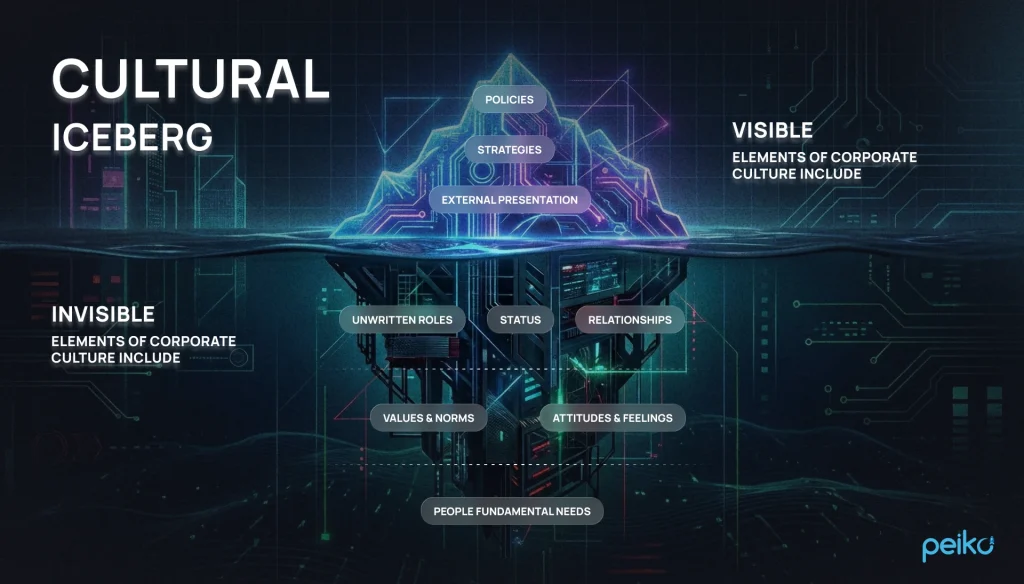
This is why one team expects detailed instructions before they move, while another treats autonomy as a sign of respect. It’s why direct, unfiltered feedback reads as honest and efficient in one culture — and as aggressive or disrespectful in another. You can’t resolve these differences by addressing what’s visible. You have to understand what’s underneath.
Important: cultural frameworks are diagnostic tools, not personality tests.
A person should never be expected to behave a certain way simply because of their nationality. Cultural models describe tendencies at a group or societal level; they do not predict the behavior of an individual employee.
In an IT outstaffing team, organizational culture, professional background, seniority, previous international experience, personality, and team norms can be just as important as national culture.
Use cultural frameworks to generate questions — not conclusions.
How to Build a Cross-Cultural Communication Framework for an IT Outstaffing Team
Cross-cultural communication becomes much easier when expectations are designed rather than left to interpretation.
Before an outstaffing team starts working together, the client and provider should agree on a small set of communication rules. These rules should cover not only which tools the team uses, but also how people make decisions, raise concerns, give feedback, and document important information.
A practical framework can be built around seven areas:
| Area | What to define |
| Communication | Which topics belong in chat, email, meetings, or project documentation |
| Response times | Expected response windows for normal, urgent, and critical issues |
| Decision-making | Who can decide independently and which decisions require approval |
| Escalation | When and how engineers should raise blockers or risks |
| Feedback | How positive and corrective feedback should be delivered |
| Documentation | Where decisions, requirements, architecture, and action items are recorded |
| Working hours | Core collaboration hours, time-zone expectations, holidays, and availability |
The goal is not to create bureaucracy. It is to remove ambiguity.
For example, instead of telling an engineer to “raise issues early,” define what that means: any blocker expected to last more than four working hours is reported in the project channel and added to the issue tracker. Instead of saying “respond quickly,” define a target response time for urgent requests.
Explicit rules are particularly valuable in distributed teams because asynchronous communication removes many of the contextual cues available in face-to-face conversations. Documentation therefore becomes part of the communication system rather than an administrative afterthought.
Example Cross-Cultural Communication Charter
| Topic | Example rule |
| Daily communication | Use the project channel for operational questions |
| Decisions | Record decisions in the project documentation |
| Urgent issues | Escalate immediately through the agreed channel |
| Blockers | Raise blockers when they threaten the committed delivery |
| Feedback | Give specific feedback focused on behavior or output |
| Disagreement | Challenge ideas, not people |
| Deadlines | Always specify date, time, and time zone |
| Meetings | Share agenda beforehand and document decisions afterward |
| Availability | Respect agreed working hours and local holidays |
| Ownership | Every action item has one clearly named owner |
Where Things Actually Break Down
Across international IT teams, the same friction points tend to show up again and again.
| Friction point | Typical misunderstanding | Better team practice |
| Direct vs indirect communication | “Maybe” is interpreted as agreement | Explicitly distinguish agreement, uncertainty, and disagreement |
| Hierarchy | Team members don’t challenge unrealistic requirements | Make constructive disagreement an expected behavior |
| Initiative | Client expects autonomy; engineer expects instructions | Define ownership boundaries |
| Feedback | Direct criticism damages trust | Agree on feedback format and private/public boundaries |
| Uncertainty | One side wants a detailed plan; another expects iteration | Define which decisions must be fixed and which can evolve |
| Time | “Tomorrow” means different working hours | Use dates, times, and time zones |
| Silence | No response is interpreted as approval | Define when silence means “no objection” and when it means nothing |
| Escalation | Problems are hidden to avoid appearing incompetent | Reward early risk reporting |
Communication style. Hall’s high-context and low-context framework is useful for understanding communication preferences, but real teams are more complicated than national categories suggest. Professional culture, company culture, seniority, language proficiency, and previous international experience can all influence how people communicate. The practical lesson is therefore not “this culture communicates indirectly.” It is: do not assume that everyone interprets the same message in the same way.
In an outstaffing team, important decisions should therefore be explicit: document the decision, owner, deadline, assumptions, and next action.
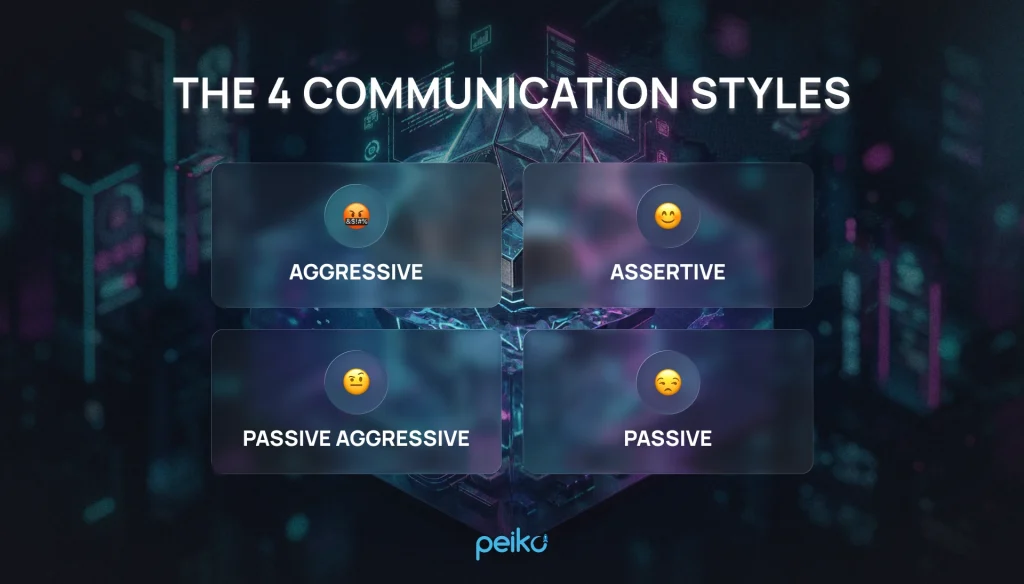
Attitudes toward hierarchy. Geert Hofstede’s research on cultural dimensions shows that in high power-distance cultures, employees naturally look upward for guidance and tend not to challenge decisions openly. In low power-distance cultures, openly debating your manager’s call is not just acceptable — it’s expected. Put these two orientations in the same team without acknowledging the difference, and you get confusion, resentment, and missed signals.
Tolerance for uncertainty. Some teams function well only when there’s a clear plan, detailed processes, and a predictable structure. Others are entirely comfortable operating in ambiguity and pivoting as things evolve. Neither approach is wrong — but when they collide, you end up with constant tension around priorities, deadlines, and who’s responsible for what.
Feedback culture. What feels like a frank, productive conversation in one cultural context can land as blunt or even hostile in another. Over time, this erodes trust and psychological safety — two things that are very hard to rebuild once they’re gone.
Moving From Intuition to a Real System The organizations that handle this well don’t leave it to chance or personal instinct. They treat cultural differences as a manageable variable — something that can be studied, planned for, and actively worked with.
A few frameworks have proven genuinely useful here. Hofstede’s Cultural Dimensions Theory gives leaders a structured way to understand how national culture influences attitudes toward hierarchy, individualism, and risk — and how to adjust management styles accordingly. Hall’s high- and low-context communication model helps teams design shared norms that actually work, especially in distributed environments where clarity isn’t optional. Fons Trompenaars’ work adds another layer by examining how different cultures approach rules, time, and relationships — which turns out to be directly relevant for everything from policy design to resolving conflicts.
Used consistently, these frameworks turn culture from a source of unpredictable friction into something you can actually work with.
Cross-Cultural Communication Best Practices for IT Outstaffing
The most effective approach is to turn cultural awareness into repeatable team behavior. The following practices work particularly well for distributed software development teams:
1. Define communication norms before problems appear
Agree on channels, response times, meeting rules, escalation paths, and documentation standards during onboarding.
2. Write down important decisions
Don’t rely on a meeting, chat message, or someone’s memory. Record the decision, rationale, owner, and next step in a shared system.
3. Replace ambiguous language with explicit expectations
Instead of “ASAP,” use a specific deadline. Instead of “this shouldn’t take long,” specify the expected delivery date. Instead of “let me know if there are issues,” define when an issue must be escalated.
4. Make disagreement safe
Engineers should be able to challenge requirements, architecture decisions, estimates, or priorities without being perceived as difficult.
5. Separate intent from impact
A message can be well-intentioned and still create a negative impact. When misunderstandings happen, discuss what was understood rather than assuming bad intent.
6. Use asynchronous communication deliberately
Distributed teams should not require everyone to be online at the same time for every decision. Written context, documented decisions, and clear ownership allow work to continue across time zones. GitLab’s current remote-work guidance similarly emphasizes asynchronous communication, documentation, and a single source of truth for distributed teams.
7. Build relationship capital
Not every interaction should be transactional. Short informal conversations and intentional team-building help people interpret each other’s communication more accurately and build trust.
8. Review the communication system regularly
Communication problems are often symptoms of process problems. If the same misunderstanding occurs repeatedly, change the system rather than simply telling people to “communicate better.”
How to Measure Cross-Cultural Communication in an IT Outstaffing Team
Communication is difficult to improve if it is treated as an abstract soft skill. For an outstaffing engagement, several operational indicators can show whether communication is helping or slowing delivery.
| Metric / signal | What it can indicate |
| Decision latency | How long important decisions remain unresolved |
| Blocker age | How long team members remain blocked waiting for information or approval |
| Rework caused by misunderstanding | Whether requirements or expectations are being interpreted incorrectly |
| Escalation frequency | Whether problems are being raised early or only after becoming serious |
| Missed handoffs | Whether information is being lost between people or time zones |
| Requirement clarification rate | How often work has to be clarified after development starts |
| Stakeholder satisfaction | Whether the client and delivery team feel aligned |
| Team pulse survey | Whether people feel safe asking questions and disagreeing |
| Documentation coverage | Whether important decisions and requirements are discoverable |
These metrics should not be used to rank individual employees. Their purpose is to identify patterns in the communication system.
For example, a high number of clarification requests may indicate unclear requirements rather than poor communication skills. Repeated late escalations may indicate that engineers do not feel safe challenging decisions. Long decision latency may indicate unclear ownership rather than a time-zone problem.
How to Prevent Cross-Cultural Misunderstandings Before They Affect Delivery
The cheapest communication problem to solve is the one prevented during onboarding.
Before an outstaffing engagement begins, both sides should agree on a short communication charter covering:
- Who decides what?
- When should an engineer escalate a problem?
- What does “urgent” mean?
- Which communication requires a written record?
- Which hours are reserved for collaboration?
- How should disagreements be handled?
- How is feedback delivered?
- Where are final decisions stored?
- Who communicates with the client?
- What happens when a requirement is unclear?
A good onboarding process should also include a short retrospective after the first few weeks. The objective is not to evaluate people’s cultures. It is to identify recurring misunderstandings and convert them into clearer team rules.
This creates a feedback loop:
Misunderstanding → identify root cause → change team rule → document it → monitor whether the problem repeats.
Over time, the team becomes less dependent on individual communication styles because the operating model carries more of the coordination burden.
The Competitive Angle Nobody Should Ignore
Technical expertise is only one part of a successful outstaffing partnership. When several vendors can provide comparable engineering skills, the ability to collaborate reliably across organizational and cultural boundaries becomes an important differentiator.
Clients should therefore evaluate an outstaffing provider not only by its technical stack or developer profiles, but also by how it handles communication, escalation, documentation, feedback, and cross-cultural team integration.
Companies that invest in cross-cultural competence see fewer communication breakdowns, faster decision-making, stronger client trust, and better retention. Culture stops being a background variable and becomes part of the operating model — as fundamental as the tools, processes, and technical capabilities the team runs on.
Conclusion
Cross-cultural communication in IT outstaffing isn’t an abstract conversation about mindsets and worldviews. It’s an operational factor that affects delivery, client experience, and organizational resilience in measurable ways.
The companies that move from reactive problem-solving — dealing with cultural friction only after it causes damage — to a proactive, structured approach grounded in real research end up with a genuine strategic advantage. They can grow globally without losing alignment, trust, or the efficiency that makes distributed teams worth building in the first place.
In a world where most serious IT work is already distributed, that capability isn’t a differentiator. It’s becoming the baseline for staying competitive at all.
No comments yet. Be the first to comment!