


















Building a successful tech product is always risky, but when it comes to a SaaS marketplace, the complexity rises dramatically, because you’re effectively building two businesses at once. Unlike traditional SaaS, where your main goal is to serve a single customer type with one product and a clear feature set, here you’re building an ecosystem, where value comes less from your code and more from interactions between two independent sides. This is a fundamental difference that founders often ignore, trying to apply standard growth playbooks/tactics to a model that operates under very different economic and behavioral dynamics.
What Is Marketplace Liquidity?
Marketplace liquidity describes how easily buyers can find relevant supply and how reliably sellers can find relevant demand.
A marketplace can have thousands of registered users and still have poor liquidity if buyers rarely find suitable offers or sellers rarely receive relevant requests.
Liquidity is therefore better understood through transaction-related signals than through registration volume alone.
Typical indicators include:
- match rate;
- time to first relevant match;
- request-to-transaction conversion;
- seller utilization;
- buyer repeat rate;
- percentage of active supply;
- time to transaction.
The exact metrics depend on the marketplace model. A services marketplace, product marketplace and B2B marketplace may require different definitions of a successful match.
We put this together for founders and product teams who want to understand why growth stalls, despite increased spend, and how to transform your project from a “profile graveyard” into a marketplace that actually drives transactions. In this article, we’ll uncover the nuances of unit economics, dissect the structural mistakes that kill liquidity, and show you how to turn a chaotic marketplace into a repeatable, scalable business that’s ready to scale.
Top SaaS Marketplace Mistakes and Their Impact
| # | Mistake | What Happens | Core Problem | Metrics to Watch | How to Detect It | How to Fix |
| 1 | No real use case | Few transactions | Product-market fit | Activation, conversion | Users don’t complete the core transaction | Validate problem and transaction frequency |
| 2 | Too many categories | Marketplace feels empty | Liquidity | Match rate, time to match | Supply is fragmented across categories | Start with a narrow niche |
| 3 | Ignoring liquidity | Buyers/sellers don’t match | Marketplace mechanics | Match rate, time to transaction | Users search but don’t transact | Seed supply/demand manually |
| 4 | Weak positioning | Low registration/activation | Value proposition | Conversion, activation | Users cannot explain marketplace value | Separate buyer/seller messaging |
| 5 | SaaS-style onboarding | Low-quality supply or buyer drop-off | UX | Activation, completion | Same onboarding is used for both sides | Create role-specific flows |
| 6 | No trust layer | Users hesitate to transact | Trust & safety | Conversion, disputes | High abandonment around transaction | Verification, reviews, moderation |
| 7 | Monetization too early | Users bypass platform | Business model | GMV, retention, leakage | Transactions move off-platform | Monetize after value is demonstrated |
| 8 | Acquisition over retention | High CAC, low LTV | Growth | Retention, repeat rate | New users grow but cohorts disappear | Build retention loops |
| 9 | No analytics | Poor decisions | Visibility | Match rate, conversion | Team cannot identify bottlenecks | Build event-based analytics |
| 10 | Scaling too early | Quality and operations degrade | Scalability | Support load, quality, retention | Manual processes already fail | Stabilize core operations first |
Key Takeaways: SaaS Marketplace Mistakes to Avoid
The biggest SaaS marketplace mistakes usually come from trying to scale before proving that buyers and sellers can repeatedly create value on the platform.
The most important problems to watch are:
- No real use case: The marketplace does not solve a problem that is frequent, expensive, risky, or inconvenient enough to justify an intermediary.
- Too much scope: Launching with too many categories can spread supply and demand too thin and make the marketplace feel empty.
- Low liquidity: Buyers cannot quickly find suitable sellers, while sellers cannot consistently find relevant demand.
- Weak positioning: Buyers and sellers do not immediately understand why they should join the platform.
- Poor onboarding: The two sides of the marketplace often need different onboarding flows and levels of verification.
- Weak trust and safety: Reviews, verification, moderation, dispute handling and payment protection are insufficient for the transaction risk.
- Premature monetization: The platform introduces fees before users have a strong reason to transact repeatedly.
- Weak retention: Growth depends on acquiring new users instead of creating reasons for existing buyers and sellers to return.
- Insufficient analytics: The team tracks traffic or registrations but cannot see whether supply, demand and transactions are actually improving.
- Premature scaling: The team automates and expands before the core marketplace process works reliably at smaller scale.
A SaaS marketplace should therefore be validated in stages: prove the use case, establish initial liquidity, create trust, validate repeat transactions, understand unit economics, and only then scale acquisition and automation.
Why SaaS Marketplaces Struggle to Grow
The main reason for the high failure rate of startups in this niche isn’t about tech or design, it’s about not understanding the dynamics of a two-sided market. In traditional SaaS, you control the product: if you fix a bug, the customer is happier. But in the case of a platform, you don’t control the end product, which is a third party’s product/service, but only create the conditions for supply and demand to match.

Growth stalls because teams focus on attracting traffic instead of building liquidity, which is the core metric of success. Liquidity is how likely it is that a seller will find a buyer, and a buyer will find what they are looking for quickly enough. If you drive traffic into a leaky bucket where transactions don’t happen due to trust gaps or process friction, you’re simply burning cash.
In addition, retention plays a critical role: unlike single-sided SaaS, here the loss of one seller can trigger dozens of buyers to churn, weakening the network effect. This is especially critical in the B2B segment, where a bad experience is far more costly, and where reputation is built over years and lost with one bad deal.
Mistake #1 – Building a Marketplace Before You Have a Real Use Case
The most common (and costly) mistake is trying to build a complex platform for a problem that doesn’t need an intermediary. Many founders fall into this mental trap when they sincerely believe that putting providers and customers on one site will automatically create a business, but a successful SaaS marketplace follows a different set of incentives.
What’s the problem here
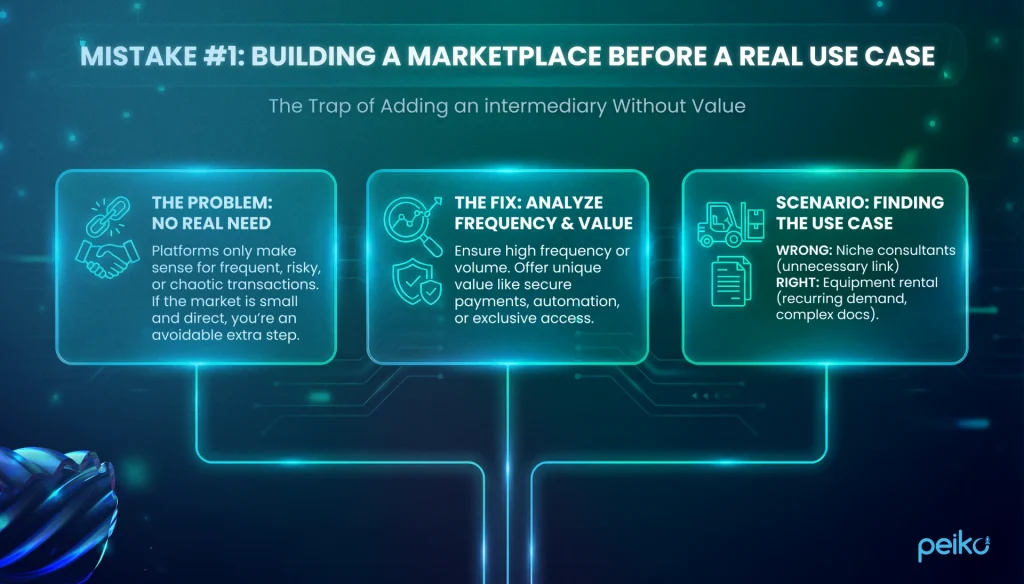
A platform only makes economic sense in cases where the current way of interacting with people is extremely inconvenient, risky, or chaotic. If your potential customers transact infrequently, say once every five years, or if the market is so narrow that all the key players have known each other for a long time, then you will simply become an extra step they’ll avoid. No one wants to pay a commission just for the fact of having a website if the issue can be resolved with a quick call or email without your involvement. Creating a product for the sake of the product is the fastest way to a dead directory that no one visits.
How to fix it
Before you start development, you need to do a serious analysis of the transaction frequency and the nature of the market, because success requires many buyers and sellers and frequent transactions. If you see that transactions in your niche occur rarely, you must compensate for this with a very high average deal size or offer such value that is physically impossible to obtain with direct interaction. This can be a guarantee of secure payments, automation of complex paperwork or providing access to an exclusive database of vetted providers.
Scenario
Imagine that you are launching a platform for consultants in heavy industry, and there are only a few dozen of them in the country, and all clients know them directly. In such a market, your service becomes an unnecessary link. But if you shift the focus to short-term rental of special equipment between hundreds of companies, where the request is constant and there are a lot of documents, a real use case and recurring demand appears.
Mistake #2 – Trying to Launch With Too Many Categories
The ambition to create a one-size-fits-all marketplace often leads to a situation where the team simply does not have enough resources to build real depth in even one niche. As a result, you get a platform that tries to be useful to everyone, but in fact has not enough supply in any category to feel useful.
Why this happens
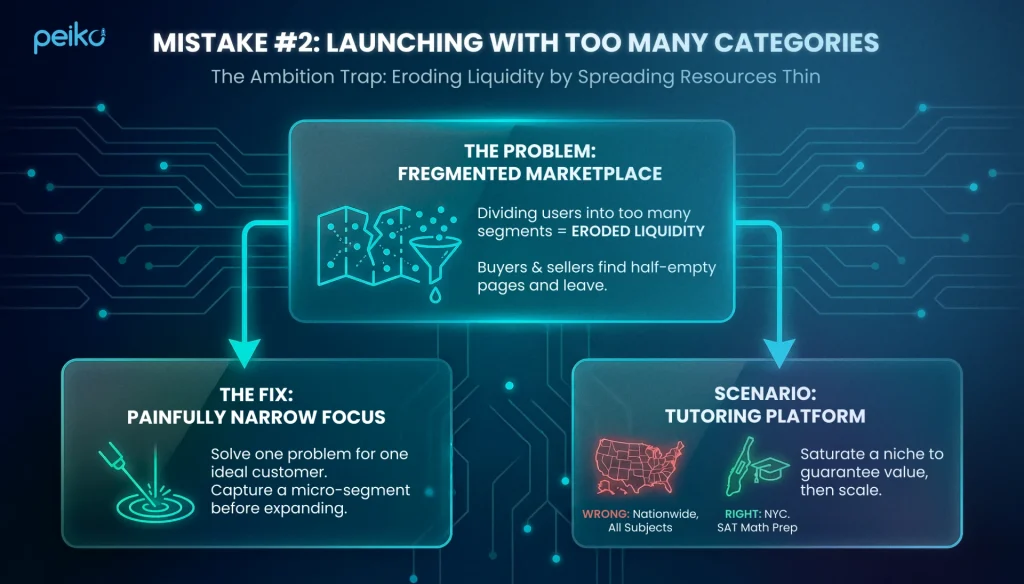
This erodes liquidity. When you divide buyers and sellers into dozens of different segments, users see half-empty pages, get frustrated, and never come back.
| Launch approach | Typical risk |
| 1–2 focused categories | Limited initial market size but easier concentration of supply |
| 5–10 categories | More complexity and potentially fragmented supply |
| Dozens of categories | Higher risk of empty search results and weak matching |
The right number of launch categories depends on the size and structure of the target market. The objective is not to minimize categories for its own sake, but to ensure enough relevant supply and demand exists within each category to create useful transactions.
How to fix it
Starting with a narrow market can make early validation easier because the team can concentrate limited supply, demand, messaging and operational resources around a clearly defined customer problem.
The appropriate scope depends on the market. A niche can be defined by customer type, geography, transaction type, industry or another meaningful constraint.
Scenario
Let’s say you’re launching a tutoring platform, but instead of offering all subjects for all age groups across the U.S., you narrow your focus to SAT math prep in New York City only. This approach allows you to focus your entire budget on one point, saturate your database with the best teachers in this particular profile, and guarantee parents that they’ll find a professional in minutes.
Mistake #3 – Ignoring the Liquidity Problem (and Hoping SEO Will Fix It)
The team often hopes that all they have to do is set up SEO and recruit people and everything will automatically work. However, for a SaaS marketplace, traffic alone is not enough if there are virtually no successful matches on the platform.
| Liquidity signal | What it tells you |
| Match rate | How often buyer demand finds relevant supply |
| Time to match | How quickly users find a suitable counterpart |
| Search-to-contact rate | Whether marketplace listings satisfy buyer intent |
| Contact-to-transaction rate | Whether matches actually convert |
| Seller utilization | Whether providers receive enough relevant demand |
| Repeat transactions | Whether successful matches create ongoing value |
| Unfulfilled demand | Where supply is insufficient |
What it looks like in practice
Founders often hope that simple SEO and high traffic will automatically launch sales. However, for any marketplace, thousands of visitors are completely useless if customers and performers cannot find each other.
Why it kills growth
The first customers come to the platform, do not see relevant offers and go to competitors forever. At the same time, sellers do not receive orders and quickly lose interest in the service, which is why liquidity never appears, and the entire marketing budget is burned in vain.
How to fix it
Don’t wait for the algorithms to work by themselves, but apply three proven tactics:
- Manual matching: at the start, independently and manually match each new request with several of the best performers.
- Concierge onboarding: help sellers properly design profiles and clearly describe their prices, terms, and portfolio.
- Seeded supply and demand: Fill the database with real offers and collect the first test requests before the public launch.
- Track basic metrics: activation, match rate and time-to-first-value.
Scenario
A new client leaves a request on a still half-empty platform. Instead of waiting for automation, the team independently selects three ideal performers and quickly sends their offers to the client on the same day. The buyer instantly gets the desired result, sellers are happy with the first order, and real marketplace liquidity begins to grow successfully.
Mistake #4 – Weak Positioning (Users Do’t Know Why They Should Join)
A marketplace value proposition must answer two different questions:
For buyers: Why should I use this marketplace instead of searching or buying directly?
For sellers: Why should I provide my inventory, services or time through this marketplace instead of using another channel?
These answers do not need to be identical. In a two-sided marketplace, the value proposition should reflect the different jobs, risks and incentives of each side
The platform is trying to be for everyone, so the message is blurred – people don’t understand why they should register.
What is the problem
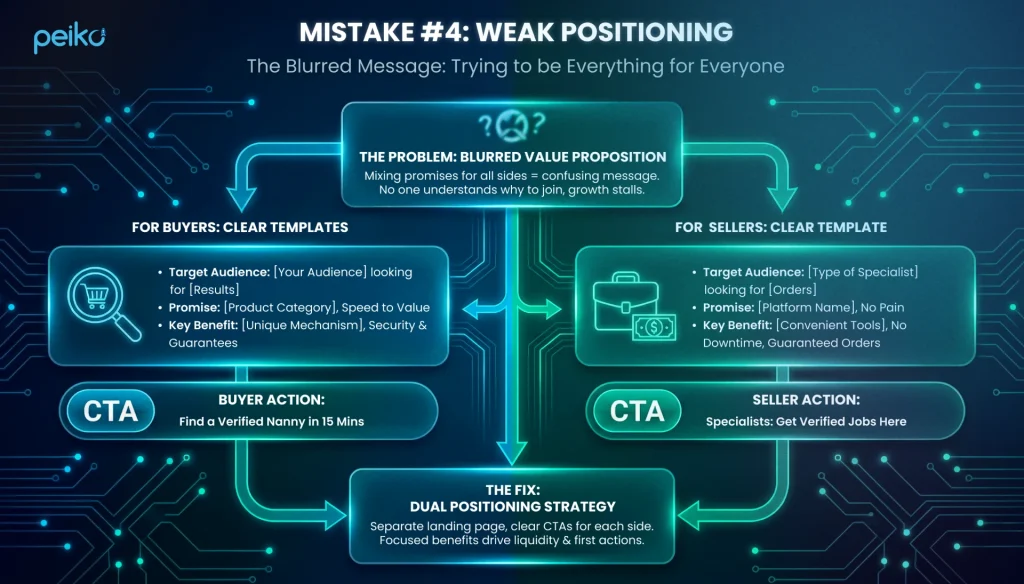
Many platforms try to please absolutely everyone at once for fear of losing even one customer, as a result of which their value proposition becomes so blurred that no one can understand the real reason for signing up.
Why it kills growth
There are two sides to the marketplace with different motives. When you mix promises on one page, conversion to registration and first action drops, and without this there will be no marketplace liquidity.
How to fix it
You need a dual positioning strategy using clear templates for each side of the market.
Positioning formula:
- For buyers: For [your audience] who are looking for [desired results] without [major risks], we offer [product category] that delivers [speed to value] through [unique mechanisms];
- For sellers: For [type of specialist] who are looking for [guaranteed orders] without [organizational pain], we offer [platform name] that delivers [key benefit] through [convenient tools].
What should be on the landing page:
- A focused headline that targets only the side of the market that you are most difficult to attract at this stage;
- Two prominent buttons for instant and clear distribution of traffic according to the needs of buyers and sellers;
- A separate block of benefits for buyers with an emphasis on transaction security, speed and money-back guarantees;
- A separate block of benefits for sellers, emphasizing the absence of downtime and the convenience of order management tools.
Scenario
The user enters and sees not an abstract slogan, but a concrete promise: find a verified nanny in 15 minutes. Next to it is a separate button for specialists looking for work. Thanks to the separation of messages, the person immediately understands “this is for me” and what the next step is.
Mistake #5 – Onboarding That’s Designed Like a Normal SaaS
Blindly copying the onboarding process from regular SaaS products, where the main goal is maximum speed and no obstacles, becomes a big mistake for two-sided platforms.
Why this happens
In the world of classic software, free entry is considered an advantage, but in the marketplace, too easy registration for sellers leads to flooding the catalog with low-quality listings. At the same time, an overly complex sign-up flow with a bunch of forms for buyers simply kills conversion and the desire to place an order, so the approach must be differentiated.
How to fix it
You need to implement an onboarding strategy for both sides, where the seller’s journey contains a bit of friction through the use of checklists and guided setup to motivate high-quality profile filling. Instead, the buyer’s journey should be as fast as possible, providing quick wins like a search without registration and leading to their first “aha” moment in a minimum number of clicks.
Scenario
The buyer has the opportunity to create a project and see a list of candidates for free even before registration, which is needed only for contact. The seller sees a mandatory list of requirements, and until he uploads a certificate and fills out a biography, his profile will not be published, which guarantees the quality of the offer.
| User | Onboarding priority | Typical requirements |
| Buyer | Speed to first value | Search, request, shortlist |
| Seller | Quality + readiness | Profile, credentials, availability, pricing |
| Business seller | Verification + compliance | Business information, tax/payment details |
| High-risk category | Trust + safety | Additional verification, moderation |
Mistake #6 – No Trust Layer (Reviews, Verification, Quality Control)
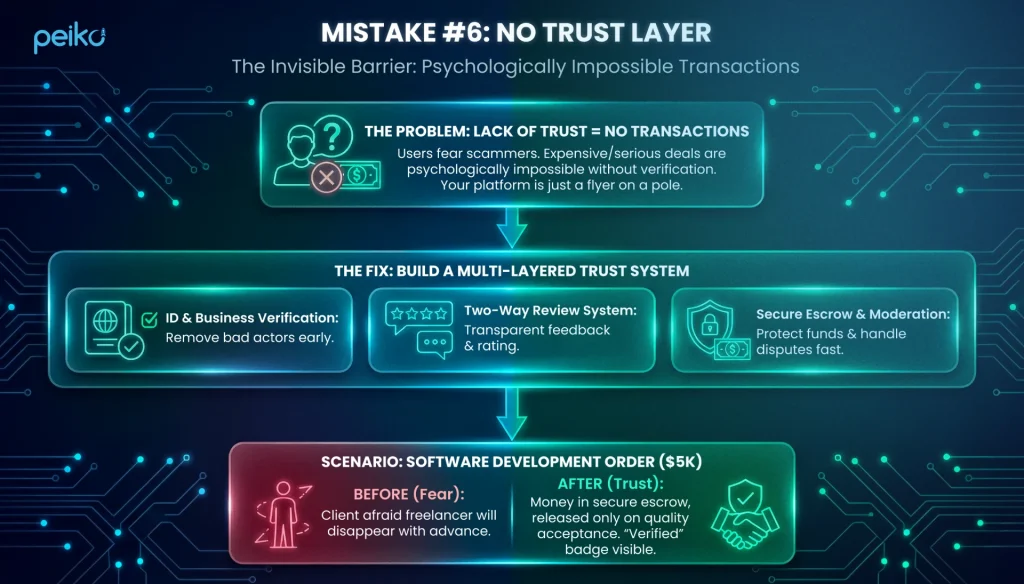
In online conditions, the lack of reliable mechanisms for building trust makes expensive and serious transactions psychologically impossible for the vast majority of customers.
How it looks in practice
If the user is not sufficiently confident that there is a real professional on the other side of the screen, and not a scammer, he will never dare to send money. Without a transparent rating system, ID and business verification and protection of transactions, your platform is no different from a flyer on a telephone pole. Trust is the main currency of any successful marketplace.
How to fix it
You need to build a multi-layered security system that will remove customers’ fears. Depending on the transaction model and jurisdiction, marketplaces can use payment-provider capabilities such as controlled payouts, payment holds, dispute workflows or other supported payment flows to reduce transaction risk. The exact structure should be designed with the payment provider and applicable legal requirements in mind.
Set clear moderation rules and basic anti-fraud protections (spam prevention, duplicate detection, and fast dispute handling). The goal is to remove bad actors early and protect marketplace trust.
Scenario
A company wants to order the development of complex software for $5,000, but is very afraid that the freelancer will disappear with the advance, as is often the case. Your platform offers a reliable solution: the company’s money is in a secure escrow account and is transferred to the contractor only after the company officially accepts the work and confirms its quality. Plus, there is a noticeable “Verified” check mark next to the developer’s name – this means that you have checked his government-issued ID (e.g., driver’s license) and business registration / EIN info.
Mistake #7 – Monetization Too Early or the Wrong Pricing Model
Monetization too early or a poor pricing model blocks growth before the platform has proven its value.

What is the problem
Introducing commissions at too early stages of development or choosing a monetization model that is inappropriate for your market can completely stop the growth of the platform at the very moment when it is most vulnerable.
Why it kills growth
When users don’t see a stable result, they bypass the commission and move deals “offline.” This is especially painful for a b2b saas marketplace, where deal sizes are large and the incentive to avoid fees is strongest.
How to fix it
You need to choose the right monetization model and establish clear, measurable criteria for when to include a paywall:
- A stable match rate, where a certain high percentage of requests successfully find their ideal performer;
- A projected time to first value, measured in hours or days that are acceptable for your niche;
- The presence of regular repeat transactions from the same cohorts of users;
- A controlled churn rate, where users do not try to massively conduct transactions outside the platform.
Once these conditions are met, you can fully apply pricing models, choosing a commission to earn only on successful transactions, a subscription for cases with an emphasis on working tools, or a hybrid model with a combination of subscription and a minimum percentage. The objective is to introduce monetization once the marketplace has enough demonstrated value that users understand what they are paying for and why continuing to transact on the platform is worthwhile.
| Monetization model | Works well when | Main risk |
| Transaction fee | Platform directly facilitates transactions | Users may try to transact off-platform |
| Subscription | Users receive recurring software value | Harder to justify before repeat usage |
| Listing fee | Supply-side visibility has clear value | Can discourage early supply |
| Lead fee | Sellers value qualified leads | Quality of leads becomes critical |
| Hybrid | Multiple revenue streams have proven value | Higher complexity |
Scenario
You launch a wholesale marketplace for building materials and initially make transactions free to gain critical mass. When liquidity stabilizes and repeat orders become the norm, you cautiously turn on monetization. You sell suppliers a subscription with demand analytics and priority placement.
Mistake #8 – Focusing on Acquisition and Ignoring Retention
Many founders are blinded by the growth charts of new registrations and forget that the real economy of the marketplace is based on repeat purchases and long-term customer retention.
| Side | Why users return | Important signals |
| Buyer | Faster discovery, trusted suppliers, saved preferences | Repeat purchase, reorder rate |
| Seller | Consistent demand, workflow tools, reputation | Repeat orders, active supply |
| Both | Better marketplace liquidity | Transaction frequency, successful matches |
What’s Going Wrong
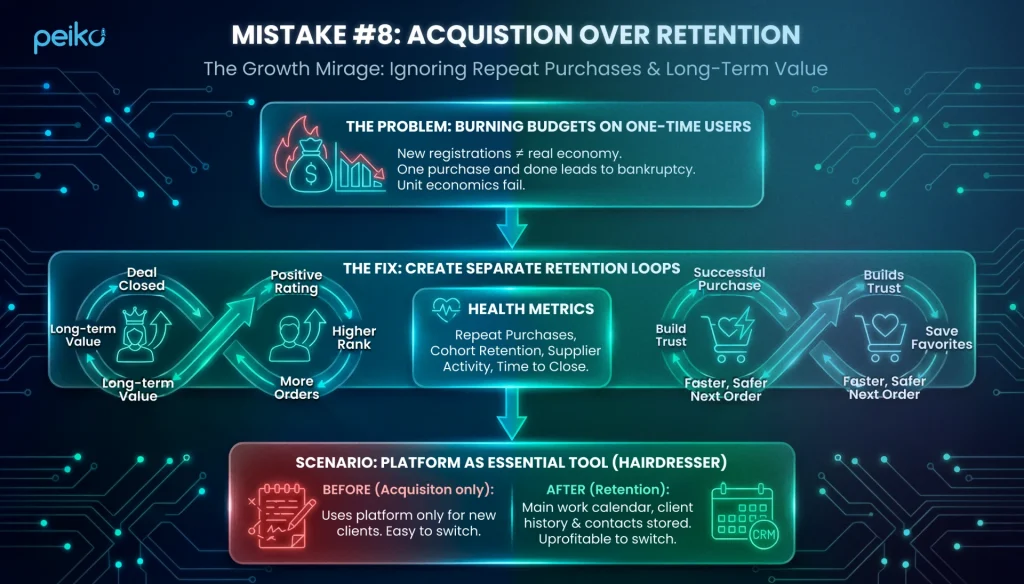
You can burn a huge budget on attracting customers through advertising, but if they make one purchase and leave forever – your unit economics will never work, and the business will go bankrupt. It’s important to remember a simple rule: supplier retention ≠ buyer retention. These are completely different mechanics that require a different approach and tools.
How to fix it
Create separate retention loops for each party so that they come back again and again:
- Supplier Retention Loop: The provider successfully closes the deal, gets a positive rating, the algorithm automatically raises him higher in the output, he gets even more new orders, begins to value the platform more and stays with you for a long time;
- Buyer Retention Loop: A successful purchase builds trust in the platform, the customer saves their favorite vendors to their list, and the next order is placed much faster and safer than through a random Google search;
- Health Metrics: Constantly monitor such important metrics as the percentage of repeat purchases, cohort retention, supplier activity, percentage of application completion and time to close the deal to keep your finger on the pulse of the business.
Scenario
A hairdresser uses your platform not only to find new people, but also as his main work calendar for recording regular clients. Since his entire schedule, visit history and contact database are stored with you, it is extremely unprofitable for him to switch to another service, even if they offer a lower commission on new orders, because he will lose a convenient management tool.
Mistake #9 – No Marketplace Analytics (You Can’t Improve What You Don’t Measure)
Using standard web analytics tools won’t give you a complete picture of the real health of your business because they simply don’t see the complex interplay between supply and demand.
The Mistake
Focusing solely on traffic or GMV can be a very misleading metric. Your sales can grow on the back of just one big customer, while 90% of your other users leave the platform disappointed, not finding what they were looking for. Without the right, specific data, you’re essentially running your business blind.
How to fix it
You need to set up tracking for a specific set of metrics to see the real picture of what’s happening:
- Supply growth;
- Demand growth;
- Activation rate;
- Conversion;
- Match rate;
- Repeat usage;
- Churn;
- CAC / payback;
- time to first value;
- time to match;
- transaction completion rate;
- cancellation rate;
- dispute rate;
- take rate;
- GMV;
- contribution margin;
- seller utilization;
- buyer repeat rate;
- off-platform leakage.
Scenario
Looking at your analytics dashboard, you notice an interesting anomaly: while the number of new rideshare driver registrations is increasing overall, the Match Rate has dropped to a critical 40% in the evening hours. This means that passengers are not able to find a car when they need it most. Using this data, you launch a special bonus program specifically for evening trips to even out the imbalance, instead of blindly buying more Facebook ads.
Marketplace Metrics: What Should You Measure Before Scaling?
Marketplace analytics should connect the entire transaction journey rather than focusing only on traffic or GMV.
A useful measurement framework covers five areas:
| Area | Metrics | Question |
| Acquisition | CAC, traffic, signup rate | Can we attract the right users? |
| Activation | Profile completion, first search, first request | Do users reach value? |
| Liquidity | Match rate, time to match, unfulfilled demand | Can both sides find each other? |
| Transactions | Conversion, completion, cancellation, GMV | Are matches becoming successful transactions? |
| Retention | Repeat rate, cohort retention, churn | Do users come back? |
| Economics | Take rate, contribution margin, CAC payback | Can the marketplace support its growth? |
The exact metrics should reflect the business model. A B2B services marketplace may care about qualified leads and contract value, while a consumer marketplace may focus more heavily on transaction frequency and repeat purchases.
The important principle is to connect metrics to decisions. If match rate is low, acquire more users only if additional users solve the supply or demand imbalance. If retention is low, increasing traffic may simply increase acquisition costs without fixing the underlying problem.
Mistake #10 – Scaling Before the Marketplace Works Manually
Trying to scale your business before everything works smoothly with manual processes is a classic and very painful mistake that early-stage startups make.
What’s the mistake?
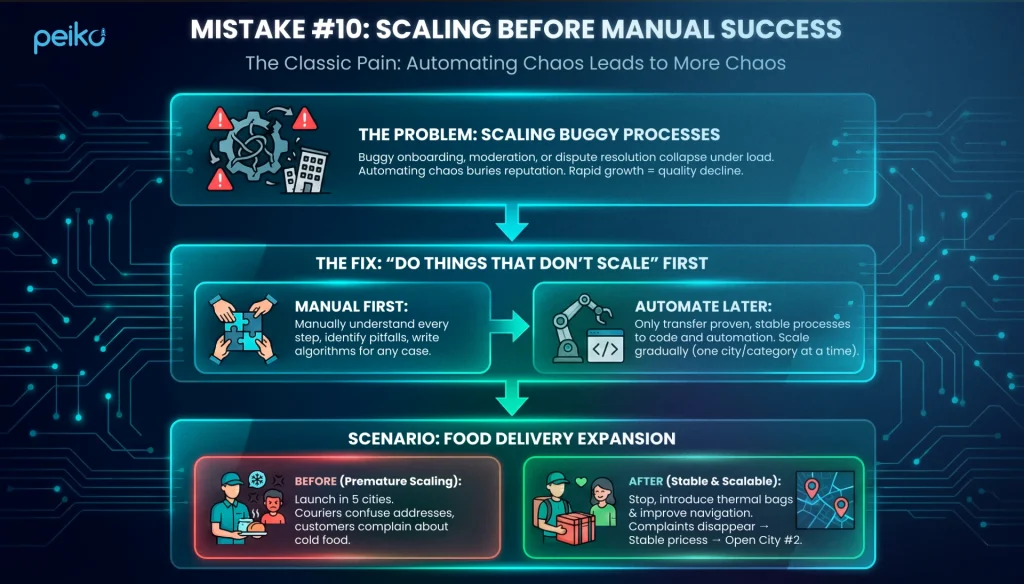
If your onboarding, content moderation, or dispute resolution processes are buggy and fail at small scale, then under heavy load the entire system will simply collapse and bury your reputation. Automating chaos doesn’t bring order, it only leads to more chaos. In addition, rapid uncontrolled growth often leads to a sharp decline in the quality of the platform’s offerings, which scares away buyers.
How to fix it
A common early-stage approach is to manually operate parts of the marketplace before automating them. Manual operation is useful when it helps the team discover which steps actually create value, where users get stuck, and which exceptions occur frequently enough to justify automation.
Scenario
You want to launch your food delivery service in five new cities at once to capture the market. But you see that in the first city, couriers still often confuse addresses, and customers constantly complain about cold pizza. Instead of expanding, you stop, introduce mandatory thermal bags to retain heat and improve the navigation system in the application. Only when the complaints disappear and the process becomes stable and predictable, you open the second city.
When Is a SaaS Marketplace Ready to Scale?
Scaling should not be defined only by traffic or user registrations. A marketplace is better positioned for expansion when the core transaction loop is working reliably and the team understands the main operational constraints.
Before scaling, evaluate:
| Area | Questions to answer |
| Use case | Are users solving a real problem through the marketplace? |
| Liquidity | Can buyers and sellers reliably find relevant matches? |
| Transaction | Can users complete the core transaction successfully? |
| Retention | Do successful users return? |
| Trust | Are verification, moderation and dispute processes working? |
| Economics | Do unit economics have a plausible path to sustainability? |
| Operations | Can the team handle current support and exceptions? |
| Technology | Can the platform handle expected traffic and transaction volume? |
| Analytics | Can the team identify bottlenecks and measure changes? |
Scaling before these mechanisms are understood can amplify existing problems. More traffic does not automatically improve liquidity, and more automation does not automatically improve a broken process.
SaaS Marketplace Platform Checklist (Before You Try to Scale)
Before you invest heavily in aggressive marketing, conduct an honest audit of your business, because if you can’t check off most of these items, it’s too early to scale.
- You’ve developed a clear strategy to solve the chicken-and-egg problem and know exactly how to engage both sides at the same time.
- Your SaaS marketplace software is stable and technically ready to withstand sharp spikes in traffic and transactions.
- You’ve chosen the narrowest possible niche and already have a clear advantage over your competitors in it.
- The first transactions are successful, and user retention indicators are showing positive dynamics.
- The necessary user verification mechanisms and basic Trust & Safety security protocols have been implemented.
- You have built a reliable marketplace SaaS platform with working retention cycles that make users come back.
- You offer more than just a bulletin board, creating a full-fledged SaaS apps marketplace experience with real added value.
- Your unit economics and LTV/CAC are at least theoretically aligned.
- End-to-end analytics are set up for both sides, tracking the path from acquisition to re-use.
- You have an effective deal leakage plan in place to prevent payments from going off-platform.
- Your team is ready to handle complex feedback and resolve disputes quickly.
Marketplace Health Check: How to Diagnose a Growth Problem
When a marketplace is not growing, the first step should be identifying where the transaction funnel breaks rather than immediately increasing marketing spend.
Use the following diagnostic framework:
| Symptom | Possible problem | First thing to investigate |
| High traffic, few transactions | Weak activation or liquidity | Search-to-match and match-to-transaction conversion |
| Many buyers, few sellers | Supply shortage | Seller acquisition and onboarding |
| Many sellers, few buyers | Demand shortage | Buyer acquisition and positioning |
| Many signups, few active users | Weak onboarding/value | Time to first value |
| Good first purchase, poor repeat rate | Weak retention | Post-transaction experience |
| Transactions happen but revenue is low | Monetization/unit economics | Take rate and contribution margin |
| High transaction abandonment | Trust or UX problem | Payment, verification and checkout funnel |
| Growing support workload | Operational scalability problem | Manual processes and exception rate |
| Strong traffic but poor conversion | Positioning or trust issue | Landing page, reviews, verification and offer quality |
This approach prevents the team from treating every growth problem as an acquisition problem.
Marketplace Trust, Payments and Off-Platform Leakage
A marketplace can lose transactions even when buyers and sellers successfully find each other. Once users discover each other, they may attempt to move communication or payment outside the platform.
This is often called off-platform leakage or disintermediation.
The risk is especially important when the marketplace earns money from transactions. If users receive the value of discovery but complete the transaction elsewhere, the platform may carry acquisition and operating costs without capturing corresponding revenue.
A marketplace can reduce this risk by providing value that remains useful after the initial match:
- secure and convenient payments;
- transaction records;
- dispute handling;
- verified identities or businesses;
- workflow tools;
- messaging;
- scheduling;
- invoices and receipts;
- warranties or buyer protection where applicable;
- reputation and transaction history.
Payment architecture should also be designed deliberately. Marketplace payment providers can support seller onboarding, verification, payment splitting, payouts, refunds and disputes, but the exact responsibilities depend on the payment flow and business model.
The goal is not simply to prevent users from communicating outside the platform. It is to make completing the transaction through the platform sufficiently valuable and convenient.
Final Thoughts: Growth Comes From Systems, Not Hacks
Real marketplace growth does not depend on one successful tactic, but is built on a clear formula: liquidity + trust + retention + unit economics. This system should work as a single mechanism, because the weakness of even one element will inevitably slow down the development of the entire business.
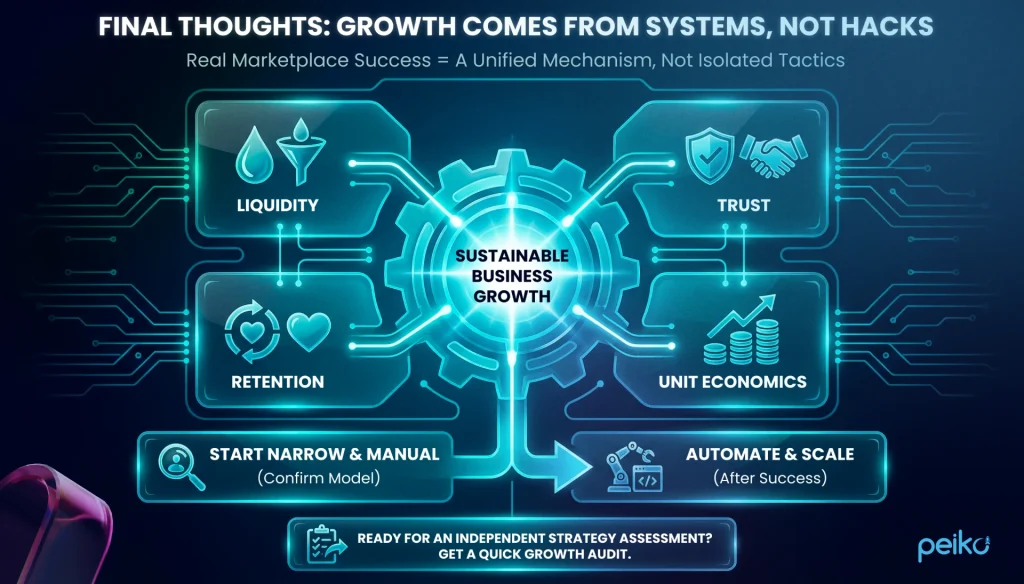
Start with a narrow niche and manual processes, and only after confirming the model, move on to automation. If you want to get an independent assessment of your strategy, we are ready to conduct a quick growth audit and highlight the most important points for improvement.

No comments yet. Be the first to comment!