
















Starting a new software project is often compared to constructing a building. You wouldn’t ask a construction crew to start pouring concrete without a blueprint, architectural drawings, and a structural analysis, would you? The same logic applies to the software development life cycle. This is where the Discovery phase service for software development becomes the most critical investment you can make.
Many stakeholders mistakenly view the Discovery phase as merely a series of meetings or abstract conversations. However, a professional software development Discovery phase is a structured, engineering-driven process that produces tangible, actionable assets. The Discovery phase deliverables serve as the roadmap, the contract, and the instruction manual for your future product.
If you are wondering exactly what you pay for when you engage in Discovery phase services, this comprehensive guide is for you. We will break down every essential document, diagram, and plan you should expect to receive. We will explore the purpose of the Product Requirements Document (PRD), the visual necessity of wireframes and prototypes, the technical depth of architecture drafts, and the strategic importance of risk assessments and accurate estimates.
In this article, prepared by our experts, we will demonstrate how these deliverables bridge the gap between a vision and a viable product, ensuring that development is predictable, budget-efficient, and aligned with business goals.
The Role of Discovery Phase Deliverables in Project Success
The main aim of the pre-development Discovery process is to eliminate uncertainties and the risks of the incorrect usage of the budget and timeline. When requirements are not clear enough, the development team tries to “guess” the customer’s needs. Such “guessing” often results in code rewriting and leads to “scope creep,” overwhelming the costs and missed deadlines.
The solution Discovery phase deliverables are the solution to minimize such risks. They act as a universal language between business stakeholders (who focus on revenue, Users, and market fit) and the technical team (who focus on databases, APIs, and code stability).
When you engage the experts’ Discovery phase services, you are not just allocating more time to the pre-development stage; you are purchasing a suite of intellectual property that belongs to you. Whether you continue development with the same vendor or move to an in-house team, these deliverables ensure that anyone developing the product knows exactly what needs to be built, how it should function, and why it matters to your Users.
Let’s dive deep into the specific artifacts you should expect.
The Product Requirements Document (PRD)
The Product Requirements Document (often synonymous with or covering the Software Requirements Specification – SRS) is one of the Discovery phase deliverables. It is a comprehensive document that describes the product planned to be built as a rigid set of instructions.
The PRD translates high-level business goals into specific functional and non-functional requirements. It details every button, every logic gate, every User role, and every system behavior.
Without a detailed PRD, you cannot hold a development team accountable. The PRD is the “truth” against which the final product is tested.
Key Components:
- User Roles and Access: who will be using the system (Admins, Authorized Users, Guests (Unauthorized Users) and the permissions dedicated to each Role.
- Functional Requirements: explanation of what the system does and what functionality the system shall provide to the particular User Role, depending on the described preconditions.
- Non-Functional Requirements: description of how the system performs. This includes load times, security standards (compliance), and scalability.
- Business Logic: explanation of the rules of data management within the system. For instance, in a fintech application, this section would define how interest is calculated or how custody of assets is managed.
Example: In a recent complex institutional crypto custody solution, the PRD completed within a Discovery phase was the critical tool for regulatory alignment.
- The Requirement: The User needs to ensure that assets are segregated according to MiCA (Markets in Crypto-Assets) regulations.
- The PRD Deliverable: We documented a specific module for “Record Retention.” The SRS specified that the system must maintain full historical records of all custody-relevant operations for a minimum of five years. It detailed the exact data points to be stored: transaction history, balance updates, and compliance screening outputs (AML/KYT). By documenting this in the PRD, the developers knew exactly how to structure the database to be audit-proof before writing a single line of code.
User Flows: Mapping the Customer Journey
While the PRD answers the “what” questions, the User Flows describe all the “hows”. User Flows map out the steps a User takes to achieve a functional benefit within the application.
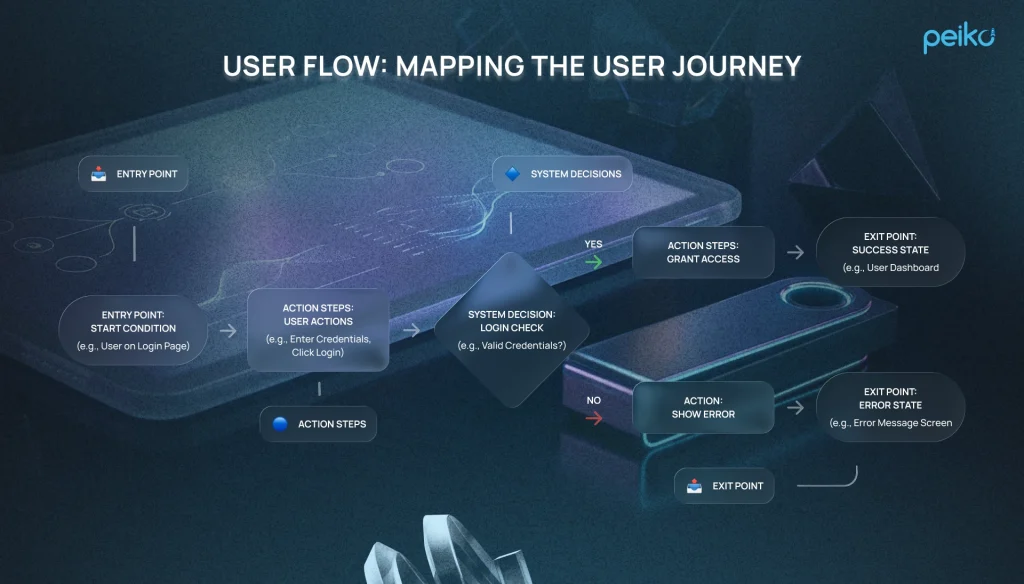
A User Flow is a flowchart that represents the path a User takes through the product. It shows decision points, success states, and error states, covering the major scenarios and the system behavior within each case.
User flows identify the logic blind zones. They prevent the “dead-end” scenario where a User clicks a button, and the system does not know where to take them next.
Key Components:
- Entry Point: defines the starting conditions for the User’s intention.
- Action Steps: describes the User actions.
- System Decisions: emphasizes the system reaction in different scenarios.
- Exit Point: provides the final step of the User actions within the flow.
Example: Consider a social challenge platform that our Team has successfully developed and which is a successful existing product. The main business goal is high User engagement.
- The Scenario: A User wants to join a “Fitness Challenge.”
- The User Flow Deliverable: We created a diagram showing the path:
- User opens app (Home Screen).
- User filters challenges by “Fitness.”
- User selects a specific challenge.
- System checks if the User has enough “Points” to join.
- Branch A (Insufficient Points): System prompts User to buy points -> Payment Gateway -> Return to Challenge.
- Branch B (Sufficient Points): User confirms entry -> System deducts points -> User added to leaderboard.
This flow displays a potential friction point (buying points), and allows the team to optimize that specific screen for conversion before design has even started.
Wireframes: The Structural Blueprint
Once the logic (User Flows) is agreed upon and defined, we move to the visualization. Wireframes provide low-fidelity illustrations of the interface.
Think of wireframes as the architectural floor plan of a house. They show where the walls and windows go, but they do not show the paint color or the curtains. Wireframes focus on layout, information hierarchy, and usability without the distraction of colors, fonts, or branding.
Wireframes allow for rapid iteration. Changing a line on a wireframe takes minutes. Changing a fully coded interface takes days. They are cost-effective problem solvers.
Key Components:
- Layout Structure: Header, footer, sidebar, content area.
- Content Placement: Where text, images, and videos will live.
- Navigation Elements: Menus, buttons, and links.
- Functionality Indicators: Search bars, filters, and form fields.
Example: In a DeFi project involving complex data visualization as dashboard analytics, wireframes are essential to manage information density.
- The Challenge: The dashboard needed to show Real Balances, Transit Balances, Asset Portfolios, and Hedging positions all on one screen.
- The Wireframe Deliverable: We produced a schematic drawing of the “User Dashboard.” It allocated specific “widgets” for each data set. We iterated on this three times. The first version was too cluttered. The final wireframe grouped “Transit Balance” and “Real Balance” into a tabbed view to save space.
This decision, made during the software development Discovery phase, saved designers hours of reworking pixel-perfect UI later.
Clickable Prototype: the Experience Simulation
The Clickable Prototype is often the most pleasant Discovery phase deliverable, where the product starts to feel real.
A prototype is a high-fidelity, interactive model of the application. It looks like the final app with the applied UI and feels like the final app, but it has no backend code. Simply saying, it is a simulation of the expected product.
Prototypes are crucial for User testing and stakeholder engagement. You can provide this to the real Users and ask whether any displayed feature makes sense. The feedback you gather here is definitely more valuable than the time and effort invested in it.
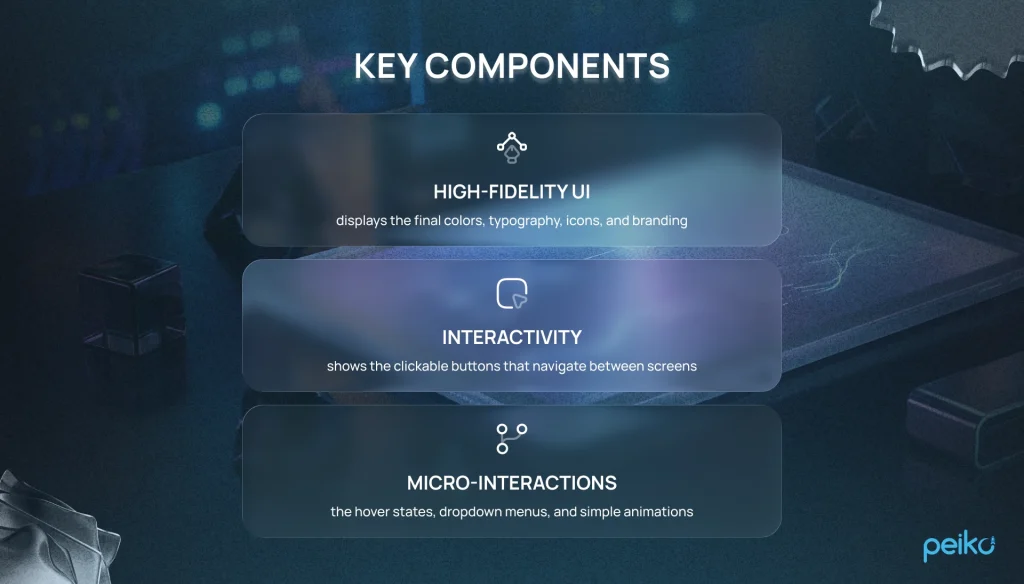
Example: For a mobile-first design project, stakeholders need to feel the application in their hands.
- The Deliverable: We delivered a Figma prototype accessible via a link. The client could open it on their iPhone. They could simulate the sign-in flow, scroll through a feed, and tap to make a simulated transaction.
- The Value: This allowed the Client to show the product to potential investors before development began. They secured early funding by demonstrating a working simulation of the product, proving the concept was viable, and the UX was polished.
Scope & Backlog: Defining the MVP and Beyond
One of the most painful parts of software development is deciding what shall be excluded from the first steps of the product. The MVP Scope and Backlog documents manage these decisions.
The Scope of Work (SoW) defines exactly what is included in the initial release (often the Minimum Viable Product).
The Backlog is a prioritized list of all the features that are desired but might be pushed to a future release to save time or budget.
This deliverable protects your budget. It prevents “feature creep” by forcing difficult decisions early on, ensuring the team focuses on high-value features first.
Key Components:
- MVP Scope: The “Must-Have” features: without these, the product does not function or can not be presented to the first Users and investors.
- Phasing: Breaking the project into milestones by defining and prioritizing the Epics.
- User Stories: Breaking down features into small, testable units.
Example: In a massive e-commerce and logistics platform, the Client initially wanted everything: crypto payments, complex referral systems, AI chatbots, and multi-language support right within the MVP scope.
- The Reality Check: Based on the budget, building all of this would take up to 10-12 months.
- The Deliverable: The Team has conducted the Discovery phase to negotiate the scope. We moved the AI Chatbot and the extensive Referral System to the Backlog. The MVP Scope focused exactly on Product Listing, Secure Checkout, and the Order Tracking Epics. This reduced the Time-to-Market from 12 months to 4 months, allowing the Client to start the market expansion and generate revenue sooner.
Architecture Draft: The Technical Foundation
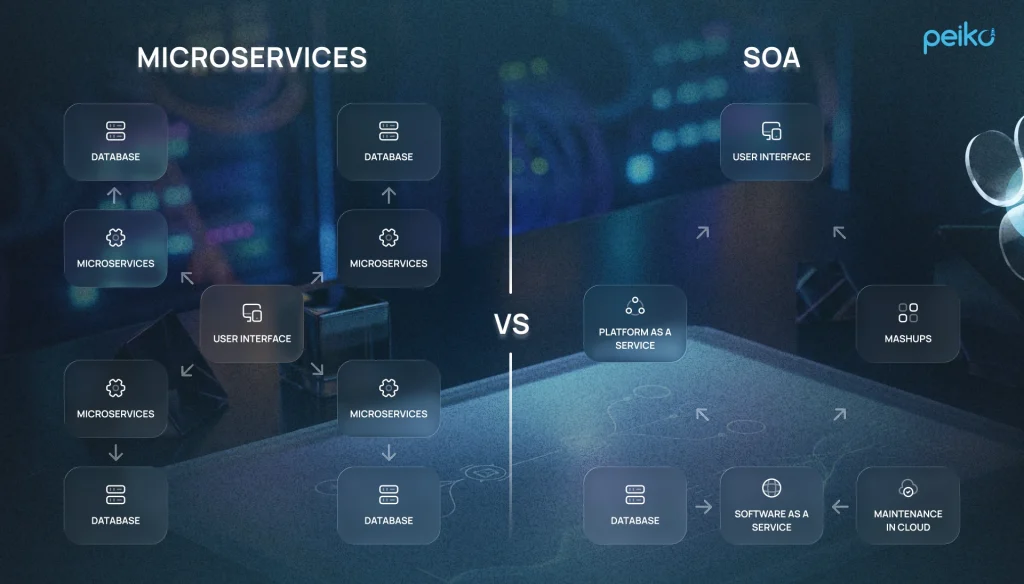
While the PRD and Prototypes focus on the User, the Architecture Draft ensures the system can actually support those Users. This is a technical blueprint created by System Architects and Lead Developers that provides a visual and written representation of the technology stack, database structure, and third-party integrations.
A solid architecture draft prevents “technical debt.” It ensures the system is scalable (can handle 100 Users or 1 million Users) and secure from day one. It helps you understand why the development costs what it costs.
Key Components:
- Tech Stack: Selection of languages, frameworks, and databases.
- Diagrams: High-level architecture diagrams showing how the frontend talks to the backend and external APIs.
- Infrastructure: Cloud provider selection (AWS, Google Cloud, Azure) and setup (Kubernetes, Docker).
- Security Architecture: Encryption methods, firewall configurations, and authentication protocols.
Example: Let’s look at a complex DeFi ecosystem in the project our Team has successfully delivered.
The Requirement: The system needed to handle “Staking,” “Vesting,” and “DAO Voting.”
- The Architecture Deliverable: We provided a diagram detailing the interaction between the Web Client (React), the Backend API (Node.js), and the Blockchain nodes. Crucially, the architecture specified the use of Smart Contracts for the logic of “granting roles” and “accruing rewards.” It defined that critical financial calculations would happen on-chain (in the smart contract) for transparency, while User profile data would be stored off-chain (in a standard database) for speed.
Risks List: Proactive Mitigation Strategies
Every project has risks. Ignoring them just postpones the real problem appearing.
A formal Risk Assessment document (often a matrix) that identifies potential pitfalls, estimates their likelihood and impact, and proposes a mitigation plan.
This shows that your partner isn’t just coding blindly but is thinking strategically about your business continuity. It prepares you for the “worst-case scenario” so it doesn’t become a disaster.
To allocate funds and plan marketing launches within a predictable range, a precise estimate derived from a Discovery phase allows for accurate ROI calculation and internal resource planning.
Key Components and examples:
- Technical Risks: “ The third-party API might be unstable”.
- Business Risks: “A competitor might launch a similar feature”.
- Regulatory Risks: “GDPR requirements might change”.
- Mitigation Strategy: “List of the risk-reducing steps”.
Example: For a project involving biometrics and KYC integrations:
- The Risk: The third-party KYC provider might have downtime, preventing new Users from signing up.
- The Impact: High (loss of revenue).
- The Mitigation Plan: We documented a strategy to implement a “fallback” provider or a queuing system. If Provider A fails, the system automatically routes the request to Provider B or saves the request to be processed later, notifying the User.
Estimates: Budget and Timeline Precision
Finally, the output of all the previous work is the Estimate. Because we now know exactly what we are building (PRD), how it looks (Wireframes), and how it works (Architecture), we can give as accurate numbers as possible.
The Estimation list is a detailed breakdown of the time and cost required to build the solution defined in the Scope.
Key Components:
- Work Breakdown Structure (WBS): estimation of hours per feature or module.
- Team Composition: the experts and the roles needed for the product development.
- Timeline: a roadmap showing when features are planned to be delivered.
- Cost: the total investment expected to deliver the product.
The Difference: Before the Вiscovery phase, an estimate is just a guess (e.g., USD 50,000 – USD 100,000, delivered up to 6 months). Having completed the Discovery phase and its deliverables, the budget and timeline estimates are getting more accurate (e.g., USD 72,500, delivered in 14 weeks).
Peiko is your ideal partner for Discovery Phase Services
At Peiko, we treat the Discovery phase service for software development as the foundation of our partnership. We don’t just ask “what do you want?” We ask “what does your business need?” and “what will your users love?”
Our approach is deeply rooted in transparency and technical excellence. Whether we are designing a complex blockchain ecosystem, a mobile-first retail app, or an enterprise SaaS platform, our team works seamlessly to give you a clear, confident way forward.
Our Expertise in Action: We have successfully delivered Discovery phases for:
- Fintech & Web 3 Solutions: Defining regulatory-compliant custody solutions and high-performance trading platforms.
- E-commerce: Architecting scalable marketplaces with complex inventory and payment logic.
- Healthcare & Social: Mapping out sensitive User data flows and engaging User journeys.
When you choose Peiko, the documentation is not the only outcome of the Discovery: you get a strategic roadmap, prepared with high-quality, and any skilled development team could use it. However, our Clients tend to continue further delivery with us because they recognize the depth of our understanding of their product and the team’s involvement in delivering successful products.
Our Process:
- Workshops: Intensive sessions to extract requirements.
- Research: Competitor analysis and technical feasibility studies.
- Documentation: Preparing the PRD/SRS documentation.
- Visualization: Creating wireframes and prototypes.
- Validation: Reviewing everything with you for approval.
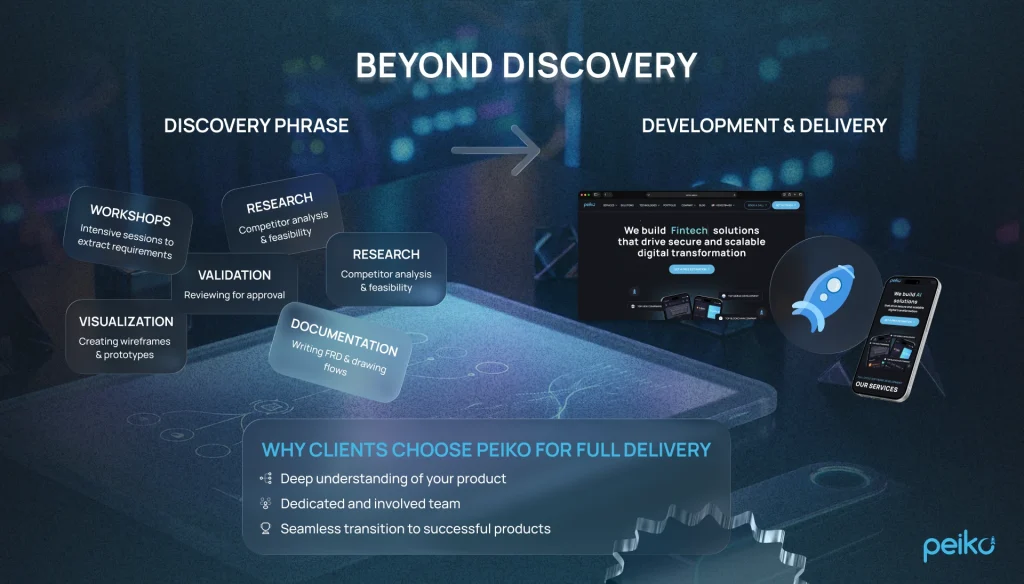
Avoid costly mistakes and skip the unplanned testing and planning costs in the future: contact Peiko, and you will have a unique opportunity to perfect your product idea before writing a single line of code.
Conclusion
The difference between a successful product launch and a failure mostly lies in the quality of the preparation. Discovery phase deliverables are not administrative obstacles, or the timeline extends: they are the artifacts that secure your investment.
By engaging the dedicated team in comprehensive documentation, detailed User Flows, interactive Prototypes, and a solid Technical Architecture completed within the Discovery phase, you protect your business from the risks of uncertainty and can ensure that every dollar spent on development is spent on a well-defined, necessary, and feasible functionality.
Discovery phase deliverables provide the clarity required to move from an abstract idea to reality. Whether you are a startup looking for investors or an enterprise looking to modernize, starting with Discovery is the smartest business decision you can make.
Are you ready to transform your vision into a structured, actionable plan prepared by experts? Reach out to Peiko today to discuss how a Discovery Phase can save your budget and timeline.
No comments yet. Be the first to comment!