


















One of the most widespread misconceptions in SaaS development is the assumption that building a multi-vendor platform is closer to building a standard subscription product. Obviously, it is not. Marketplace payments do not equal SaaS subscription checkouts.
When you process payments for third parties, you enter a labyrinth of regulatory compliance, vendor payouts, chargeback liabilities, and complex taxation. Choosing the wrong payment provider will not just make the payment process less convenient and more suspicious for your users but also can trigger IRS audits, freeze your funds, and fundamentally break your unit economics.
For big companies and SMEs, selecting the right Stripe Connect marketplace architecture or evaluating alternatives like Paddle and PayPal is the main technical decision you will make.
In this article, you will find an expert breakdown of marketplace payment systems, taxes, and architectural tradeoffs for 2026. But… If you have no time to read…
Paddle vs Stripe: which is better for SaaS in 2026? Short Answer
Paddle is generally better suited to SaaS companies that want a Merchant of Record and prefer to outsource payment and tax-compliance operations. Stripe is generally better suited to companies that need greater control over payments, billing, tax infrastructure, or marketplace money movement. For multi-vendor marketplaces, Stripe Connect is the more relevant solution because it supports seller onboarding, payment routing, and payouts.
SaaS Payments vs Marketplace Payments
SaaS and marketplace businesses may both accept online payments, but their payment architecture is fundamentally different.
A SaaS company normally sells its own software directly to customers. The payment flow is relatively straightforward: customer → SaaS company. The main requirements are recurring billing, trials, upgrades, downgrades, invoices, failed-payment recovery, refunds, tax calculation, and international payments.
A marketplace introduces additional parties. A customer pays for a product or service provided by a third-party seller, while the marketplace may collect a commission and then transfer the remaining amount to the seller. This creates additional requirements around seller onboarding, identity verification, split payments, payouts, disputes, tax reporting, and regulatory compliance.
Stripe Connect is specifically designed for this multi-party model, with connected accounts, onboarding, payment routing, payouts, verification, and marketplace workflows.
Paddle is primarily positioned around SaaS and digital-product businesses using its Merchant of Record model. Paddle’s current acceptable-use policy also excludes digital marketplaces where other sellers use the platform to sell products.
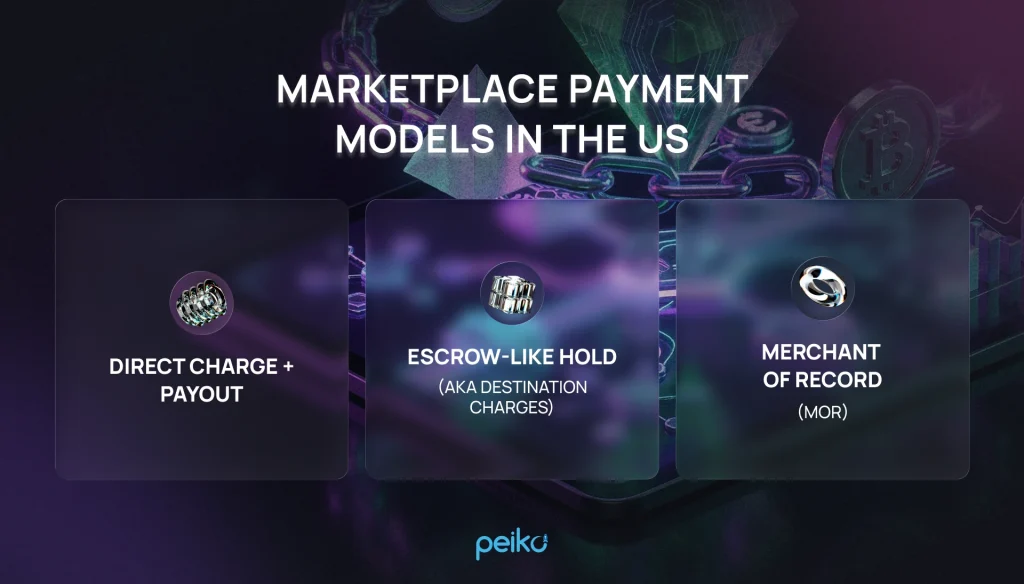
Marketplace Payment Models in the US
US marketplaces generally need to support three core payment flows: collecting money from customers, calculating and retaining the marketplace’s commission, and paying sellers or service providers. The exact implementation depends on whether the marketplace acts as the seller, facilitates payments between independent sellers and buyers, or uses a hybrid model.
The payment provider therefore needs to support more than checkout. Seller onboarding, identity verification, payout scheduling, refunds, disputes, tax reporting, and money movement can all become part of the payment architecture.
In the US, platforms typically process their payments within one of the following financial models:
Direct Charge + Payout: Within this model, the platform facilitates the whole payment. The buyer’s receipt shows the vendor’s name. The payment processor splits the funds instantly.
Escrow-like Hold (aka Destination Charges): This model covers the capture of the funds by the platform and holding them. The hold is usually provided by the payment processor’s ledger. Then, when the condition is met (=service was delivered), the payout is triggered. This protects the platform from chargebacks on undelivered goods.
Merchant of Record (MoR): Here, the platform technically buys the goods (services) from the vendor and immediately resells them to the buyer. This is the fundamental difference from a payment processor: with an MoR, the legal transaction is between the customer and the platform, while in Stripe-style processing the seller remains legally responsible for chargebacks, sales tax, and compliance.
Stripe Connect for Marketplaces (The US Default)
Stripe Connect is one of the strongest options for US marketplaces because it is designed specifically for platforms that need to onboard sellers, accept customer payments, collect marketplace fees, and distribute funds to connected accounts.
Stripe supports several payment-flow models, including direct charges, destination charges, and separate charges and transfers. This allows the payment architecture to be adapted to different marketplace business models rather than forcing every marketplace into one transaction flow.
Stripe also provides tools for seller verification, payouts, refunds, disputes, tax reporting, and compliance. Its current Connect documentation states that the platform supports onboarding connected accounts in 35+ countries and payouts to users in 118+ countries.
Stripe Connect offers three main integration types:
- Standard (common integration): Vendors connect their own Stripe accounts that were set up and configured in advance. The vendor is responsible for chargebacks. In the context of development, this option is an easy way to build swiftly, but it provides the platform very little control over the UX
- Express: A popular option for most US startups with a more complex and hybrid approach. Stripe provides the onboarding UI and tax reporting, which saves more time for the management team. However, the platform controls the User experience and the flow of funds.
- Custom: Full white-label control via building the entire onboarding UI via API. The platform is fully responsible for managing the user experience, but Stripe still handles the backend compliance.
Key Features of the Stripe Connect Integration:
- Onboarding & KYC: The integration verifies vendor identities (SSN, EIN, ID uploads) to comply with US anti-money laundering (AML) laws.
- Scheduled Payouts: Stripe Connect allows configuring daily, weekly, or manual payouts.
- Refunds & Chargebacks Processing: Defines the system-level permissions for working with chargebacks, either through the platform account or the vendor’s connected account.
- Webhook Reliability: Stripe’s event-driven webhooks have a wide range of functionality, allowing the backend to react instantly to payment success, dispute creation, or vendor verification failures. Its API is often described as “poetry” and remains the gold standard for developer experience, giving teams extensive customization and control.
Paddle for SaaS: Merchant of Record Model and Marketplace Limitations
Paddle is primarily designed for SaaS and digital-product businesses that want to outsource much of the operational burden associated with global payments and tax compliance.
As a Merchant of Record, Paddle acts as the seller in the transaction and takes responsibility for collecting and remitting applicable sales taxes, while also providing checkout, subscription billing, payment processing, customer support, and related revenue-management functionality.
Paddle’s current standard pricing is 5% + $0.50 per Checkout transaction, with custom pricing available for larger businesses. The fee includes payments, billing, cross-border sales tax compliance, fraud and chargeback protection, and other services.
However, Paddle is not a general-purpose marketplace payment platform. Its current Acceptable Use Policy specifically excludes digital marketplaces that enable other sellers to sell products or services to customers.
This makes Paddle a much more natural choice for a SaaS company selling its own software than for a marketplace where independent sellers need to receive payouts.
PayPal for Marketplaces (Pros & Cons, and When It Works)
PayPal remains relevant for marketplaces and platforms, particularly when PayPal or Venmo acceptance is important to the target customer base. PayPal also offers platform solutions covering merchant onboarding, risk management and payouts.
However, PayPal should not be treated as simply another version of Stripe Connect. The capabilities, pricing structure, seller onboarding model, geographic coverage, and money-movement workflows differ.
For example, PayPal Enterprise Payouts currently supports payouts in 200+ markets and 50+ currencies, while PayPal Payouts supports 95+ countries and 23+ currencies.
- US Compliance and User Trust: PayPal is a well-known, trusted brand, and offering it at checkout typically boosts conversion rates — especially among customers who are wary of entering card details directly on a marketplace they don’t fully trust yet.
- UX Tradeoffs: Compared to Stripe‘s API, the integration and developer experience are frequently less sophisticated.
- Limitations for Split Payouts: PayPal’s risk models are strict, even though it allows multi-party payments. If PayPal’s algorithm notices a spike in volume or disputes, it frequently freezes marketplace funds for up to 180 days, which can destroy a startup’s vendor trust.
US Sales Tax & Compliance Basics
US sales-tax compliance is one of the biggest differences between using a Merchant of Record and building a payment stack around a payment processor.
With an MoR such as Paddle, the provider takes on the seller-side responsibility for applicable sales-tax collection and remittance. Paddle states that it handles sales tax, VAT, GST and equivalent taxes for digital products where legally required.
With Stripe, businesses can use Stripe Tax to automate tax calculation and collection, while Stripe Tax Complete adds features such as tax-registration and filing support. Stripe currently lists Tax Basic at 0.5% per transaction where the business is registered to collect tax, while Tax Complete starts at $90/month and includes registration, calculation, collection and filing capabilities subject to plan limits.
The important distinction is that tax calculation software and Merchant of Record services are not the same thing. Before choosing a provider, determine which entity is legally responsible for the sale and which party is responsible for registration, collection, filing, remittance, refunds and tax records.
The business owners often neglect compliance at the initial steps of the marketplace development until they receive fiscal or legal consequences. To minimize these risks, you need to architect for the following:
- 1099-K Reporting: The IRS requires marketplaces to report gross payment volume for US vendors meeting certain thresholds. If you use Stripe Connect, Stripe will generate and file these forms automatically. If you build a custom payout engine, you must build the 1099-K reporting infrastructure.
- KYC (Know Your Customer): You cannot pay out funds without verifying who is receiving them. Doing so risks facilitating money laundering or violating OFAC sanctions.
- Marketplace Facilitator Concept: Over 40 US states have enacted laws stating that if a marketplace facilitates a sale, the marketplace (not the individual vendor) is responsible for calculating, collecting, and remitting state sales tax. With Stripe-style processing, the seller still bears tax liability for calculating, collecting, and remitting sales tax in every jurisdiction where customers are located, and must stay compliant with tax authorities and local laws.
- Terms of Service + Dispute Policy: Your Terms of Service must legally establish your role. Are you an agent of the seller? A neutral venue? This defines your liability when a transaction goes wrong.
| Responsibility | Paddle | Stripe |
|---|---|---|
| Payment processing | Yes | Yes |
| Subscription billing | Yes | Yes, with Stripe Billing |
| Sales-tax calculation | Included | Stripe Tax |
| Tax collection | Yes | Yes, where configured |
| Tax registration | Handled as part of MoR model | Available through Tax Complete |
| Tax filing/remittance | Paddle handles applicable obligations | Available through Stripe Tax Complete |
| Merchant of Record | Yes | Stripe Managed Payments has MoR-type functionality, but availability and scope differ |
| Marketplace payments | Not designed for digital marketplaces | Stripe Connect is designed for marketplaces |
| Seller payouts | Not a marketplace feature | Connect supports marketplace payouts |
| Best fit | SaaS/digital products | SaaS, platforms and marketplaces |
* Features and responsibilities vary by country, product, account configuration and eligibility. Verify current terms before implementation.Payment Gateway Architecture Considerations
Your marketplace architecture must treat financial data with an extreme level of care.
What is the difference between a payment processor and a Merchant of Record?
A payment processor moves money between the customer and business but generally does not become the legal seller of the product. A Merchant of Record (MoR) acts as the seller in the transaction and can take responsibility for payments, tax collection and remittance, refunds, chargebacks, and related compliance obligations. Paddle operates as a Merchant of Record for SaaS and digital products, while Stripe primarily operates as a payments platform with separate products for billing, tax, and marketplace payments.
You are not just building a web app; you are building a financial ledger.
- Webhook Idempotency: Financial webhooks will occasionally be sent twice by providers like Stripe due to network retries. Your backend must process webhooks idempotently (using a unique event ID) so you do not accidentally credit a vendor twice for the same transaction.
- Double-Entry Ledger & Audit Trail: Your marketplace database design must include an immutable ledger. Every financial event (Payment Authorized, Payment Captured, Platform Fee Deducted, Payout Initiated, Payout Failed) must be recorded as a discrete, timestamped row. Never simply UPDATE a user’s balance column.
- Reconciliation: Build internal admin tools that reconcile your database’s understanding of vendor balances with Stripe’s actual API balances on a daily cron job.
- Security: API keys and webhook signing secrets must be strictly managed via environment variables and secrets managers (like AWS Secrets Manager), never hardcoded.
How Payments Affect Marketplace App Development Cost
Payment infrastructure can have a significant impact on marketplace development cost because a marketplace requires more than a checkout form. Development may include seller onboarding, identity verification, payment routing, commissions, refunds, disputes, payout scheduling, tax reporting, webhooks, reconciliation, fraud prevention, and administrative dashboards.
Using a provider such as Stripe Connect can reduce the amount of payment infrastructure that needs to be built internally because many of these capabilities are available through APIs and prebuilt interfaces.
However, integration cost should not be estimated from the provider’s transaction fee alone. The engineering effort required for subscription logic, accounting, reconciliation, tax workflows, and edge cases can have a greater long-term impact on total cost.
- Scope Creep: Implementing checkout is a swift solution. Instead, it is worth taking into account that implementing the lifecycle of a marketplace payment (authorization, holding funds, splitting fees, vendor KYC, handling failed payouts, processing chargebacks, and generating tax documents) takes weeks or months, depending on the individual requests. In paddle vs Stripe decisions, Stripe’s base fee is typically 2.9% + 30¢ per transaction, but the total cost can rise due to add ons, tax compliance work, fraud prevention tooling, and other operational overhead, which adds additional cost beyond core billing.
- Admin Tools: Building internal dashboards could cause significant budget spending. When a vendor emails support asking, “Why wasn’t I paid?” the platform support team needs an interface to see the source of the case (for example, the KYC verification failed, or the bank rejected the ACH transfer).
- Reporting: Building custom CSV exports for your accounting team to reconcile platform revenue vs. vendor payouts adds development overhead. With Stripe Billing, teams with complex subscription management or advanced billing workflows may also need an additional tool, while other features increase the total cost of ownership.
What to Choose: Decision Matrix
Below you can see a decision matrix to guide your choice between paddle and stripe:
| Business requirement | Paddle | Stripe | Better fit |
|---|---|---|---|
| SaaS subscriptions | Excellent | Excellent | Depends on control vs simplicity |
| Merchant of Record model | Yes | Limited/depends on product | Paddle |
| Global SaaS tax compliance | Strong | Strong with Stripe Tax | Paddle for outsourced compliance |
| Maximum payment customization | Moderate | High | Stripe |
| Marketplace seller onboarding | Not designed for this | Strong with Connect | Stripe |
| Marketplace payouts | Not designed for this | Strong with Connect | Stripe |
| Subscription management | Built in | Stripe Billing | Both |
| Usage-based billing | Supported | Supported | Both |
| International SaaS expansion | Strong | Strong | Depends on compliance model |
| Developer control | Lower | Higher | Stripe |
| Operational simplicity | Higher | Depends on stack | Paddle |
| Complex marketplace money movement | Not a fit | Designed for it | Stripe |
| Best for selling your own SaaS | Excellent | Excellent | Depends on business model |
| Best for multi-vendor marketplace | No | Yes | Stripe |
Summary: Final verdict: choose Paddle when your priority is selling SaaS or digital products while outsourcing much of the payment and tax-compliance burden. Choose Stripe when you need deeper control over payments, billing, tax, or marketplace money movement. For a true multi-vendor marketplace, Stripe Connect is the more relevant product category.
Common Mistakes: the US Marketplaces
- Leaving Payouts “For Later”: A payout architecture cannot be added at the last minute. On the first day, the entity relationships between users, orders, and financial ledgers need to be designed.
- No Chargeback Strategy: Who is responsible for paying if a buyer contests a $500 charge and the bank returns the money? Your platform just lost $500 if the vendor has already been paid. Automated clawbacks or delayed payouts require coding.
- Weak Admin Tools: While engineering teams enjoy creating buyer user interfaces, they detest creating admin panels. Your customer service operations will fail if you don’t have a detailed financial dashboard.
- Misunderstanding MoR: Teams comparing paddle and stripe often miss the split in responsibilities: with Paddle, the MoR handles more of the tax and compliance burden, while with standard Stripe you still own tax setup, refunds, and much of the billing lifecycle unless you add more tools.
Paddle vs Stripe: Total Cost of Ownership in 2026
Comparing Paddle and Stripe only by headline transaction fees can produce the wrong result. SaaS companies should calculate the total cost of the payment stack, including transaction processing, subscription billing, tax tools, fraud prevention, chargeback management, customer support, engineering time, accounting, and compliance.
Paddle’s current standard Checkout pricing is 5% + $0.50 per transaction and includes payments, billing, cross-border sales-tax compliance, fraud and chargeback protection, and related services. Paddle also offers custom pricing for larger businesses.
Stripe’s standard US pricing currently starts at 2.9% + $0.30 for successful domestic card transactions. Additional fees can apply for international cards, currency conversion, manually entered cards, payment methods, Billing, Tax, Connect and other services.
This means Stripe can have a lower headline processing rate while still requiring a broader collection of products and operational processes. Conversely, Paddle’s higher transaction fee can be attractive to a SaaS company that wants to outsource tax and payment administration.
The correct comparison is therefore not simply “Which has the lower fee?” but “Which payment model produces the lower total cost and operational burden for our business?”
| Cost category | Paddle | Stripe |
|---|---|---|
| Base transaction fee | 5% + $0.50 Checkout | From 2.9% + $0.30 for US domestic cards |
| Subscription billing | Included in platform | Stripe Billing |
| Tax calculation | Included | Stripe Tax |
| Tax compliance/filing | MoR model | Stripe Tax Complete |
| Marketplace payments | Not designed for this | Stripe Connect |
| Engineering flexibility | Lower | Higher |
| Operational burden | Lower for SaaS | Potentially higher |
| Best optimization target | Reduce operational overhead | Build a customized payments stack |
* Pricing and product availability change over time; verify current rates before publishing or making a purchasing decision.Paddle vs Stripe in 2026: Which One Should You Choose?
The choice between Paddle and Stripe depends primarily on what you are selling and how much control you want over your payment infrastructure.
Choose Paddle if you sell SaaS or digital products and want to minimize the operational burden of global payments and tax compliance. Paddle’s Merchant of Record model is designed specifically around this use case, combining payments, billing, tax compliance, and related revenue-management capabilities.
Choose Stripe if you need maximum flexibility and control over your payment architecture. Stripe provides a broad set of products for payments, subscriptions, tax, fraud prevention, and financial infrastructure. Its Connect product is specifically designed for platforms and marketplaces that need to onboard sellers, route payments, and manage payouts.
For a traditional SaaS product selling its own subscriptions, both platforms can work well. The deciding factor is often the trade-off between operational simplicity and control.
For a multi-vendor marketplace, the decision is different: Paddle is generally not the appropriate platform because its current policies exclude digital marketplaces, while Stripe Connect is specifically built for marketplace payment flows.
In other words, there is no universal winner. Paddle is primarily a SaaS Merchant of Record; Stripe is a broader payments and financial infrastructure platform. Your business model should determine which one you choose.
Conclusion
Choosing between Paddle and Stripe in 2026 is primarily a question of business model and operational priorities.
Paddle is a strong option for SaaS and digital-product companies that want a Merchant of Record to handle much of the complexity associated with payments, billing, sales tax, and international compliance.
Stripe is a better fit when a business needs deeper control over its payment infrastructure, wants to build a customized billing stack, or needs marketplace functionality such as seller onboarding, payment routing, and payouts through Stripe Connect.
Building a multi-vendor platform in the US requires you to act like a fintech company just as much as a software company. For a SaaS business, compare the total cost of ownership rather than transaction fees alone. For a marketplace, focus on money movement, seller onboarding, payouts, compliance, and reconciliation.
The best payment architecture is the one that fits your business model today while giving you enough flexibility to scale internationally tomorrow.
Before setting up a single action of payment logic, ensure you have validated your core platform assumptions. Read our comprehensive guide on how to build a marketplace app to understand the foundational product steps.
If you are ready to execute your vision and need an expert team that understands the deep technical requirements of a payment service provider ecosystem, it is time to hire SaaS developers who specialize in high-stakes marketplace app development. Let’s build a platform that scales securely and compliantly. Contact us to deliver a high-quality product that fits the market demand and assists you in reaching the top of the market!
No comments yet. Be the first to comment!