
















So you have an idea, and a vision of users loving your product, of traction graphs rising, of investors raising eyebrows, and surely of yourself building real wealth from your creation.
You might also be picturing long development timelines and high costs — months of work and tens of thousands of dollars spent before they can even show something real to users or investors. But what if that didn’t have to be the case? Thanks to modern AI‑assisted development workflows, it’s now possible to go from idea to investor‑ready prototype in a fraction of the time and at a much lower price point.
For tightly scoped products, AI-assisted workflows can reduce implementation time considerably. In Peiko’s experience, some focused MVPs can be delivered in approximately 10–15 days with budgets around $10K, although this does not apply to every product type or scope.
This is the ultimate guide to how much you’ll actually pay to build an MVP in 2026 — not theories, not wild guesses, but real ranges based on current market data and startup experience.
Key Takeaways
- A typical custom MVP in 2026 can cost roughly $10,000–$75,000, while very simple validation products may cost less and complex AI, fintech, healthcare, marketplace, or enterprise MVPs can exceed $100,000.
- Scope is the biggest cost driver. Features, workflows, platforms, integrations, security, data requirements, and administrative tools directly affect engineering and QA effort.
- A simple web MVP is usually cheaper than building separate web, iOS, and Android applications.
- AI can reduce development effort in some workflows, but AI-powered product features may increase overall cost through APIs, data pipelines, evaluation, monitoring, and infrastructure.
- Team model matters. Freelancers, small product teams, agencies, and in-house development have different cost structures and management requirements.
- Budget beyond launch. Hosting, APIs, monitoring, maintenance, support, analytics, and future product iterations create ongoing costs.
- The best MVP is not the cheapest possible product. It is the smallest product that can test the most important business assumption with real users.
What Is an MVP, or the Real Startup Definition
Let’s be crystal clear before we talk dollars:
An MVP (Minimum Viable Product) is the smallest version of your product that delivers real value to early users so you can validate, iterate, and grow with actual data — not hope. It’s not a toy. It’s not a prototype that sits in your design tool. It’s a functioning product that people can interact with.
| Concept | Main Purpose | Real Users? | Production Backend? | Typical Goal |
| Prototype | Demonstrate UX or concept | Usually no | Usually no | Validate user flow or pitch idea |
| Proof of Concept | Test technical feasibility | Usually no | Limited | Prove that a technology can work |
| MVP | Validate product assumptions | Yes | Usually yes | Learn from real usage |
| V1 Product | Start broader commercialization | Yes | Yes | Growth and continued product development |
In 2026, MVPs aren’t about feature lists — they’re more about outcomes:
- Validate demand
- Test core assumptions
- Acquire real user feedback
- Gather metrics that matter.
2026 MVP Cost Ranges: What Founders Actually Pay
Short answer: a custom software MVP in 2026 commonly falls in the $10,000–$75,000 range, while lean validation products can start around $5,000 and complex products may exceed $100,000. AI-heavy or compliance-intensive MVPs can reach $150,000–$200,000+ depending on scope. The number becomes meaningful only when the product type, platforms, features, integrations, team model, and security requirements are defined.
The cost isn’t a single number. It’s a range based on complexity, platform, features, team, region, and quality expectations.
Here’s the market picture in 2026, showing typical MVP app cost across different project types:
| MVP Type | Typical Scope | Estimated Cost | Typical Timeline |
| Validation / No-Code MVP | One core workflow, basic automation, limited custom backend | $5k–$15k | 2–8 weeks |
| Simple Custom MVP | Authentication, core feature, database, basic dashboard | $10k–$30k | 4–10 weeks |
| SaaS MVP | Roles, payments, admin, analytics, integrations | $30k–$75k | 8–14 weeks |
| AI-Driven MVP | LLM/RAG, AI workflows, data processing, evaluation | $80k–$200k+ | 10–20+ weeks |
| Compliance-Heavy MVP | Security controls, documentation, regulated workflows | $100k–$150k+ | 3–6+ months |
Startup MVP budgets in 2026 are broader than ever — because the definition of an MVP has expanded. It now ranges from simple validation products to full‑fledged platforms with advanced technology.
Here are what these ranges actually mean in practice.
1. Lean & Nocode MVP — Kickstart With Minimal Spend
Goal: Validate concept with the lowest possible investments.
In 2026, a lean MVP is often built using no‑code or low‑code tools (e.g., Bubble, Webflow) and AI to accelerate development. Understanding the MVP development cost here helps founders decide how to allocate resources efficiently. Typical MVP app development cost at this stage ranges from $5,000–$15,000, making it the most budget-friendly option for early validation.
Typical builds:
- Simple landing page + user flow
- Form + backend logic (e.g., leads, signups)
- Basic dashboard or admin view
- No advanced integrations
Cost of MVP: ~$5,000 – $15,000
Time: ~2–8 weeks
Pros:
- Fastest bootstrap route
- Great for early validation
- Minimal upfront cost
Cons:
- May have scalability, customization, or platform limitations as the product grows
- Might need rework for production growth
This tier is ideal for early testing before you invest.
2. Simple Web/App MVP — First Real Product Build
Goal: Deliver a real web app with core functionality.
This is what most bootstrap founders start with — a custom MVP built by freelancers or small teams.
Example scope:
- User authentication
- Core feature (the one thing your product must do)
- Dashboard or basic UI
- Simple backend + database
- Deployment + analytics.
Cost of MVP: $10,000 – $30,000
Time: 4–10 weeks
This range represents good value — enough quality to learn from real users without overspending.
When does it make sense?
1. You’re still testing product‑market fit
2. You don’t need advanced AI, real‑time features, or heavy integrations
3. Standard SaaS MVP — Scalable & Fundable
Goal: Build an MVP that feels solid, can handle a real user base, and supports early scaling. This range is where many early‑stage funded startups live.
Typical features:
- Multi‑user authentication and roles
- Payment processing
- Basic analytics
- Admin dashboards
- Third‑party integrations (Stripe, SendGrid, etc.
Cost to build an MVP: $30,000 – $75,000
meline: 8–14 weeks
This is a founder‑friendly, investor‑acceptable MVP level that still delivers a product users can pay for and rely on.
4. Advanced & AI‑Driven MVP — Higher Complexity and Cost
AI is now common in both software development workflows and product features, but it should only be part of an MVP when it supports the core value proposition. Adding LLMs, retrieval systems, voice interfaces, recommendation engines, or other AI capabilities can increase development and operating costs because they introduce additional integration, evaluation, data, security, and infrastructure requirements. But AI adds cost:
- LLM integration
- Neural search / embeddings
- Predictive features
- Voice / natural‑language processing.
These aren’t cheap plug‑ins — they require architecture, data pipelines, and testing.
Cost: $80,000 – $200,000+
Timeline: 10–20+ weeks
This is the range you pay when AI is part of your core value proposition and can’t be removed without destroying product relevance. At this level, MVP development cost reflects not just the features, but the architecture, data pipelines, and testing required to deliver a truly functional AI-driven product.
5. Enterprise & Compliance‑Heavy MVP — Security Is Not Cheap
Some industries (finance, blockchain, healthcare) require:
- Compliance audits
- Security certifications
- Data governance
- Enterprise‑grade architecture.
This pushes MVP cost into the $150,000+ range, with lengthy timelines and heavy documentation.
The cost isn’t a single number. It’s a range based on complexity, platform, features, team, region, and quality expectations. Understanding the cost to build an MVP helps founders plan their budget wisely and avoid unexpected expenses. Here’s the market picture in 2026, showing typical MVP app cost across different project types
MVP Cost by Product Type in 2026
Two MVPs with the same number of screens can have very different development costs. A simple B2B workflow app may rely primarily on standard authentication, forms, and database operations, while a marketplace needs multi-sided workflows and payments, and a fintech product may require significantly more security and compliance engineering.
The following ranges provide a more practical view of MVP cost by product category.
| Product Type | Typical MVP Components | Indicative Budget |
| SaaS | Authentication, roles, subscriptions, dashboard, admin | $25k–$75k |
| Marketplace | Buyer/seller accounts, listings, payments, payouts, admin | $40k–$100k+ |
| Mobile App | User accounts, API/backend, core workflow, notifications | $25k–$80k |
| AI Product | AI API/model integration, data pipeline, evaluation, monitoring | $50k–$150k+ |
| Fintech | Payments, identity, transaction logic, security, auditability | $60k–$150k+ |
| Healthcare | User/patient workflows, data security, integrations, compliance | $60k–$150k+ |
| Internal B2B Tool | Workflow automation, permissions, admin, integrations | $20k–$60k |
These figures are planning ranges rather than fixed prices. Product category gives useful context, but scope remains the biggest cost factor. A focused fintech product can cost less than a complex SaaS platform, while a marketplace with multiple payment flows and integrations may exceed the ranges above.
What Really Drives Your MVP Cost: The 6 Key Factors
Now numbers are good — but context is better. Understanding why MVP development cost can vary helps you make strategic choices before you spend a single dollar.
1. Complexity of Features
Each feature you add is not just code, it’s design, backend, UI, tests, and deployment. A “simple” feature done well isn’t cheap.
2. Platforms
- Web-only products are often cheaper to launch because a single responsive application can cover desktop and mobile browsers without maintaining separate native apps
- Mobile (iOS/Android) — adds time & testing. Cross-platform mobile frameworks can reduce the additional cost of supporting both iOS and Android, although platform-specific integrations and QA still add effort.
- Both — multiplies cost if not using cross‑platform frameworks.
3. Team & Location
Choosing where to build your MVP is not just a question of hourly rates — it’s a strategic decision that directly affects product quality, speed, long-term costs, and overall MVP development cost. Different regions offer very different trade-offs between engineering expertise, communication, and management effort.

The table below compares these regions from a founder’s perspective — helping you align your budget, risk tolerance, and product goals before committing to a development team:
| Team Location | Typical Cost Position | Main Advantages | Considerations |
| North America | Highest | Time-zone access for US clients, local market familiarity | Higher hourly and project rates |
| Western Europe | High | Mature engineering market, strong product expertise | Higher rates than many offshore regions |
| Eastern Europe | Medium | Large engineering talent pool and competitive rates | Time-zone overlap varies by client location |
| LATAM | Medium | Strong overlap with North American working hours | Rates and specialization vary by country/team |
| South & Southeast Asia | Low–Medium | Large talent pool and competitive pricing | Vendor quality and communication processes should be evaluated individually |
Geography affects labor costs, but it should not be used as a proxy for engineering quality. Portfolio relevance, seniority, technical assessment, delivery process, communication, and references are more reliable vendor-selection criteria.
4. Design Quality
A no‑frills template design is cheap; a polished UX/UI takes dedicated hours.
5. Third‑Party Integrations
Every connection (Stripe, AI APIs, Maps, Payments) means extra development + testing.
6. AI and Advanced Logic
Custom AI features require expertise, data pipelines, and often ongoing costs (API usage, tokens, compute), which all contribute to the overall MVP development cost.
MVP Development Team Models and How They Affect Cost
Who builds the MVP can affect both the initial budget and the amount of management required from the founder. A lower hourly rate does not automatically produce a lower total project cost if coordination, rework, or missing expertise creates additional effort.
| Team Model | Relative Cost | Main Advantages | Main Trade-Off |
| Founder-built / No-code | Lowest | Very fast experimentation | Limited technical capacity |
| Freelancer | Low–Medium | Flexible and affordable | Founder manages coordination and continuity |
| Small dedicated team | Medium | Fast communication and focused delivery | Capabilities depend on team composition |
| Development agency | Medium–High | Product, design, engineering, QA and DevOps available together | Higher commercial overhead |
| In-house team | High | Full long-term product ownership | Recruitment time and fixed employment costs |
For a narrow MVP, a skilled freelancer or small team may be enough. Products involving multiple platforms, payments, complex integrations, security, or regulatory requirements often benefit from a broader cross-functional team.
The best comparison is therefore not simply hourly rate vs hourly rate. Compare the expected total effort, required roles, management overhead, delivery risk, and cost of potential rework.
Where Your Budget Gets Spent, a Practical Breakdown
Here’s what typical MVP budgets look like across stages:
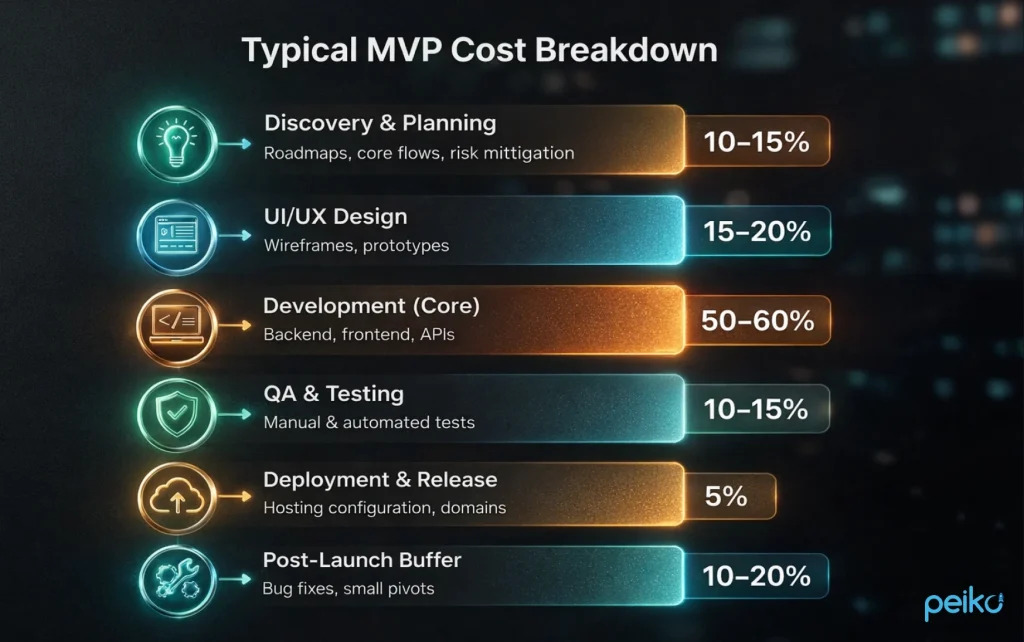
Note: overlooking planning and the discovery phase is one of the most expensive mistakes founders make when building an MVP. It may feel like a shortcut, but in reality it often delays launch, inflates costs, and weakens the product.
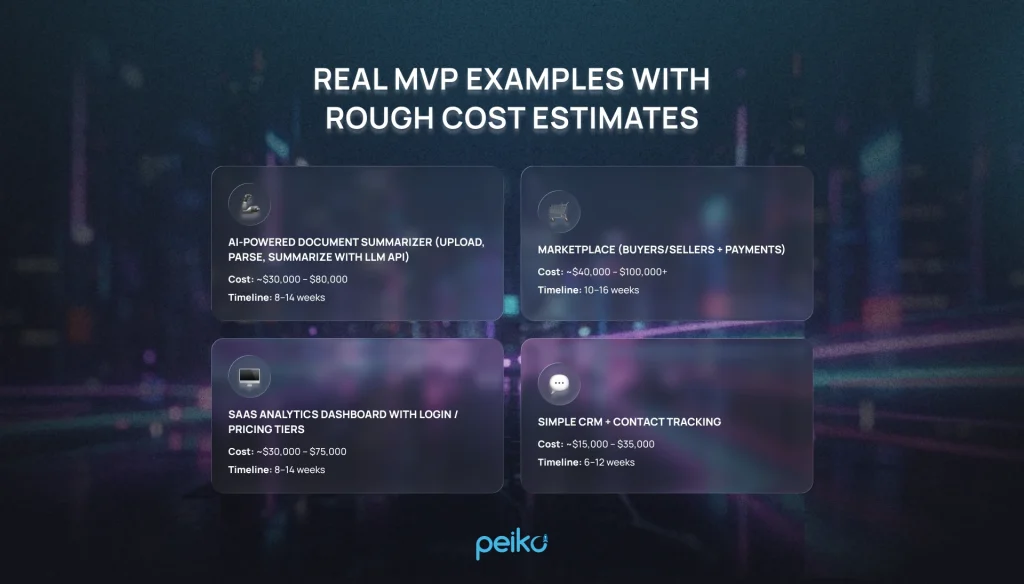
Here are some practical examples so you can visualize what your MVP idea might cost:
Fixed Price vs Time & Materials for MVP Development
The commercial model can affect how easily an MVP adapts when assumptions change during development. Founders usually choose between fixed-price delivery, Time & Materials, or a dedicated-team arrangement.
| Pricing Model | Best For | Cost Predictability | Scope Flexibility |
| Fixed Price | Small, well-defined scope | High | Low |
| Time & Materials | Evolving MVP requirements | Medium | High |
| Capped T&M | Startups needing flexibility with a budget ceiling | High–Medium | High |
| Dedicated Team | Continuous product development | Medium | Very High |
Fixed price works best when requirements, integrations, designs, and acceptance criteria are already clear. Changes after signing usually require formal scope adjustments.
Time & Materials allows the team to reprioritize features as the product evolves. This is often useful for MVPs because new technical information and product decisions frequently emerge during development.
Capped T&M can provide a middle ground: the team works flexibly while the founder defines a maximum budget or milestone limit.
The right contract model depends on how much uncertainty remains. Trying to force an uncertain product into a rigid fixed scope can create change requests later rather than truly reducing cost.
Hidden & Ongoing Costs Founders Almost Always Forget
Even after an MVP is launched, spending doesn’t simply stop at the snap of your finger.
Even after an MVP is launched, spending doesn’t simply stop at the snap of your finger. Ongoing expenses are a key part of MVP development cost and are essential to keep the product functional, secure, and competitive.
This includes server and infrastructure maintenance, bug fixes, minor feature updates, and monitoring performance metrics. Additionally, user feedback often drives incremental improvements, which require development time and resources. Marketing, customer support, and analytics tools also add to the monthly budget. Planning for these recurring costs from the outset ensures that your MVP can evolve into a fully-fledged product without unexpected financial strain.
Even after your MVP is built, you may need:
Hosting & Infrastructure: $20 – $500+ monthly
API / Token Fees: $50 – $1,000+ monthly
Maintenance & Updates: A common planning assumption is to reserve roughly 15–25% of the initial development budget annually, but actual costs depend on product maturity, infrastructure, user volume, security requirements, and how frequently the product changes
Marketing & User Acquisition: Highly variable and should be budgeted separately from software development
Ignoring these means your MVP isn’t really live — it’s parked.
How to Reduce MVP Development Cost Without Hurting Validation
Reducing MVP cost should mean removing unnecessary scope, not removing the functionality required to test the core business assumption.
The first step is to define one primary user, one critical problem, and one core workflow. Features that do not directly contribute to validating that workflow can usually wait.
A practical cost-reduction strategy includes:
- Launch on one platform first. A responsive web application may be enough to validate demand before investing in separate mobile apps.
- Prioritize one critical workflow. Avoid building every future use case into the first release.
- Use existing services. Authentication, payments, email, maps, analytics, cloud storage, and AI APIs can often be integrated faster than building equivalent infrastructure internally.
- Avoid premature microservices. A well-structured modular application is often simpler and cheaper to operate during the MVP stage.
- Use no-code or low-code where appropriate. Internal dashboards, administrative tools, forms, and simple workflows may not require custom development.
- Define integrations early. External APIs often create hidden scope because they require authentication, error handling, testing, and ongoing maintenance.
- Use AI-assisted engineering selectively. AI can accelerate coding, documentation, tests, and repetitive tasks, but generated output still requires engineering review and validation.
- Reserve budget for iteration. Spending 100% of the budget before receiving user feedback defeats one of the main purposes of building an MVP.
MVP Cost-Cutting Decision Table
| Decision | Usually Reduces Cost | Risk to Validation |
| Remove nice-to-have features | High | Low |
| Start with one platform | High | Low–Medium |
| Use third-party infrastructure | Medium–High | Low |
| Use template-based UI | Medium | Low |
| Skip automated testing entirely | Medium | High |
| Skip security requirements | Medium | Very High |
| Skip user analytics | Low | High |
| Remove the core user workflow | High | Critical |
The goal is not to build the cheapest application possible. It is to spend the minimum amount required to obtain reliable evidence about whether the product should be developed further.
Conclusion
Before you budget, answer these:
What exact problem are you testing?
Who is your first real user?
What is the must‑have feature?
What is the nice‑to‑have that we can cut?
How much runway do you have after launch?
Remember:
Too cheap is expensive.
Too expensive kills validation.
Documented deliverables matter.
Anyone can claim they’ll build your MVP — real accountability comes with documentation, deployment, and support.
No comments yet. Be the first to comment!