
















For enterprises targeting the US market, understanding how to build a marketplace app is no longer just about matching buyers with sellers; it’s also about creating a seamless user experience and a constantly developing product following the most current approaches and technologies. A successful marketplace product in 2026 is a complex ecosystem that covers various aspects of automated payouts, tax compliance, identity verification (KYC), and other ways to ensure high User trust and legal compliance.
In the US, a marketplace is perceived much wider than just a website; it is a regulated financial engine that requires the full coverage of all external and internal factors. US users expect constant and reliable support, instant refunds, and uncompromising data security. Meanwhile, the IRS expects strict 1099-K reporting, and B2B clients demand SOC 2 compliance.
Turning a marketplace concept into a revenue-generating, compliant platform requires more than just generic coding skills. It demands deep domain expertise in financial APIs, database isolation, and US regulatory standards.
If you want to dive deeper into the realities of marketplace app development, from defining unit economics to choosing the right tech stack, this article provides a step-by-step roadmap tailored for the US market. Whether you are bootstrapping or backed by external funding, here is what you need to know about SaaS development for multi-vendor platforms.
Key Takeaways
- A US marketplace MVP typically needs separate buyer and seller onboarding, listings, search, payments, vendor payouts, reviews, disputes and an admin panel.
- Most early-stage products should begin with a modular architecture instead of moving directly to microservices.
- Marketplace payment infrastructure must support seller onboarding, identity verification, fees, refunds, disputes and payouts.
- US tax obligations depend on the marketplace model and individual state rules; marketplace-facilitator requirements are not identical nationwide.
- Development cost depends mainly on payment complexity, admin operations, integrations, security requirements and whether mobile apps are included.
- A marketplace should validate liquidity and unit economics before investing in advanced features.
What Is a SaaS Marketplace App?
| Term | Meaning |
| Marketplace app | A platform connecting two or more participant groups and facilitating transactions |
| Multi-vendor marketplace | Multiple independent sellers/providers sell through one platform |
| SaaS marketplace | A marketplace delivered as a software platform, often combining subscription/workflow functionality with marketplace transactions |
| Software marketplace | A marketplace selling or distributing software/apps, such as integrations or extensions |
A SaaS marketplace combines software-as-a-service workflows with a multi-sided transactional platform. Unlike regular linear businesses, you are processing multiple User bases simultaneously.
2-Sided vs. 3-Sided Marketplaces:
A standard 2-sided marketplace usually connects Supply (Vendor) with Demand (Buyer) (e.g., Airbnb).
A 3-sided marketplace includes an additional operational layer, such as independent delivery drivers (e.g., DoorDash) or specialized QA inspectors.
Website vs. App:
When researching how to build a marketplace website, the business owners often can not decide initially between a web platform and a mobile app. For a complex B2B approach, a responsive web app is usually sufficient for an MVP. For consumer-facing on-demand services, a native or cross-platform mobile app makes more sense to cover the critical functionality, such as push notifications and geolocation.
Marketplace Types That Work Best in the US
Because of its extreme fragmentation, the US market is ideal for vertically specific, niche platforms.
Service Marketplace App
A service marketplace app connects clients with suppliers of the requested service. The most common examples are home services, telehealth consulting, or specialized legal experts. The core challenge here is scheduling logic and managing the “off-platform” leakage events, where Users are making transactions offline.
B2B Marketplace
B2B marketplaces provide vendor procurement, wholesale ordering, and supply chain logistics. The decent trust level is fundamental here. B2B buyers expect invoice-based payments (Net 30/60 terms), strict access controls, and SOC 2 readiness to ensure their corporate data is secure.
Multi-Vendor Ecommerce
These are platforms where independent sellers list physical or digital goods (e.g., Etsy, eBay). Such products usually have a technical complexity of managing unified shopping carts containing items from multiple vendors, calculating real-time dynamic shipping, and executing split payouts.
| Marketplace Type | Example Use Case | Main Complexity | Typical Monetization |
| Service marketplace | Home services, consultants | Scheduling, trust, disputes | Commission |
| B2B marketplace | Procurement, wholesale | Roles, invoices, enterprise integrations | Subscription + commission |
| Multi-vendor ecommerce | Physical/digital goods | Catalog, shipping, split payments | Commission + seller fees |
SaaS Marketplace Business Models and Monetization in 2026
| Model | Best For | Advantage | Main Risk |
| Commission | Transactional marketplaces | Revenue grows with GMV | Leakage/off-platform transactions |
| Subscription | B2B/SaaS marketplaces | Predictable MRR | Harder early acquisition |
| Listing fee | Classified/listing models | Simple | Weak alignment with transactions |
| Lead fee | Professional services | Monetizes introductions | Lead quality disputes |
| Hybrid | Mature marketplaces | Diversified revenue | Greater pricing complexity |
REAL-WORLD US SAAS MARKETPLACE EXAMPLES
Real-world US SaaS Marketplace Examples
Seeing how each marketplace type plays out in practice makes the abstract model concrete before you start building your own.
- Thumbtack (Service Marketplace): Connects homeowners with local service professionals, solving the scheduling and off-platform leakage challenges outlined earlier through in-app messaging and payment capture.
- Faire (B2B Marketplace): Connects independent retailers with wh
- olesale brands, relying heavily on invoice-based payment terms and buyer trust signals to overcome the “decent trust level” requirement of B2B platforms.
- Poshmark (Multi-Vendor Ecommerce): Lets individual sellers list secondhand goods, managing split payouts and unified cart logistics at massive scale.
Each of these platforms started with a narrow, constrained niche before expanding — reinforcing the “Validate the Marketplace Model” approach covered earlier in this guide.
Step-by-Step Marketplace App Development Process
This is when theory meets practice. Successful marketplace app development requires extreme discipline in scoping and validating.
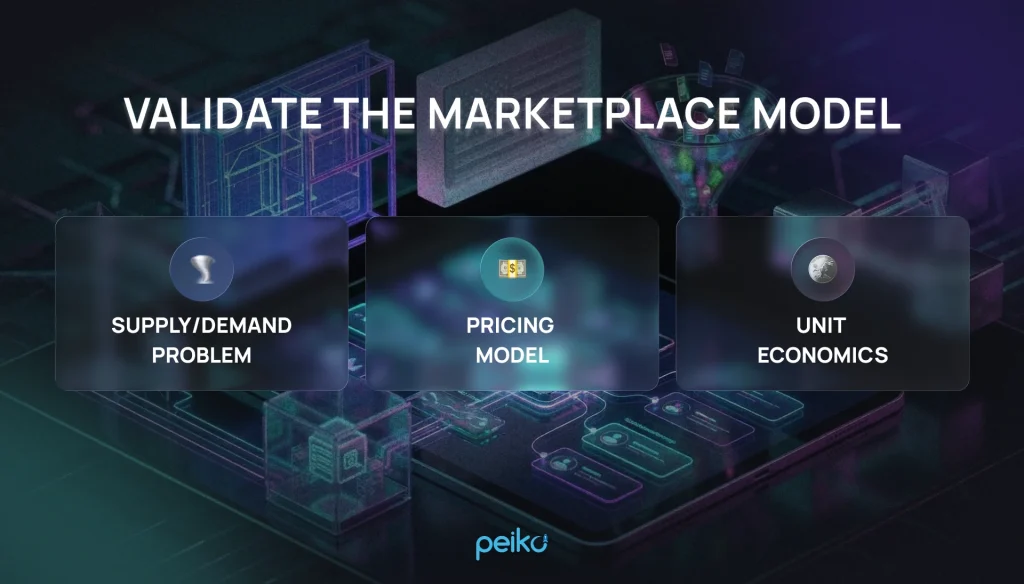
Validate the Marketplace Model
Before writing a single line of code, you must solve the “chicken-and-egg” problem.
- Supply/Demand Problem: Who do you onboard first? In the US, the most common approach is to focus on a certain segment by constraining the market initially: usually in a single location or niche. The following step is subsidizing the supply side until liquidity is reached.
- Pricing Model: The decision of the Tier 1 monetization that would generate your revenue: a flat subscription fee (SaaS), a transaction commission (Take Rate), listing fees, or a hybrid.
- Unit Economics: Calculate the basic and the target statistics to keep the health financing of the product, for example, the Customer Acquisition Cost (CAC) for both buyers and sellers. Your Lifetime Value (LTV) must exceed the combined CAC, or the platform will bleed cash.
Define MVP Scope
To test your hypothesis quickly, strip the product down to the absolute must-haves:
| Feature | Buyer Side | Seller Side | Admin/Platform Side | MVP Priority |
| Registration & onboarding | Yes | Yes | User management | Critical |
| Listings | Browse | Create/manage | Moderate | Critical |
| Search & filters | Search inventory | — | Configure taxonomy | Critical |
| Payments | Checkout | Receive earnings | Fees/refunds | Critical |
| Messaging | Contact seller | Contact buyer | Moderation | High |
| Reviews | Leave reviews | Respond | Moderate | High |
| Payouts | — | Receive payouts | Configure schedules | Critical |
| Disputes | Open case | Respond | Resolve | Critical |
| Analytics | Limited | Basic | Operational dashboard | Later |
Marketplace Architecture (What You Need to Decide Early)
Getting your marketplace architecture right determines whether your platform will scale or collapse under load.
- Monolith vs. Microservices: A modular monolith is often appropriate for an MVP because it minimizes operational complexity while preserving clear domain boundaries. Scaling decisions should be based on measured workload rather than an arbitrary user-count threshold.
- Multi-Tenancy: If you are building a SaaS marketplace where vendors need their own customized sub-portals, you must design for multi-tenancy from day one. Data isolation is critical.
- Event Flows: Marketplaces are highly asynchronous. Implement message brokers for event flows: payment capture triggers a notification, which updates the inventory, which triggers an email.
- Observability: Implement robust logging and alerting. When a transaction fails, you need to know exactly where the bottleneck occurred.
| Architecture Decision | MVP Approach | Scale-Up Approach |
| Backend | Modular monolith | Selective services where justified |
| Database | PostgreSQL | Replication/read scaling + specialized stores when needed |
| Tenancy | Shared DB with strict tenant isolation | More advanced tenant isolation where required |
| Async workflows | Basic queues | Event-driven architecture |
| Search | Database/full-text | Dedicated search engine |
| Observability | Centralized logs + alerts | Metrics, traces, SLOs, distributed tracing |
Recommended Tech Stack for a US SaaS Marketplace App
Once your architecture decisions are made, the actual technology choices should reinforce them rather than fight against them.
- Backend: Node.js or Python (Django) both handle marketplace transaction logic well; choose Node.js for real-time messaging-heavy platforms, Django for complex admin and compliance tooling.
- Frontend: React or Next.js for web platforms, since server-side rendering improves SEO for public listing pages.
- Database: PostgreSQL is the standard choice — it supports strict relational integrity for financial data while allowing JSONB columns for flexible listing attributes.
- Payments: Stripe Connect, as covered in the payments section, remains the default for US-based split payments and compliance.
- Search: Elasticsearch or Algolia for marketplaces with large, filterable catalogs where basic database queries won’t scale.
- Messaging/Notifications: Twilio or SendGrid for transactional communication, paired with a message broker like RabbitMQ or AWS SQS for internal event flows.
- Hosting: AWS or GCP, both offering the compliance certifications (SOC 2, HIPAA where relevant) that US B2B buyers expect.
None of these choices should be locked in before your architecture decisions — the stack should serve the monolith-vs-microservices and multi-tenancy decisions you’ve already made, not the other way around.
Marketplace Database Design (Avoid Costly Mistakes)
Your marketplace database design is the foundation of your platform’s integrity. A bad schema will lead to data anomalies, lost funds, and legal nightmares.
- Core Entities: Clearly separate Users (authentication credentials), Profiles (buyer/seller specific data), Listings, Orders (the intent to purchase), Transactions (the actual movement of money), and Disputes.
- Flexible Schema: On day one, avoid over-engineering. While your financial ledger must be a strict relational database, listing attributes can utilize JSONB columns to allow for flexible, evolving category specifications without requiring constant database migrations.
- Audit Trail: This is a non-negotiable must-have. Every status change in an order or payment must be recorded in an immutable audit log. If a vendor asks why they weren’t paid, your admin team needs a definitive history of the transaction.
Payments & Payouts in the US (Stripe Connect)
Handling financial transactions in the US requires an enhanced and experienced approach. Simply saying, it is not correct to just accept funds into your corporate bank account and wire them to vendors manually: such actions could just make you an unlicensed money transmitter.
In the US, the integration of Stripe Connect is one of the most common marketplace payment infrastructures. It handles the heavy lifting of compliance and money routing.
Below you can find the solutions provided by Stripe service providers:
Split Payments
The Destination Charges automatically split the buyer’s payment between the vendor’s earnings and your platform fee.
| Connect Model | Who Charges the Buyer? | Typical Marketplace Use |
| Direct charges | Connected seller | Seller-centric platforms |
| Destination charges | Platform | Platform-controlled checkout with one primary seller |
| Separate charges and transfers | Platform | Multi-party or more complex fund routing |
Payout Schedule
Assists with managing the funds release via defining the payout periods (automation) or triggered by a delivery confirmation event.
Refunds & Chargebacks
With Stripe instruments, your platform must define who bears the cost of a chargeback (the platform or the vendor) and automate the clawback of funds.
Know Your Customer (KYC) Identity Verification
Stripe Connect handles vendor KYC, checking against US watchlists, and verifying SSNs or EINs before allowing payouts.
US Legal, Tax, and Compliance Basics
Marketplace facilitator rules vary by state. Whether a platform must collect and remit sales tax depends on the state definition, transaction type, nexus and applicable thresholds.
| Area | What Marketplace Owners Need to Check |
| 1099 reporting | Seller/service-provider tax reporting obligations and payment-provider support |
| Marketplace facilitator tax | State-specific nexus, thresholds and taxable product/service rules |
| KYC/identity verification | Seller identity/business verification where required by payment infrastructure |
| PCI DSS | Card-data handling and payment integration scope |
| Privacy | Federal/state privacy obligations based on users and data |
| Terms of Service | Seller/buyer responsibilities, refunds, disputes, prohibited activity |
| Enterprise security | Controls, auditability and potentially SOC 2 expectations for B2B customers |
* This is strategic advice, not formal legal counsel. Trust & Safety: Preventing fraud in a marketplace
Legal compliance protects you from regulators — trust and safety protects you from bad actors on both sides of your platform.
- Identity verification beyond KYC: While Stripe Connect handles payout-related KYC, listing-side fraud (fake vendors, stolen product photos) requires separate verification, such as document checks or phone verification at signup.
- Review and rating manipulation: Implement rate-limiting and pattern detection to catch vendors buying fake reviews or buyers leaving retaliatory ratings.
- Chargeback and payment fraud: Define clear rules for who absorbs chargeback costs (platform vs. vendor) and use Stripe Radar or similar tools to flag suspicious transaction patterns before they complete.
- Escrow-style holds for disputes: Holding funds temporarily during an active dispute prevents a bad actor from receiving payment and disappearing before an issue is resolved.
- Account takeover protection: Require two-factor authentication for vendor accounts, since a compromised vendor account can be used to redirect payouts to a fraudulent bank account.
Trust and safety isn’t a single feature — it’s an ongoing layer that touches onboarding, payments, reviews, and dispute resolution simultaneously, which is exactly why it needs to be budgeted as core infrastructure rather than a post-launch add-on.
Marketplace App Development Cost (US-focused)
The cost of the development is the first question every business owner asks.
The marketplace app development cost varies wildly based on scope, but on the high level, there are some realistic ranges for a high-quality US build:
| Product Stage | Typical Scope | Indicative Development Budget |
| Validation prototype | UX, limited workflows, little automation | $15k–$40k |
| Marketplace MVP | Buyer/seller flows, listings, search, payments, admin | $40k–$80k |
| Production V1 | Advanced operations, disputes, analytics, integrations | $80k–$150k+ |
| Complex/scalable marketplace | Complex payments, multi-tenancy, high-scale infrastructure, automation | $150k–$300k+ |
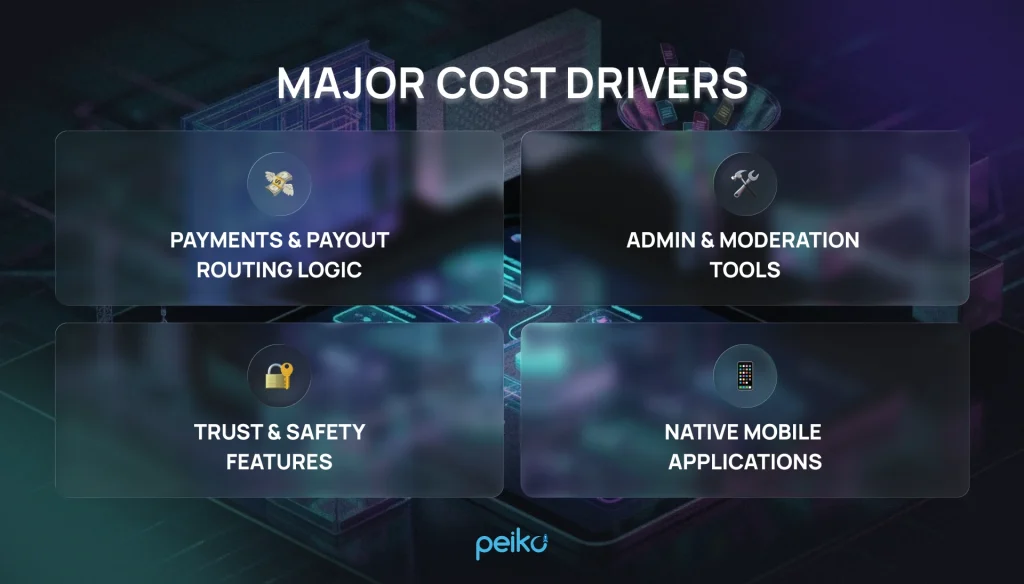
* These are planning ranges rather than fixed market prices; actual cost depends heavily on team location, architecture and compliance requirements.Major Cost Drivers that shall be considered:
- Payments & Payout routing logic.
- Admin & Moderation tools (sometimes neglected, but vital for operations in reality).
- Trust & Safety features (automated ID verification, fraud detection).
- Native Mobile Apps (iOS/Android).
Timeline: How Long It Takes to Build a Marketplace App in the US
Building a robust financial product takes time. Here are some realistic timelines for the marketplace application development:
| Phase | Typical Range |
| Discovery & architecture | 1–3 weeks |
| UX/UI design | 2–4 weeks |
| Core MVP development | 8–14 weeks |
| QA, stabilization & launch | 2–4 weeks |
| Production V1 | ~4–6 months total |
| Scaling/optimization | Continuous |
Common Mistakes That Risk Marketplace Startups
- Building Too Much Before Supply Exists: Don’t build advanced analytics dashboards before you have 10 active vendors. Focus entirely on liquidity first.
- Ignoring Payouts and Compliance: Hardcoding payment logic without considering refunds, failed payouts, or US tax withholding will paralyze your business at scale.
- Limited Admin Tools List: If your customer support team has to ask developers to manually update database rows to resolve a user dispute, you will drown in operational debt.
- No Dispute Resolution: Buyers and sellers will inevitably disagree. Lacking an escrow-style hold or a formalized dispute flow destroys trust.
Marketplace Metrics & KPIs to Track after Launch
Once your platform is live, the metrics that matter shift from “did we build it” to “is it actually working.”
- Liquidity: The ratio of successful transactions to total listings or requests — low liquidity signals a supply or demand imbalance before revenue numbers will show it.
- Take Rate: Your platform’s revenue as a percentage of total transaction value (GMV) — this validates whether your pricing model from the “Validate the Marketplace Model” stage is actually sustainable.
- CAC vs. LTV (both sides): Track customer acquisition cost separately for buyers and sellers — your combined LTV must exceed combined CAC or the platform will bleed cash regardless of transaction volume.
- Repeat Transaction Rate: How often the same buyer-seller pairs transact again — a strong signal of trust and platform stickiness.
- Time-to-First-Transaction: How long it takes a new vendor to get their first sale — a slow ramp here often points to a discovery or search problem, not a supply problem.
These metrics matter more than raw user counts because they reveal whether your marketplace has genuine two-sided health, not just one-sided growth.
Build vs Buy
When exploring how to build a marketplace website, you must consider whether to build from scratch or use a SaaS platform.
- When No-Code / SaaS is OK: If you are testing a highly standardized rental or simple service model, tools like Sharetribe or a heavily modified Shopify setup can validate demand cheaply.
- When Custom is Required: If your marketplace involves complex multi-party scheduling, custom algorithmic matching, tiered B2B pricing, or non-standard payment splits, off-the-shelf tools will become a straitjacket.
- Migration Strategy: Many US founders launch on no-code to get their first 100 transactions, then secure Seed funding to hire an engineering team to build a custom, scalable asset.
Conclusion: Building for the Long Game in the US Market
Building a successful SaaS marketplace in the US is not just about creating a sleek interface that matches buyers and sellers; it’s about engineering trust.
The platforms that will thrive in 2026 are those that treat complex financial compliance (like 1099-K reporting), automated payout routing, and multi-tenant security not as afterthoughts, but as the very foundation of their business model.
As we’ve explored throughout this guide, the technical complexity of a multi-vendor platform is significantly higher than that of a standard subscription app. You are simultaneously solving workflow problems for two distinct user bases while acting as the secure, automated financial intermediary between them.
If you are looking to accelerate your time-to-market without compromising on your platform’s foundation, bringing in the right technical talent is your first major operational hurdle. Knowing how to efficiently hire SaaS developers who possess specific marketplace and fintech expertise can be the difference between a launch that scales and one that stalls.
Ready to bring your marketplace vision to life with architecture that scales and compliance you can trust? At Peiko, our business analysts, architects, and engineering teams specialize in building complex, high-load platforms tailored specifically for the US market. If you are looking to hire saas developers who understand the complexities of the US market, reach out to our team today for a technical consultation.
No comments yet. Be the first to comment!