
















Fintech innovators, Web3 builders, and enterprise product leaders all need to learn how to make a prediction market app. In a time when there is a huge need for crowd-sourced forecasting, the idea of a prediction market app 2026 edition goes way beyond just betting. It has grown into a complex system for finding prices, protecting against risk, and figuring out how people feel about things.
You have to deal with a lot of different things if you want to make a prediction market app. These include processing data in real time, financial math, and strict compliance. To make a successful prediction market app, you need more than just a nice interface. You also need a strong settlement engine, reliable oracles, and liquidity models that can grow.
The technological choices you make today will determine how well your platform does tomorrow, whether you want to build a centralized corporate forecasting tool or a decentralized prediction market app that anyone in the world can use.
In this complete guide, we’ll look at the whole process of building a modern prediction market, breaking down the architecture, liquidity mechanisms, backend details, and user experience that are needed to launch a successful platform.
What Is a Prediction Market App
A prediction market platform is basically an exchange where people can buy and sell contracts that pay out based on what happens in the future. At any given time, the market price of a contract shows what everyone thinks is the chance that the event will happen.
For example, if a contract pays $1.00 to a certain candidate if they win an election and is currently trading at $0.65, the market thinks there is about a 65% chance of that happening. This system uses the “wisdom of the crowd” to turn financial incentives into very accurate predictive data.
The modern prediction market software ecosystem spans several primary use cases:
- Finance and Economics: Traders protect themselves from big events in the economy, like rising interest rates, inflation reports, or changes in the prices of commodities.
- Sports and Entertainment: People guess what will happen at big sporting events, award shows, or the box offices. This means that systems need to be very responsive and able to handle huge spikes in traffic during live events.
- Politics and World Events: Markets that are based on election results or policy decisions give real-time measures of how the public feels, and they are often more accurate than traditional polls.
- Corporate & Enterprise: Big companies use internal prediction markets to guess when projects will be done, how many sales they will make, or how well a new product launch will go. This encourages employees to be honest.
Centralized vs Decentralized Prediction Market Apps (Web2 vs Web3)
Before you get into the technical details, you need to decide if you’ll build a prediction market platform as a centralized (Web2) or decentralized (Web3) system. This basic choice will affect every decision that follows, and choosing the right path depends on your timeline, resources, and how much control you want over the product long term.
Centralized Prediction Market Platforms (Web2)
In a centralized system, one company runs the exchange, holds users’ money in trust, and decides what is true when there are disagreements about results tied to future events.
- Pros: The user experience is familiar, transactions are faster, it’s easier to set up traditional fiat payment gateways (like credit cards and bank transfers), and customer support and account recovery are easy.
- *Cons: *Users have to trust the operator with their money and information. The operator is the only point of failure for both security breaches and regulatory shutdowns.
Decentralized Prediction Market Apps (Web3)
In a decentralized prediction market app, users use contracts tied to future events to predict or forecast outcomes, including certain events across finance, sports, and politics. Blockchain technology and smart contracts are used to remove the central operator, and blockchain integration can also be a strategic choice when transparency, wallet support, and trustless settlement matter most for your audience. Users trade directly from their non-custodial wallets, and decentralized oracle networks, not a central admin, settle the trades.
- Pros: No need to trust anyone, available to everyone around the world, resistant to censorship, and clear on-chain auditing. Users still have full control over their assets until the contract is over.
- Cons: Users who aren’t already familiar with crypto may have a harder time learning it, it depends on network gas fees, there may be limits on how much data can be sent depending on the blockchain, and the rules are complicated.
Both models have their own places in the 2026 market. Knowing how technically advanced and limited by regulations your target audience is will help you make this important choice.
Prediction Market App Architecture in 2026
A resilient prediction market app architecture must balance the needs of high-frequency trading platforms with the strong data integrity that financial apps need. Choosing between centralized and decentralized is about picking the right path based on speed, control, and compliance needs, because a prediction market platform requires robust infrastructure, clear data flows, and secure execution from the start. Many live systems use a hybrid model with off-chain quoting and matching plus on-chain settlement, which is often the most practical shape for a production ready platform. To do this, the architecture is usually split into small, independent microservices that are very specific.
For decentralized systems, blockchain integration is a strategic choice that improves transparency and trust, though it can make UX and settlement slower. In practice, that makes real-time probability updates and reliable data feeds non negotiable, and it also shapes the broader prediction market development approach.
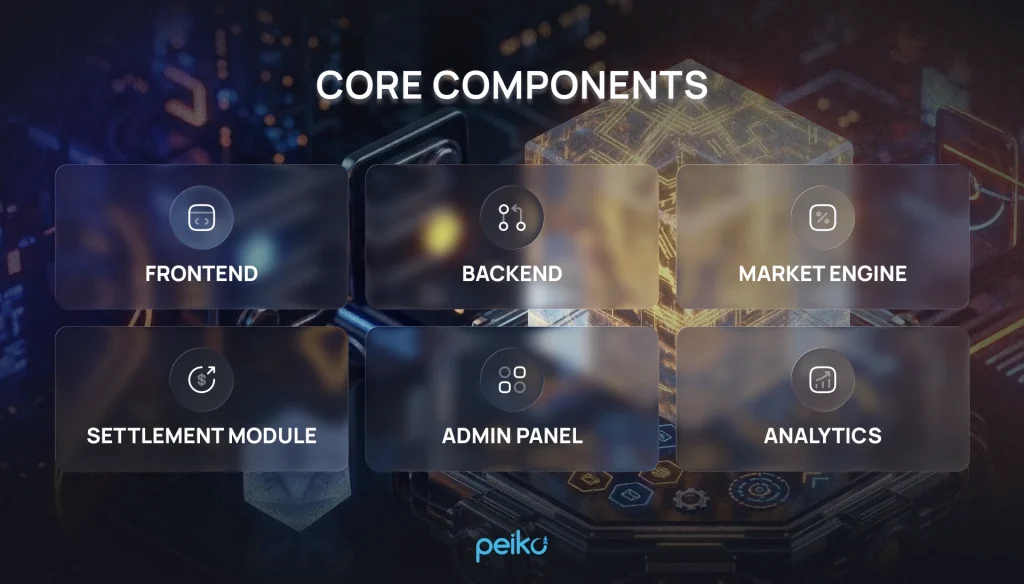
Core Components
Designing a scalable prediction market platform involves several interconnected modules, each handling a specific domain of the application lifecycle.
1. Frontend (Web/Mobile)
The application that clients use must be very responsive. In 2026, most frontends are made with React or Next.js for the web and Flutter or React Native for mobile. The frontend has to use WebSockets to handle real-time state updates so that the odds change without having to reload the page. This way, traders will always see the most accurate market prices.
2. Backend
The backend is like the brain of the prediction market software. It handles user authentication, state synchronization, historical data aggregation, and API orchestration. It was built with high-performance languages like Go, Rust, or Node.js. Even in a decentralized prediction market app, a Web2 backend (also known as an indexer) is important for caching on-chain data so that users can have a quick experience.
3. Market Engine
This is the math that makes the app work. The market engine figures out the odds, keeps track of the order books or liquidity pools, and matches buyers and sellers. It makes sure that the rules of the specific prediction market liquidity model are followed.
4. Settlement Module
The settlement module starts working when an event is over. It gets the result from the source of truth (an API or a Web3 Oracle), checks that the result is correct, figures out how much to pay out to all the winning positions, and sends the money. Extreme security audits are needed for this module because it controls how money is given out.
5. Admin Panel
Designing a scalable prediction market platform means balancing performance, data integrity, liquidity, compliance, and UX across several interconnected modules. Building one also requires combining decentralized finance (DeFi) infrastructure, robust data oracles, and intuitive UI/UX design, and early tech-stack choices can strongly affect delivery time and future scalability.
It also needs to support high volumes of real-time trading with low-latency execution.
1. Frontend (Web/Mobile)
The application that clients use must be very responsive. In 2026, most frontends are made with React or Next.js for the web and Flutter or React Native for mobile. The frontend has to use WebSockets to handle real-time state updates and instant price updates so that the odds change without having to reload the page. This way, traders will always see the most accurate market prices.
2. Backend
The backend is like the brain of the prediction market software. It handles user authentication, state synchronization, historical data aggregation, API orchestration, and market data delivery. It was built with high-performance languages like Go, Rust, or Node.js. Even in a decentralized prediction market app, a Web2 backend (also known as an indexer) is important for caching on-chain data so that users can have a quick experience.
3. Market Engine
This is the math that makes the app work. The market engine figures out the odds, keeps track of the order books or liquidity pools, and matches buyers and sellers. It makes sure that the rules of the specific prediction market liquidity model are followed.
4. Settlement Module
The settlement module starts working when an event is over. It gets the result from the source of truth (an API or a Web3 Oracle), checks that the result is correct, figures out how much to pay out to all the winning positions, and sends the money. For markets tied to financial markets, this layer also depends on secure, tamper-resistant feeds for accurate resolution. Extreme security audits are needed for this module because it controls how money is given out and directly affects user trust.
5. Admin Panel
Market creators and operators need a full back-office system to run the platform. This includes tools for making new events, stopping trading when something strange happens, managing liquidity, settling user disputes, and keeping an eye on systemic risk. It should also help teams balance regulatory compliance, deep liquidity, trust in market resolution, and intuitive user experience.
6. Analytics
An internal analytics engine keeps track of things like user behavior, trading volume, spread profitability, the health of the market, and each user’s trade history. This part is very important for finding toxic order flows or manipulative trading behaviors that could hurt the platform’s integrity. These are non-negotiable traits of a production-ready platform.
Liquidity & Pricing Models
The way your platform decides how much a contract costs is probably the most important technical and business choice you’ll make. This is what your prediction market liquidity model looks like.
Market Engine
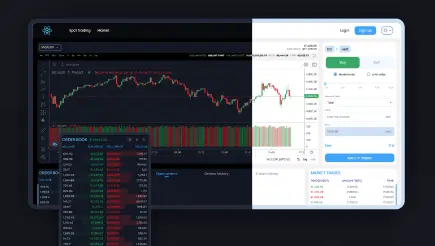
Your market engine controls how prices move and how users trade. In most platforms built on blockchain technology, early traction depends on how quickly the engine can support active trading without making the market feel empty. If you use an order-book model, the order book engine matches buy and sell orders in real time, while a separate event-management layer governs event creation and resolution criteria. If you use an AMM model, pricing updates automatically based on trades and available collateral.
At launch, liquidity is often the hardest issue to solve because a new platform has a classic liquidity problem before enough real users arrive. One practical answer is market making, whether through internal liquidity providers, external partners, or automated pricing logic that keeps spreads usable from day one. There are always trade-offs here: tighter spreads and deeper books can improve activity, but they also increase capital requirements and risk exposure.
Backend
On the backend, your stack needs to support low-latency pricing, order handling, and user activity at scale. For decentralized systems, Go and Rust are strong choices for high-performance services, while Node.js with TypeScript or Python with FastAPI work well for the application layer. A common setup also uses Redis for live order book state and PostgreSQL for persistent trade history and user positions.
Settlement Module
Your settlement module decides how markets resolve and how funds move after an outcome is confirmed. Reliable, tamper-resistant data feeds are critical for user trust, especially in markets tied to financial markets, because resolution accuracy directly affects confidence in the platform. Decentralized oracles such as Chainlink or UMA can supply secure data feeds for this layer and help reduce disputes around final outcomes.
Frontend and Analytics
On the user side, interface speed affects more than usability. Perceived liquidity often depends on whether traders see live price updates, responsive order flow, and accessible trade history views without delay. Slow or static screens make the market look inactive even when there is real activity underneath.
Automated Market Maker Prediction Market (AMM)
An automated market maker prediction market doesn’t connect buyers and sellers directly; instead, it uses algorithmic pricing. The platform has a liquidity pool that users trade against. Most platforms hit a launch-stage liquidity problem and must balance tight spreads, market depth, and capital efficiency.
How it works:
The Logarithmic Market Scoring Rule (LMSR) or the Constant Product Market Maker (CPMM) is the most common algorithm used in prediction markets. In practice, market making is often used to seed early activity, alongside LPs, AMMs, or subsidized trading incentives. When users buy “Yes” shares, the algorithm automatically raises the price of “Yes” and lowers the price of “No.” The price is a function that only depends on the ratio of shares in the pool right now. Perceived liquidity depends not only on actual depth, but also on responsive pricing and interface speed.
Advantages:
- Always Available Liquidity: Users can always make a trade, even in niche markets with few participants, because they are trading against the algorithm instead of waiting for a human counterparty.
- Simplified User Experience: Traders just trade at the quoted algorithmic price, which is like swapping tokens on a decentralized exchange.
Disadvantages:
- Capital Inefficiency: The platform operator (or liquidity providers) has to put a lot of money into the pools, which could lose value if the market strongly favors one outcome early on.
- Slippage: When a trader makes a large trade, the price can change a lot (slippage), which means the trader gets a bad execution price.
- Volatility Controls: Automatic fail-safes and risk-adjusted pricing help protect the market during sharp moves.
The Logarithmic Market Scoring Rule (LMSR) or the Constant Product Market Maker (CPMM) is the most common algorithm used in prediction markets. When someone buys “Yes” shares, the algorithm automatically raises the price of “Yes” and lowers the price of “No.” The price is a function that only depends on the ratio of shares in the pool right now.
Advantages:
- Always Available Liquidity: Users can always make a trade, even in niche markets with few participants, because they are trading against the algorithm instead of waiting for a human counterparty.
- Simplified User Experience: Traders just trade at the quoted algorithmic price, which is like swapping tokens on a decentralized exchange.
Disadvantages:
- Capital Inefficiency: The platform operator (or liquidity providers) has to put a lot of money into the pools, which could lose value if the market strongly favors one outcome early on.
- Slippage: When a trader makes a large trade, the price can change a lot (slippage), which means the trader gets a bad execution price.
Order Book Prediction Market
An order book prediction market operates identically to traditional stock exchanges or major crypto exchanges. It maintains a ledger of all open buy and sell orders at various price points.
How it works:
If a trader wants to buy a “Yes” contract at $0.60, they place a limit order and buy outcome shares from the pool based on their view of the event. The trade only executes if another user is willing to sell a “Yes” contract (or implicitly buy a “No” contract) at that exact price. A matching engine continuously scans the book to pair compatible bids and asks so users can place trades efficiently.
When needed:
Order books are absolutely necessary for markets with a lot of volume and liquidity, like presidential elections or big sports finals, where professional traders and institutional market makers are involved. Operators can also earn passive revenue through market-making by keeping a small spread between buy and sell prices, which also helps execution availability.
Hybrid Models
In 2026, the best prediction market software often uses a mix of methods. The platform might use an AMM to get liquidity going in new or niche markets and to launch new markets faster, which would let early users trade. If a trader wants to buy or sell, they place a trade through a limit order at a specific price. As the market gets more active and the number of trades goes up, the system changes to a central limit order book. This lets professional market makers come in and narrow the spreads, which is best when rapid execution matters for active traders.
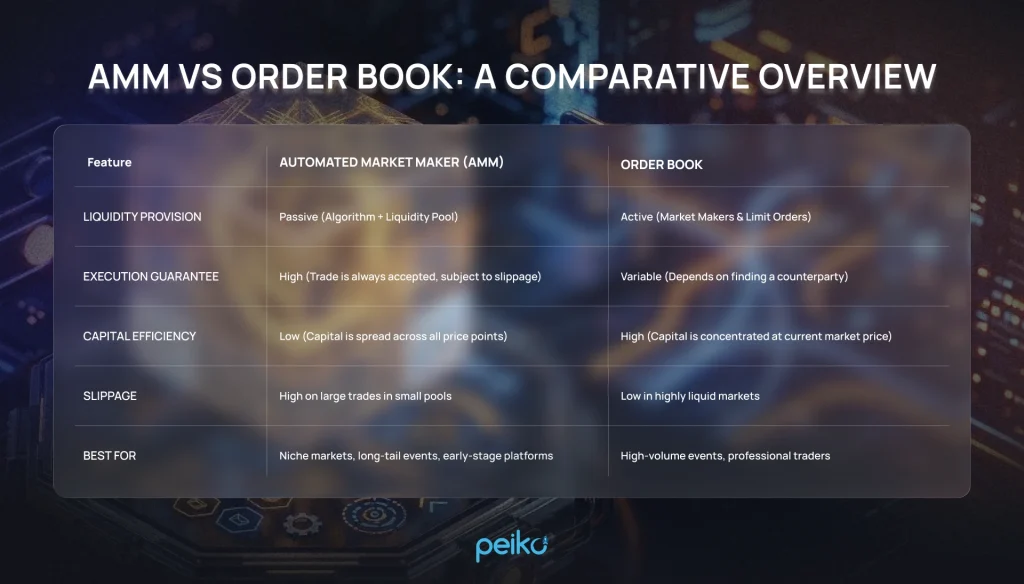
AMM vs Order Book: A Comparative Overview
| Feature | Automated Market Maker (AMM) | Order Book |
| Liquidity Provision | Passive (Algorithm + Liquidity Pool) | Active (Market Makers & Limit Orders) |
| Execution Guarantee | High (Trade is always accepted, subject to slippage) | Variable (Depends on finding a counterparty) |
| Capital Efficiency | Low (Capital is spread across all price points) | High (Capital is concentrated at current market price) |
| Slippage | High on large trades in small pools | Low in highly liquid markets |
| Best For | Niche markets, long-tail events, early-stage platforms | High-volume events, professional traders |
Pro Tip: Managing Liquidity Fragmentation
One mistake that new founders often make is opening too many markets at once. This breaks up user attention and liquidity, which leads to “ghost town” markets with big spreads and bad user experiences. Start with a small number of very relevant markets and make sure they are very liquid before adding more.
Backend Design & API Layer
To support a seamless user experience, the backend infrastructure must be resilient, scalable, and capable of real-time data processing.
Prediction Market Backend Design
A contemporary prediction market backend architecture is predicated on an event-driven microservices framework. Let’s look at the most important data areas:
Users & Wallets:
Handles user profiles, KYC statuses, and internal ledgers. This includes keeping track of fiat balances in a Web2 setup. It keeps track of connected wallet addresses and past on-chain interactions in a Web3 setup.
Markets & Events:
The backend must track the full lifecycle of an event:
- Draft: Market is being configured (rules, resolution criteria, end dates).
- Open: Market is active; trading is enabled.
- Halted: Trading paused temporarily due to volatility or circuit breakers.
- Resolving: The event has occurred; the system is waiting for oracle confirmation.
- Settled: Outcome confirmed; payouts are being processed.
Trades & Ledgers:
There must be an unchangeable record of every order, cancellation, and execution. For high-concurrency trading bursts, the database architecture (for example, PostgreSQL for relational data and Redis for fast in-memory order matching) must be able to handle ACID transactions to stop double-spending or race conditions.
Risk & Fraud Engine:
This service assists with monitoring order flows all the time to look for wash trading, API manipulation, or strange betting patterns that could mean insider knowledge or syndicate attacks.
Prediction Market App API
The API for your prediction market app connects your complicated backend to the user interface. To work with different types of data quickly, it needs to support more than one communication protocol.
REST / GraphQL:
Use GraphQL queries or standard RESTful endpoints to get transactional and historical data. Examples are getting user portfolios, getting market rules, looking up historical price charts, and making sure users are who they say they are. GraphQL works really well here because it lets the front end ask for the exact shape of data it needs, which makes payloads smaller.
WebSockets for Real-Time Odds:
A price delay of even a few seconds in a prediction market can make the user experience terrible or let arbitrageurs take advantage of it. WebSockets are necessary for sending real-time order book updates, AMM price changes, and instant trade execution confirmations directly to the client without polling.
Smart Contracts (Web3)
If you have chosen to build a decentralized prediction market app, your backend logic largely shifts to the blockchain. This requires meticulous engineering of prediction market smart contracts.
Prediction Market Smart Contracts
Smart contracts govern the inviolable rules of the market. Because they hold user funds, they must be flawless. A typical Web3 prediction market utilizes a suite of interconnected contracts:
1. Market Creation Contract:
This contract is like a factory that makes new sub-contracts for each event. It keeps the metadata hash (which points to IPFS for the market description), the date of resolution, and the oracle’s address.
2. Trade Execution Contract (The AMM or On-Chain Order Book):
This contract holds the liquidity pool (like USDC) and makes outcome tokens (like “Yes-Token” and “No-Token”) if you use an AMM. It has the math logic (like CPMM) to figure out how many outcome tokens a user gets for their input collateral. The ratio changes based on the pool’s current state.
3. Settlement Contract:
The authorized oracle is the only thing that can trigger this contract. The settlement contract changes its state after the oracle sends in the final result (for example, “Yes”). Then, it lets people who have the winning “Yes-Tokens” burn them in exchange for the USDC collateral, making the “No-Tokens” worthless.
4. Fee Collection Contract:
Platform operators make money by taking a small cut of the trading volume or profits. The smart contracts are set up to send this fee (for example, 1%) to a specific treasury wallet automatically during every trade or when the trade is finished.
Pitfall: Upgradeability vs Immutability
Smart contracts should be unchangeable for full trust, but bugs do happen. When making smart contracts for prediction markets, teams need to use secure proxy patterns (like UUPS) so that contracts can be updated. But these upgrades need to be protected by multi-signature wallets and strict time-locks so that users have time to leave the market if they don’t like a change to the protocol that is coming up.
Oracle Integration & Dispute Resolution
Finding the truth is the hardest part of a prediction market, not matching trades. The system needs a way to check real-world results that can’t be changed.
Prediction Market Oracle Integration
A prediction market oracle integration links your on-chain or backend settlement engine to the real world outside of the blockchain. There are many ways to design this truth-discovery system, but outcomes must be objective, verifiable, and free from manipulation to maintain user trust:
1. Centralized / Manual Resolution:
The platform operator or a committee chosen by the operator looks over the real-world event by hand and starts the settlement through an admin dashboard. This is cheap and quick, but it completely destroys the trustless nature of the platform and adds a lot of risk to the centralization. Before trading opens, every market should also have clear resolution criteria and resolution rules that define how settlement works once the outcome occurring is confirmed.
2. Decentralized Oracle Networks (DONs):
Platforms work with well-known networks like Chainlink or UMA. In an Optimistic Oracle model (like UMA), a decentralized network of token holders puts up money to suggest the outcome. If no one disagrees with the proposal within a certain amount of time, it is accepted as true.
3. Hybrid Oracles:
Generalized oracles might not have the right data feeds for specialized markets, like eSports results or niche financial metrics. A hybrid approach uses an API to get data from a trusted source, like an official sports league API, and then cryptographically signs it before sending it to the settlement contract.
Dispute Mechanism:
No matter what kind of oracle it is, a strong way to settle disputes is needed. If an oracle suggests a disputed outcome, like a very controversial political election where the results are delayed or recounted, the market must go into a “Dispute State.” During this phase, settlement is put on hold, and a second, stricter consensus mechanism (usually involving platform governance tokens or an appeal to a supreme council) is used to make the final decision.
UI/UX Design for Prediction Markets
The UI and UX design of a good prediction market app depends on being clear, fast, and trustworthy. You are showing changing financial data that is hard to understand, which is different from regular e-commerce.
1. The Market Page:
The main place for any event. It must clearly explain the criteria for resolving in plain English. A prediction market doesn’t work well when things are unclear. If a market asks, “Will it rain in London?” the UI needs to say, “London, UK, at Heathrow Airport, according to the UK Met Office, recording at least 1mm of rain on October 12, 2026.” Users should also be able to scan available markets quickly without losing that clarity.
2. Odds Display:
Information architecture is very important here. European users may favor fractional odds, and American users may prefer moneyline, but the most universally comprehended formats in prediction markets are implied probability (percentages) or token price (for instance, 65¢ corresponds to 65%). For many users, trading binary contracts with simple Yes/No choices is still confusing, so percentages and token-price views should be supplemented with a visual probability graph. This helps users see how the contract reflects the crowd’s current estimate of the outcome. Users should be able to switch between these views in the UI.
3. Trading UX:
The order entry module must make it clear what “Buying Yes” and “Buying No” mean. Give users a live “Impact Calculator” that shows them exactly how much they could win, what fees will be taken out, and how much slippage they will have before they confirm the trade. This is especially important when users are trading event contracts tied to real-world outcomes.
4. Onboarding and KYC:
For Web2 platforms, the KYC process needs to go smoothly, using biometric verification tools to keep people from leaving. For Web3 platforms to work, they need to be able to sign up people who don’t know anything about crypto. This can be done through Account Abstraction (ERC-4337), which lets users sign up with an email address while a smart contract wallet is made for them in the background. This means that users don’t have to worry about managing private keys or gas fees.
5. Trust Elements:
Showing that the system is healthy and safe builds trust in users. Links to smart contract security audits, clear historical resolution logs, and clear documentation of the platform’s dispute resolution framework should be easy to find in the UI.
MVP Scope & Development Roadmap
Creating a software platform for prediction markets is a huge job. You need to aggressively scope down to a Minimum Viable Product (MVP) to prove that your business model works and that there is a market for it.
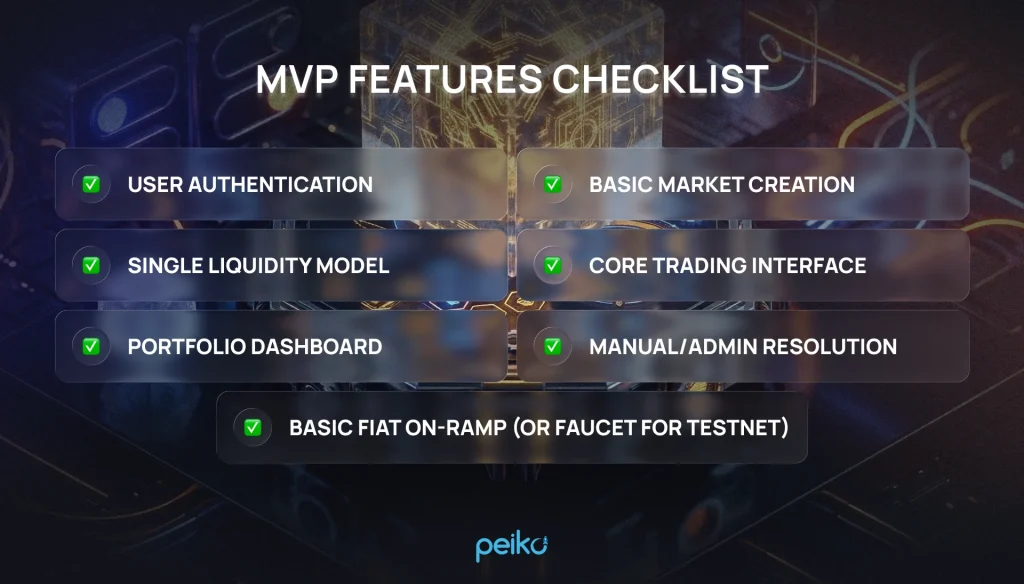
MVP Features Checklist
If you are planning your prediction market app development, your initial launch should strictly focus on these essential capabilities:
- User Authentication: Email/password for Web2, or basic wallet connection (MetaMask/WalletConnect) for Web3.
- Basic Market Creation (Admin Only): Only administrators can create markets to ensure quality control.
- Single Liquidity Model: Start with an AMM (like CPMM) to guarantee liquidity, avoiding the complexities of a matching engine.
- Core Trading Interface: Simple “Buy Yes / Buy No” interface with implied probability display.
- Portfolio Dashboard: A screen where users can view their active positions, historical trades, and current ROI.
- Manual/Admin Resolution: For MVP, rely on an admin multisig to resolve markets, bypassing complex oracle integrations until product-market fit is proven.
Basic Fiat On-Ramp (or Faucet for Testnet): A simple Stripe integration (Web2) or a connection to a service like MoonPay (Web3).
What can be excluded from MVP:
For version 1.0, don’t make a central limit order book, a user-generated market, complicated margin trading, secondary token utility, or fully decentralized autonomous organization (DAO) governance.
Timeline
A standard timeline for a high-quality MVP developed by an experienced team looks roughly like this:
- Month 1: Discovery & Architecture: Defining the prediction market liquidity model, database schemas, and writing the technical specification.
- Month 2: Backend & Smart Contracts: Developing the core matching engine or writing and testing the solidity contracts.
- Month 3: Frontend & API Integration: Building the prediction market app UI UX design and connecting it to the backend via WebSockets.
- Month 4: Audits & Testing: Extensive QA, load testing the trading engine, and mandatory third-party security audits for smart contracts.
- Month 5: Beta Launch: Releasing to a closed group of testers to monitor liquidity behavior and UI friction.
Monetization & Revenue models for prediction market apps
A prediction market platform only becomes a real business once it has a sustainable way to generate revenue beyond development spend. The right model depends heavily on whether you’re running a centralized or decentralized platform.
Common Revenue Streams
- Trading fees: A small percentage taken from every settled trade or built into the spread — the most common model across both AMM and order book platforms.
- Market creation fees: Especially relevant for permissionless or DAO-governed platforms, where anyone can propose a new market and pays a fee to do so.
- Settlement or withdrawal fees: A flat or percentage-based fee charged when users cash out winnings.
- Premium data access: Selling aggregated market sentiment or historical odds data via API to third parties like researchers, hedge funds, or media outlets.
- Native token incentives: Platforms with their own token can reward liquidity providers and early users, aligning growth with token value rather than direct fees.
Choosing the Right Model
Centralized platforms typically capture revenue directly through fees since they control the full user experience. Decentralized platforms often rely more on token-based incentives and DAO treasury mechanisms, since heavy fee extraction can push liquidity toward competing protocols. Either way, fees need to stay competitive enough to attract volume while still covering infrastructure, audit, and compliance costs.
Revenue vs. Compliance Trade-offs
The monetization model you choose isn’t just a business decision — it affects legal exposure. A platform that takes a “rake” on winning positions can look more like a betting operator to regulators than one earning revenue from flat data or subscription fees. This is worth weighing carefully before you finalize pricing, which leads directly into the compliance considerations below.
Compliance Notes (2026)
Disclaimer: This section does not constitute legal advice. Always consult with a legal advisor specializing in financial regulations in your target jurisdictions.
The rules for prediction market app 2026 projects are very strict and closely watched. Prediction markets occupy a legally ambiguous space across jurisdictions, with licensing treatment varying widely by country. Regulatory bodies often think of prediction markets as gambling, trading derivatives, or binary options.
High-Level Legal Risks:
In many places, including the United States, running an illegal prediction market where people can bet on political outcomes or real-world events is the job of agencies like the CFTC (Commodity Futures Trading Commission). In a regulated market, platforms must either ask for specific “No-Action” relief, sign up as a Designated Contract Market (DCM), or only let users in certain areas access their services. This is especially relevant to political betting, which faces added scrutiny and different restrictions across jurisdictions, including the us market.
KYC / AML Integration:
No matter if your architecture is Web2 or Web3, you need to follow strict Know Your Customer (KYC) and Anti-Money Laundering (AML) rules when dealing with real money. In most regulated markets, regulatory compliance requires identity verification during onboarding, along with ongoing AML monitoring. Your prediction market software needs to work with third-party compliance services like Sumsub or Onfido to check user identities, check against global sanctions lists, and keep an eye on transaction patterns for anything that looks suspicious.
Even decentralized prediction market apps are increasingly utilizing “Permissioned DeFi” models, where smart contracts check a user’s wallet address against an on-chain KYC registry before allowing them to interact with the liquidity pools.
Conclusion
Final Thoughts
Building a prediction market app is a thrilling mix of behavioral economics, financial engineering, and cutting-edge software development. You can build a platform that really uses the wisdom of the crowd by carefully designing your market engine, picking the right prediction market liquidity model, making sure that oracles work together smoothly, and putting the user interface and experience of your prediction market app at the top of your list.
The prediction market space is growing up quickly in 2026. Teams that come up with new ways to improve the user experience, make sure that technical security is rock solid, and plan ahead when it comes to compliance will be the ones who succeed in their own right.
Need help building a prediction market app?
Building a strong platform requires deep industry knowledge, whether you’re a startup founder trying to shake up the Web3 space or a business leader looking into internal forecasting tools. If speed and early validation matter, a clone script can also be a practical starting point before expanding beyond popular prediction market platforms. Let’s get in touch to talk about your architecture, improve your liquidity strategy, and make your vision a reality. Send this article to your tech team and start making plans for your technical roadmap today!
No comments yet. Be the first to comment!