


















Building a SaaS backend is always a huge decision for people who start companies and lead engineering teams. The backend framework you pick affects how fast you can develop, how well the system scales, how easy it is to maintain and what you pay for infrastructure in the run.
In recent years, the debate around Node.js vs Nest.js has become increasingly relevant for SaaS companies. Both technologies rely on the same JavaScript runtime, yet they approach backend architecture in very different ways.
For startups and enterprise SaaS teams evaluating the best backend framework for SaaS, understanding these architectural differences is essential.
In this article, we’ll compare:
- Core architectural differences
- Microservices readiness
- TypeScript and developer productivity
- Performance and real-time capabilities
- Enterprise maintainability
This Node.js architecture comparison will help SaaS founders and CTOs determine the right technology stack for their product.
Node.js vs Nest.js—Core Differences Explained
When discussing Node.js vs Nest.js, it’s important to clarify that these technologies operate at different levels of abstraction.
Nodejs vs Nestjs: What is Node.js?
Node.js is a JavaScript runtime environment built on Chrome’s V8 engine. It allows developers to run JavaScript on the server and build scalable backend services.
Key characteristics:
- Event-driven architecture,
- Non-blocking I/O model,
- Lightweight runtime,
- Large ecosystem of libraries.
Node.js is commonly used for:
- Node js API development,
- Real-time applications,
- Streaming platforms,
- SaaS backends.
However, Node.js itself does not impose any architectural structure. Developers must choose frameworks such as Express, Fastify, or build custom architectures.
What is Nest.js?
Nest.js is a progressive backend framework built on top of Node.js, providing a structured architecture inspired by Angular.
It was specifically designed for enterprise level applications and other complex server side applications.
Key characteristics:
- Built-in TypeScript support,
- Nest.js modular architecture,
- Dependency injection,
- built in support for REST, GraphQL, WebSockets, and microservices,
- testing tools support.
Unlike Node.js alone, Nest.js enforces clear architectural patterns, making it ideal for enterprise applications and complex SaaS systems.
Framework vs Runtime
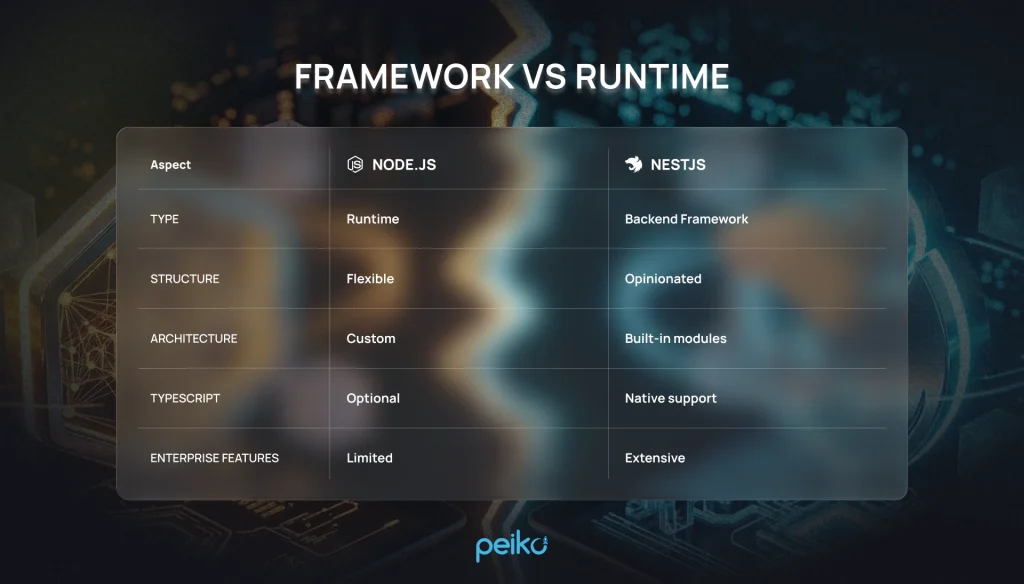
In short: Node.js gives you a blank canvas — maximum flexibility, but no built-in structure. Nest.js gives you that structure out of the box, on top of the same runtime. That single distinction — runtime vs. framework — is the root of almost every other difference covered in this guide
These key differences capture the technical difference in node.js vs Nest.js and explain the distinction at the core of the Node.js vs nestjs debate.
Opinionated vs Flexible
The biggest conceptual difference between the two technologies is flexibility versus an opinionated framework layer built on top of the runtime.
Node.js approach:
- Developers design architecture from scratch,
- Maximum flexibility,
- Risk of inconsistent codebases.
Nest.js approach:
- Enforces patterns,
- Modular architecture,
- Clean structure for larger teams,
- Better code quality over time.
For growing SaaS teams, these architectural constraints often improve long-term maintainability as the project grows, even if the learning curve is steeper.
Architecture Comparison: Flexibility vs Structure
The architecture layer is where the key differences between Node.js and Nest.js — including the runtime-versus-framework distinction — become most important for SaaS platforms.
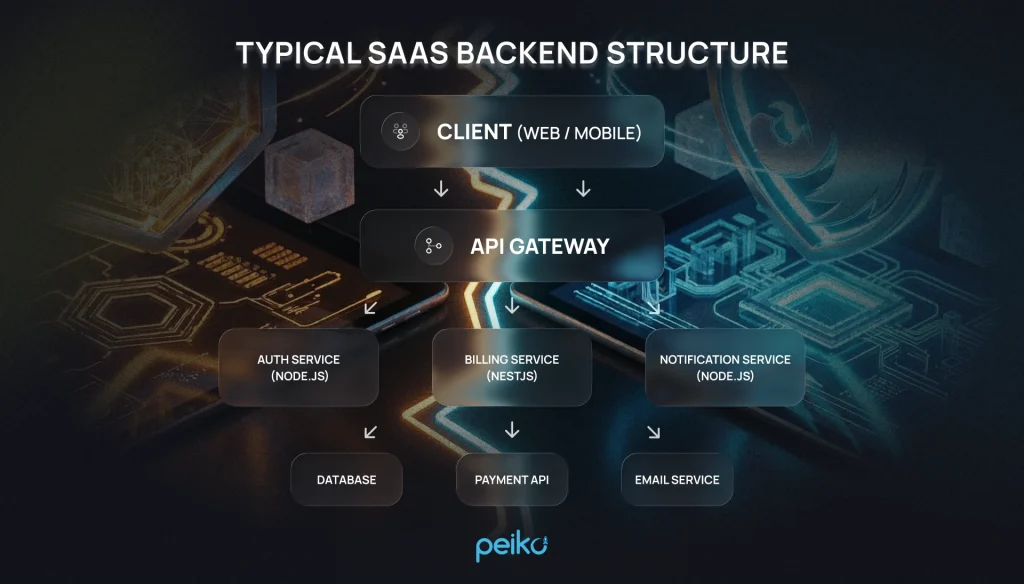
In a modern SaaS platform, Node.js services often handle lightweight APIs and real-time communication, while Nest.js modules structure complex business logic and microservices interactions, which is why the Node.js vs Nest.js debate usually centers on scale and maintainability.
Node.js Modular Approach
In this Node.js architecture comparison, developers must manually organize controllers, services, routes, and middleware to maintain clarity, scalability, and separate concerns.
Node.js itself provides no predefined application structure.
Typical architecture includes:
- Controllers
- Services
- Routes
- Models
- Middleware
Developers manually organize these components and choose libraries based on project needs.
| Advantages | Disadvantages |
| Full architectural freedom | Codebase fragmentation, |
| Lightweight services | Harder scaling with large teams as the project grows |
| Rapid prototyping | Lack of architectural consistency and code quality |
Nest.js Modular Architecture
Nest.js introduces a strict module-based architecture, whereas with Node.js developers manually separate concerns across controllers, services, routes, and middleware, and teams must choose libraries and conventions themselves.
Core components include:
- Module
- Controllers
- Providers (Services)
- Guards
- Interceptors
- Pipes
These built in features also support stronger dependency management, which helps keep large applications scalable and maintainable. This Nest.js modular architecture provides a predictable structure for large applications.
Dependency Injection
One of the most powerful features of Nest.js is dependency injection (DI).
Benefits:
Better testability,
Loose coupling,
Easier refactoring,
Clean service layering.
Node.js frameworks like Express don’t provide DI natively — developers have to wire dependencies manually or bring in a separate library. Nest’s built-in dependency injection removes that setup entirely, which is one of the main reasons teams find it easier to test and maintain large codebases over time.
Layered Architecture
Nest.js encourages clean architecture principles: Controllers → Services → Repositories → Database.
This layered structure helps maintain separation of concerns in large SaaS systems and supports a scalable architecture as applications grow.
Below you find the Architecture Comparison:
| Feature | Node.js | Nest.js |
| Architecture style | Custom | Modular |
| Dependency Injection | Manual | Built-in, making testing and maintenance life easier |
| Code structure | Flexible | Opinionated |
| Scalability for large teams | Medium | High |
| Enterprise readiness | Limited | Strong |
| Microservices support | Custom implementation, often requiring additional setup | Native |
| Event-driven architecture | Strong | Strong |
| Service structure | Flexible | Modular |
| Scaling large systems | Moderate complexity | Simplified |
Modern web application architecture layers
| Component | Main responsibility | Typical technologies |
|---|---|---|
| Frontend | User interface and client interaction | React, Vue, Angular |
| API layer | Communication between clients and backend | REST, GraphQL, API Gateway |
| Backend | Business logic and application processing | Node.js, Python, Java, .NET |
| Database | Persistent application data | PostgreSQL, MySQL, MongoDB |
| Cache | Reduce database and application load | Redis |
| Message broker | Asynchronous communication | Kafka, RabbitMQ, SQS |
| Object storage | Files and large unstructured data | Amazon S3, Azure Blob Storage |
| CDN | Deliver static and cached content closer to users | CloudFront, Cloudflare |
| Observability | Monitoring, logs, traces, alerts | OpenTelemetry, Grafana, cloud tools |
| Infrastructure | Hosting, networking and scaling | AWS, Azure, Google Cloud, Kubernetes |
Microservices & Scalability for Large Scale Applications and SaaS Platforms
In today’s reality, SaaS products rarely remain monolithic for a long time.
As platforms outgrow with new features and integrations, systems are pushed toward microservices architectures. Things obviously have to change to handle all the new features and demands. Independent services handle specific business functions.
In those situations, microservices Node.js implementations have become a popular choice due to Node.js’s lightweight runtime, strong performance in asynchronous environments, and excellent support for high-concurrency workloads. Combined with structured frameworks like Nest.js and clean architecture principles that support a scalable architecture, these are powerful tools that help engineering teams build robust, maintainable backends for rapidly growing SaaS platforms.
Choosing between Node.js and Nest.js can impact your SaaS platform’s scalability, development speed, and long-term maintainability.
Our backend architects help SaaS founders and CTOs design scalable infrastructures using Node.js microservices and Nest.js enterprise frameworks.
Node.js Microservices Architecture
Node.js microservices are a perfect fit for distributed SaaS systems thanks to Node.js’s event-driven, non-blocking I/O model. Instead of building one large, monolithic backend, the system is divided into smaller, independent services such as authentication, billing, notifications, analytics, or user management. Each service runs on its own and communicates with others through APIs or message queues.
In practice, these services “communicate” using REST APIs, gRPC, or message brokers like Kafka or RabbitMQ. This setup makes it easy for teams to deploy and scale individual services independently, handling more traffic without slowing down the rest of the system. Node.js’s fast startup times and low memory footprint per instance also make it a strong fit for cloud-native microservices, where services are frequently spun up, scaled, and torn down on demand.
Nest.js Microservices Architecture
Since Nest.js runs on Node.js, it inherits the same non-blocking execution model — but adds native abstractions for microservices on top. This lets developers implement message-based communication patterns with far less boilerplate code than building the same setup directly on Node.js.
Nest.js supports multiple transport layers such as Redis, RabbitMQ, Kafka, NATS, and MQTT, making it easier to integrate services across complex infrastructures and handle multiple connections. Its modular architecture and built-in dependency injection help teams organize code clearly, which becomes especially valuable when multiple developers are working on interconnected services and when new developers need clearer onboarding. As a result, Nest.js is often favored for large SaaS platforms that require structured scalability and long-term maintainability, while simpler systems like chat apps or other lightweight applications may not need the same level of framework structure. Under real world load, that organization also helps teams manage performance more predictably.
Event-Driven Systems
Event-driven architecture plays a crucial role in scalable SaaS backends. Rather than forcing services to talk to each other directly, the system uses events to trigger actions across different components, keeping everything flexible and responsive.
For example, when a user registers on a platform, the authentication service can emit an event that triggers multiple downstream processes, such as sending a welcome email, updating analytics systems, or synchronizing with CRM tools. Both Node.js and Nest.js support event-driven patterns effectively, but Nest.js provides more structured tooling for handling events, making large asynchronous workflows easier to manage.
Scalable Backend for Startups
When startups begin building a scalable backend, the choice between Node.js and Nest.js often depends on team size and project maturity. Smaller teams frequently choose Node.js with lightweight frameworks because it offers maximum flexibility and rapid development speed, which is ideal for MVPs and early experimentation.
As SaaS platforms grow and development teams expand, frameworks like Nest.js become increasingly valuable. Their structured architecture, strong TypeScript support, and modular design help maintain consistency across large codebases. This makes Nest.js a strong option for startups transitioning into growth stages where scalability, maintainability, and team collaboration become critical priorities.
| Aspect | Node.js | Nest.js |
| Typical Microservices Stack | API Gateway, Auth Service, Billing, Notification, Analytics | Same stack with built-in microservice abstractions |
| Communication Protocols | REST, gRPC, Kafka/RabbitMQ | REST, gRPC, Kafka, RabbitMQ, Redis, NATS, MQTT |
| Event Handling | Supported via custom implementation | Structured tooling for event handlers |
| Message Brokers | Manual integration | Built-in transports |
| Service Discovery | Manual | Built-in patterns |
| Event-Driven Systems | Effective for async systems | Structured for large-scale async systems |
Web Application Architecture Trends in 2026
Web application architecture in 2026 is moving toward more modular, cloud-native, and event-driven systems. However, modern architecture does not mean that every application should become a collection of microservices. The most effective approach is to combine architectural patterns according to actual product requirements.
Modular monoliths are increasingly practical for new products because they allow teams to maintain clear domain boundaries while avoiding the operational complexity of distributed systems. A modular architecture can later be split into independent services when scaling or organizational requirements justify the change.
Microservices remain relevant for large systems where business capabilities need to be deployed, owned, or scaled independently. They are particularly useful for organizations with multiple engineering teams, but they introduce additional requirements for observability, deployment automation, networking, service communication, and distributed data management.
Event-driven architecture is increasingly important for asynchronous workflows such as notifications, payments, order processing, analytics, and integrations. Instead of requiring every operation to happen synchronously, services can publish and consume events through a message broker.
Serverless computing is another important option for workloads with variable traffic, event-driven processing, scheduled jobs, and lightweight APIs. Serverless does not eliminate servers; it shifts infrastructure management to the cloud provider and changes how applications are deployed and billed.
Containers and Kubernetes remain important for organizations running complex distributed workloads. Kubernetes provides mechanisms for deploying, scaling, managing, and observing containerized applications, but its operational complexity means it should be introduced when the organization actually needs that level of control.
Finally, AI-enabled functionality is becoming part of the application architecture itself. Products may now include AI APIs, retrieval systems, vector databases, model gateways, or agentic workflows alongside conventional application services. This means architecture teams increasingly need to consider AI inference costs, data access, model security, latency, and observability alongside traditional backend concerns.
Which architecture pattern fits which project?
| Project requirement | Recommended starting point | Why |
|---|---|---|
| MVP or early-stage product | Modular monolith | Faster development and lower operational complexity |
| Standard SaaS application | Modular monolith | Good balance of speed, structure and scalability |
| Large enterprise platform | Modular monolith or microservices | Depends on team and domain complexity |
| Independent team ownership | Microservices | Teams can deploy services independently |
| Event-heavy workflows | Event-driven architecture | Decouples producers and consumers |
| Highly variable traffic | Serverless | Infrastructure scales with demand |
| Complex containerized platform | Kubernetes | Advanced orchestration and workload management |
| Real-time application | Event-driven + WebSockets | Supports asynchronous updates and live communication |
| AI-powered application | Hybrid architecture | Combines conventional backend services with AI infrastructure |
Developer Productivity & TypeScript Support
Developer productivity is an important factor when choosing a TypeScript backend framework for SaaS platforms. Both Node.js and Nest.js support TypeScript, but they approach it differently, which affects development speed, collaboration, and long-term maintainability.
Nest.js TypeScript-First Approach
Nest.js was designed as a TypeScript backend framework, with TypeScript deeply integrated into its architecture. Strong typing, decorators, and dependency injection help create clear contracts between modules and services. This improves IDE support, reduces runtime errors, and keeps large codebases organized.
The framework continues to evolve quickly: NestJS 11, released in early 2026, replaced the traditional TypeScript transpiler with SWC and added first-class Vitest support, meaningfully cutting build and test times for large codebases. NestJS 12, expected later in 2026, goes further with a move to ESM, a redesigned CLI, and Rspack replacing webpack — signs that the framework is actively investing in developer experience rather than standing still.
Node.js + TypeScript Flexibility
Node.js supports TypeScript through tools like ts-node, Babel, or build pipelines. This flexibility enables developers to adopt TypeScript gradually without strict architectural constraints and improve type safety through strong typing and clear contracts. However, because conventions are not enforced, projects can become inconsistent as they grow.
Long-Term Maintainability
As SaaS systems expand, technical debt and inconsistent APIs can become problems. Frameworks like Nest.js help address this through modular architecture, dependency injection, and structured project organization, making long-term maintenance easier.
Performance & Real-Time Capabilities
When comparing Node and Nest.js, performance is a widely debated topic. Both share the same runtime and therefore similar performance characteristics, though.
Event Loop
To process asynchronous operations efficiently, Node.js uses a single-threaded event loop. Instead of blocking threads, it perfectly handles multiple tasks simultaneously which makes it ideal for API-heavy systems.
High Concurrency
The non-blocking architecture allows Node.js to handle asynchronous work in a server side environment and support thousands of concurrent connections, making it a good fit for high performance applications like chat platforms, collaboration tools, streaming services, and SaaS dashboards, as well as simple APIs.
API Performance
In most cases, API performance depends more on database optimization, caching, and infrastructure design than on the framework itself. Since Nest.js runs on Node.js, raw performance differences are minimal.
Express vs Nest.js: Is There a Clear Winner?
The Nest.js vs Express comparison is common because Express is the most widely used Node.js framework, while Nest.js offers a more structured approach. When comparing Nest.js vs Express, understanding team size, project complexity, and architecture needs is essential.
When Express Makes Sense
Express is ideal for small APIs, prototypes, and MVPs. Its lightweight design and flexibility allow developers to build services quickly with minimal overhead.
When Nest.js Is Superior
In large SaaS systems, Nest.js vs Express comparison shows that Nest.js offers modular architecture, dependency injection, and better maintainability.
Enterprise Readiness
Nest.js usually has the advantage in enterprise environments. Its structured architecture and dependency injection ease usage for large teams to collaborate on complex systems.
Which Is the Best Backend Framework for SaaS?
The best backend framework for SaaS depends on the stage of the product and the size of the engineering team.
| SaaS Stage / Use Case | Node.js | Nest.js |
| Early-Stage Startup (MVP) | Fast prototyping, lightweight APIs, real-time platforms | Less suited due to architecture overhead |
| Growing SaaS | Moderate, requires custom microservices | Ideal: modular, maintainable, supports scaling teams |
| Enterprise SaaS | Limited support for complex domain logic | Ideal: strict architecture, dependency injection, modules, maintainable codebase |
| TypeScript Support | Optional (via ts-node, Babel, build pipelines) | TypeScript-first, enforced, better IDE support |
| Long-Term Maintainability | Risk of technical debt, inconsistent APIs | Reduced technical debt, structured refactoring, strong contracts |
| Performance & Real-Time Capabilities | High concurrency, non-blocking I/O | Similar (runs on Node.js), added structure benefits large systems |
| Ideal Platforms | Real-time apps: chat, collaboration, streaming | Large SaaS systems, microservices platforms, enterprise teams |
How to Choose a Web Application Architecture in 2026
Choosing a web application architecture should start with the product rather than the technology. There is no universally best architecture: a solution that works for a global marketplace may be unnecessary for a small SaaS MVP.
Start by defining the expected workload. Estimate the number of users, concurrent requests, data volume, real-time requirements, and expected traffic growth. These numbers help determine whether a simple application can scale horizontally or whether individual components need independent scaling.
Next, evaluate the complexity of the business domain. If the product has a limited number of workflows, a modular monolith can provide a clean architecture without the overhead of distributed services. If the system contains many independently evolving domains, microservices may become more appropriate.
The development team’s size and experience are equally important. Microservices require more infrastructure, monitoring, deployment automation, service communication, and operational expertise than a monolithic application. The architecture should therefore match the team’s ability to build and operate it.
Security and compliance should also influence architectural decisions from the beginning. Applications handling payments, healthcare information, personal data, or other sensitive information may require stronger isolation, encryption, access controls, audit logging, and infrastructure controls.
Finally, consider the total cost of ownership. An architecture that is inexpensive to develop may become expensive to operate, while an overly distributed architecture can increase infrastructure and engineering costs before the product needs it.
The best architecture in 2026 is usually the simplest architecture that satisfies the current requirements and provides a realistic path to scale.
| Question | If the answer is “yes” | Possible architectural direction |
|---|---|---|
| Is the product still validating its MVP? | Requirements change frequently | Modular monolith |
| Do different domains need independent scaling? | Yes | Microservices |
| Does the system process many asynchronous events? | Yes | Event-driven architecture |
| Does traffic vary dramatically? | Yes | Serverless or elastic cloud infrastructure |
| Are there multiple engineering teams? | Yes | Modular architecture or microservices |
| Does the application require real-time updates? | Yes | WebSockets + event-driven backend |
| Does the product handle sensitive data? | Yes | Security-first architecture with strong isolation |
| Does the platform run many containers? | Yes | Kubernetes may be appropriate |
When to Choose Node.js for SaaS
Node.js is a strong choice for SaaS platforms that require flexibility and rapid development. Teams that prefer building a custom architecture from the ground up often choose Node.js because it allows full control over system design and technology choices.
It is also ideal for lightweight APIs and smaller services where minimal framework overhead helps maintain speed and simplicity. Additionally, Node.js performs exceptionally well for real-time platforms such as chat applications, collaboration tools, and streaming systems thanks to its event-driven, non-blocking architecture.
When to Choose Nest.js for Enterprise SaaS
Frameworks like Nest.js are particularly well-suited for enterprise apps, where structure and maintainability are essential. Large development teams benefit from Nest.js’s modular architecture and built-in dependency injection, which help keep projects organized and consistent across multiple contributors.
Nest.js also excels when applications involve complex domain logic, such as billing systems, analytics engines, workflow automation, and integrations with multiple external services. With its TypeScript-first approach and structured architecture, Nest.js ensures long-term maintainability for large and evolving SaaS platforms.
How We Help US SaaS Companies Build Scalable Backends
Building a reliable SaaS backend requires more than choosing the right framework. It involves designing an architecture that supports scalability, microservices growth, and long-term maintainability.

For over 9 years, the Peiko team has been working closely with US companies through time- zone-aligned collaboration, secure enterprise workflows, and scalable engineering support.
Our team helps US SaaS companies build production-ready backend platforms through:
- SaaS architecture design tailored for scalability,
- Microservices implementation for distributed systems,
- Node.js and Nest.js backend development,
- Dedicated backend engineering teams.
Hire Node.js or Nest.js Backend Experts and build a backend that scales with your product!
No comments yet. Be the first to comment!