
















Imagine building a skyscraper without an initial plan. Likely, you might have a general idea, for example, “glass exterior and eighty floors,” but once the foundation is poured, you realize the general utilities are not provided properly: plumbing is in the wrong place, the elevators don’t fit the shafts, and you’ve run out of budget during the building of the tenth floor. In the world of building digital products, this chaotic scenario is exactly what happens when the proper pre-development Discovery is neglected.
For startups and enterprises, the roots of the difference between a successful product launch and a costly failure often lie in the preparation. The Discovery phase in software development is the critical preparation: a period of intensive research, planning, and alignment that bridges the gap between a vague idea and a concrete plan of action.
In this comprehensive guide, we will unpack the meaning of the Discovery phase, exploring why it is the single most effective risk-reduction tool in project management and business analysis. Let’s go through the step-by-step process, break down the costs and timelines, and provide you with a checklist of deliverables that ensure your project is ready for development.
Whether you are a startup founder looking to validate an MVP or a corporate leader planning a complex digital transformation of your product, this article is your blueprint.
What is the Discovery phase?
The Discovery phase is the preliminary stage of the software development lifecycle (SDLC) dedicated to information gathering, technical analysis, and user research. It is the period where the project team and the stakeholders come together to answer the most fundamental questions about the future product.
At its core, the meaning of this stage revolves around “clarity.” It is the process of translating high-level business goals into a detailed, technical roadmap.
As noted in our internal frameworks, the software development Discovery is designed primarily to help stakeholders understand and realize their own goals. It is common for a Client to come with a solution in mind (e.g., “I need an app like Uber”), but the pre-development stage digs deeper to find the problem that needs solving.
During this phase, we act as detectives. We don’t just ask “what features do you want?” We ask:
- What exactly are we building?
- How should it work technically and logically?
- Where will it operate (web, mobile, specific environment)?
- Who is it for (target audience definition)?
- Why does the market need this solution now?
This stage transforms uncertainties into a validated backlog, ensuring that when the developers write the first line of code, they are building the right thing. It shifts the project trajectory from the assumptions-based development to the evidence-based development.
The Bridge Between Business and Tech
Think of this pre-development stage as a bridge. On one side, you have the Business Stakeholders, who speak in terms of ROI, market share, and User acquisition. On the other side, you have the Development Team, who speak in terms of APIs, database schemas, and latency.
Without a proper preparation stage, these two groups often talk past each other. The Discovery phase of a project places a translator (Business Analyst) in the middle to ensure that a “fast User experience” request is translated accurately into clear requirements (e.g., page load time under 2 seconds).
Why it matters: The economics of risk reduction
Why spend 2 to 4 weeks planning when the coding can be launched immediately? This is a common objection, especially in fast-paced startup environments where “speed to market” is the mantra. However, skipping the Discovery phase is a false economy approach.
The cost of the bug fixes, logic errors, or misunderstood requirements during the design phase is roughly 10-100 times lower than fixing them after the product has been developed. If you find out that your architecture cannot support your User load after launch, you are facing a complete rewrite, not just a patch.
Here is why this phase is non-negotiable for mature organizations:
1. Risk Mitigation
Software development is potentially risky. There are technical risks (e.g., “Can this third-party API handle our data?”), market risks (e.g., “Do users really need this feature?”), and operational risks (e.g., “Do we have the admin tools to manage and scale this?”). Discovery identifies these pitfalls early. For example, if we are building a Fintech app, we need to know the KYC/AML compliance requirements before we design the database. Discovering a regulatory hurdle three months into development can kill a project.
2. Budget Accuracy
Without a detailed scope, any cost estimate is just a guess. In the industry, we call this the “Cone of Uncertainty.” At the start of a project, estimates can vary by 400%. The Discovery phase project management approach allows for a precise estimation, often narrowing the margin of error to 10-20%. It moves the budget conversation from “It might cost between $50k and $100k” to “The MVP scope will cost $72k.”
3. Unified Vision
It aligns the Stakeholders (who care about revenue), the Designers, and the Developers onto the same page. When everyone agrees on the “Definition of Done” before starting, friction during development is significantly reduced.
4. Investor Readiness
For startups, a completed Discovery phase with professional documentation increases the chances of securing funding. It shows investors you have a plan, not just a dream, and demonstrates operational maturity.
The Discovery Phase Process: a Step-by-Step Guide
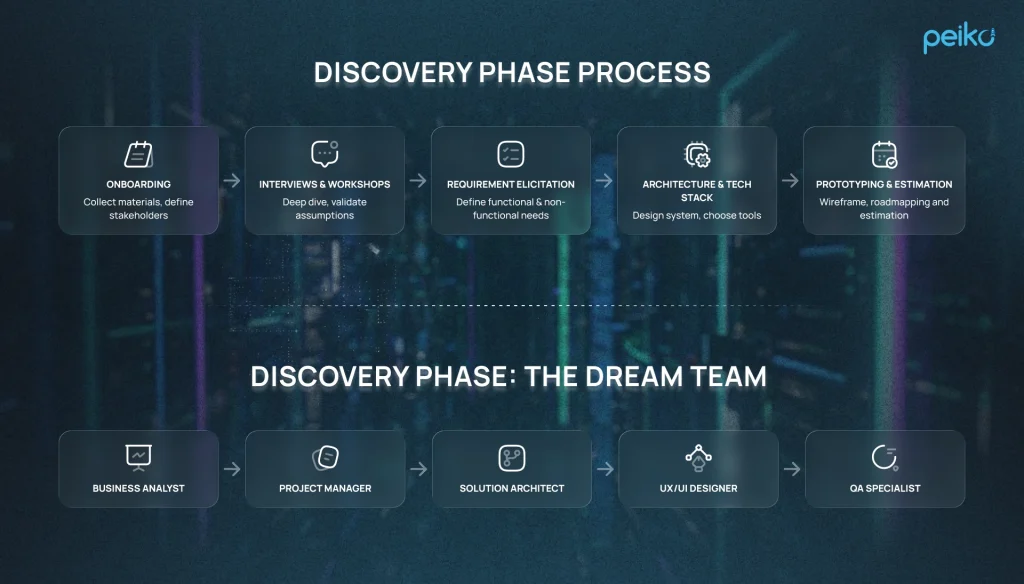
At Peiko, we approach the Discovery phase as an iterative funnel, guiding ideas from broad concepts to validated, actionable outcomes. We start wide with abstract ideas and narrow down to specific technical requirements. While every project is unique, the core methodology follows a proven path.
Step 1: Onboarding and Knowledge Transfer
The beginning is often the most complex stage. We start by collecting all existing materials: this could be a pitch deck, a rough vision document, competitor links, or even a napkin sketch.
- The Goal: The Project Manager (PM) and Business Analyst (BA) immerse themselves in the client’s domain.
- The Action: We set up the communication channels, define the stakeholders, and review any legacy code or existing documentation. We identify the “known unknowns.”
Step 2: Stakeholder Interviews & Workshop
This is where the deep dive happens. The BA leads a series of workshops to extract information. We move beyond surface-level requests to understand the business logic. We explicitly define the “To-Be” state of the system. We validate hypotheses and challenge assumptions.
Step 3: Requirement Elicitation (Functional & Non-Functional)
This is the core of the BA’s work. We categorize requirements into two buckets:
Functional Requirements (FRs): What the system must do. Examples:
- “The system shall allow users to log in via Google.”
- “The system shall generate a monthly PDF invoice.”
- “The system shall calculate shipping costs based on weight.”
Non-Functional Requirements (NFRs): How the system must behave. This is often where projects fail if ignored. As per our internal quality standards, we define metrics such as:
- Performance: The product must ensure a response time of no more than 1 second for main operations.
- Throughput: The system must support at least 1000 requests per second.
- Load Time: Page load time must not exceed 2 seconds under standard load conditions.
- Scalability: The system shall handle a spike from 1,000 to 100,000 Users during a marketing campaign.
Defining these requirements helps the team to understand the “quality” of the code required, not just the features.
Step 4: Solution Architecture & Tech Stack Selection
While the BA focuses on logic, the Solution Architect evaluates the best tools for the job.
- Monolith vs. Microservices: Do we need a complex microservice architecture, or will a modular monolith suffice for the MVP?
- Tech Stack: React vs. Angular? Python vs. Node.js? AWS vs. Azure?
- Third-Party Integrations: We evaluate APIs (Stripe, Google Maps, Twilio) to ensure they fit the budget and technical constraints.
Step 5: UX/UI Prototyping
Simultaneously, the Designers create low-fidelity wireframes to visualize user flows. This allows stakeholders to “click through” the application logic before it exists visually.
- Why this helps: It is much cheaper to move a button on a wireframe than to move a database column in code. This step validates the “usability” of the requirements.
Step 6: Estimation and Roadmapping
Once the scope is defined (the backlog) and the design is visualized (the wireframes), the team can provide a granular estimate. We break the project into Sprints or milestones, attaching hours and costs to each feature.
The Dream Team: Who is involved
The quality of this step depends entirely on the expertise of the team. A junior team can gather requirements; a senior team can uncover hidden requirements. The team composition typically includes:
- Business Analyst (BA): The driver of the project at this stage. The BA bridges the business and technical worlds, documenting requirements and managing the scope. They are responsible for asking all the “why” questions.
- Project Manager (PM): Manages the timeline, resources, and client communication. They ensure the Discovery stays on track and doesn’t turn into “analysis paralysis.”
- Solution Architect / Tech Lead: Involves Frontend (FE) and Backend (BE) Leads to validate feasibility, estimate technical complexity, and design the architecture. They ensure that what the BA documents is actually buildable.
- UX/UI Designer: Visualizes the requirements into user flows and wireframes. They champion the user’s perspective.
- QA Specialist: Often overlooked, but crucial. The QA reviews documentation early to ensure requirements are testable and logical. If a requirement cannot be tested, it cannot be built reliably.
Note: If the BA defines a need for specific expertise (e.g., a blockchain expert for a Web3 project or a security specialist for a fintech app), they communicate this need to allocate resources.
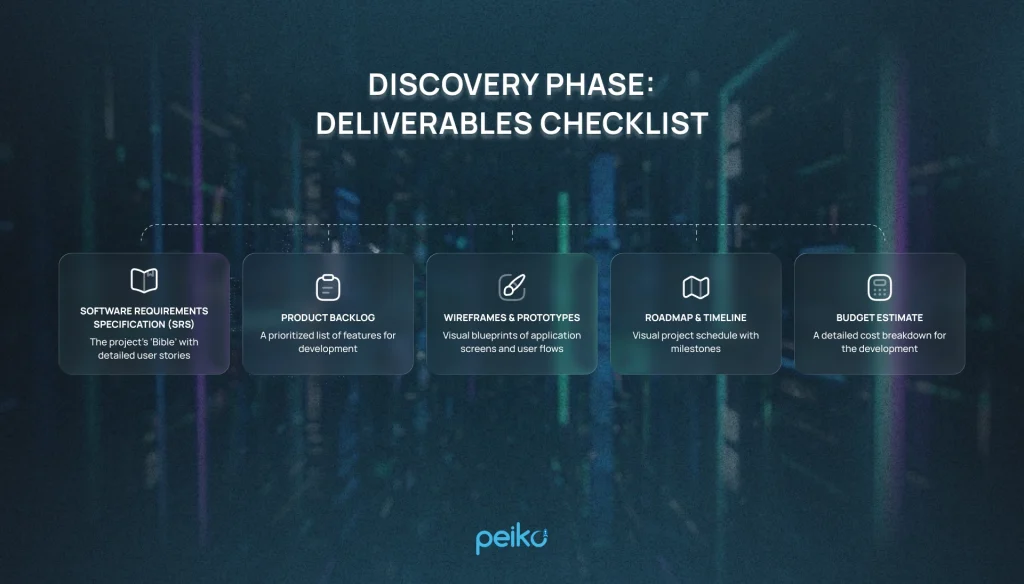
Discovery phase deliverables checklist: What do you actually get?
A successful Discovery phase project management effort results in a package of tangible artifacts. These are the documents that you will own. Even if you decide not to proceed with the same vendor, these documents can be used to build the software with any competent development team.
- Software Requirements Specification (SRS): The “Bible” of the project. It contains a comprehensive description of the product from both technical and product perspectives. It details every user story, acceptance criteria, and logic rule.
- Product Backlog: A prioritized list of features, essential for Agile/Scrum development planning.
- Wireframes and Prototypes: Visual blueprints of the application screens, showing layout and navigation without the distraction of colors and branding. This defines Information Architecture.
- Architecture Design Document: A high-level technical diagram showing the server structure, database relationships, cloud infrastructure, and third-party integrations (APIs).
- Roadmap & Timeline: A realistic Gantt chart or timeline for the development phase, broken down by milestones (MVP, V1, V2). It answers “When can we launch?”
- Budget Estimate: A detailed cost breakdown for the development phase, usually with a high degree of accuracy.
Important Nuance: The result isn’t always a full SRS. Depending on the project, it might be a Technical Assignment (TA), a backlog, or just diagrams and mockups. Everything depends on the specific project needs and the methodology.
Timeline: How long should a Discovery phase take?
The Discovery phase timeline in software development varies depending on the complexity of the project and the availability of stakeholders. Generally, it falls into the 1 to 4 weeks range.
Small Projects (1-2 weeks)
- Context: Simple MVP, landing page with logic, or a specific feature addition.
- Focus: Quick requirement gathering, basic wireframing, and estimation.
- Output: Lean Canvas, Backlog, rough estimate.
Medium Projects (2-3 weeks)
- Context: Standard mobile apps (e.g., e-commerce, social), SaaS platforms, or internal tools.
- Focus: Detailed workshops, full SRS documentation, clickable prototypes, and architecture design.
- Output: Full SRS, Wireframes, precise budget.
Large Enterprise Projects (4+ weeks)
- Context: Complex ecosystems (e.g., Banking software, ERPs, Healthcare systems with HIPAA compliance).
- Focus: Deep technical research, legacy system analysis, multiple stakeholder alignment sessions, and extensive security auditing.
- Output: Detailed Technical Specification, Security Plan, Migration Strategy.
Efficiency Tip: The key to keeping the timeline efficient is “iterative approvals.” We don’t wait until the end to show you the work. We obtain feedback and approvals regularly, often reviewing the SRS in parts.
Cost Breakdown: Investment vs. Expense
How much does the Discovery phase cost? While exact figures depend on hourly rates and region, it is best to view the cost as a percentage of the total project budget: typically 10% to 15%.
The cost is driven by the number of specialists involved and the duration. A standard breakdown of billable hours might look like this for a typical 3-week Discovery:
- Business Analyst: 60-80 hours (The heavy lifter: interviews, documentation, workshops).
- Solution Architect: 20-30 hours (Technology selection, database schema, security planning).
- UX/UI Designer: 30-50 hours (User flows, wireframing, prototyping).
- Project Manager: 15-20 hours (Coordination, meetings, planning).
Why is this cheaper than skipping it? Let’s look at the math. Imagine you skip Discovery and start development immediately to “save” $5,000. Two months in, you realize the payment gateway you chose doesn’t support your target country’s currency. You have to scrap 3 weeks of code and re-integrate a new system. That mistake alone could cost $10,000+ in developer hours, plus the opportunity cost of a delayed launch. The phase would have caught that for a fraction of the cost. It is an insurance policy against expensive mistakes.
Common Myths
Even with clear benefits, we often encounter resistance based on misconceptions. Let’s debunk a few.
Myth 1: “We know exactly what we want”.
Reality: You likely know the solution you want, but haven’t fully explored the implications. You might want a “Chat feature,” but have you decided on file attachment limits, message retention policies, offline modes, and moderation tools? Discovery forces you to answer these questions before they become problems.
Myth 2: “Discovery creates too much documentation”.
Reality: Good Discovery creates useful documentation. We don’t write 100-page documents for the sake of it. In an Agile environment, we might focus more on a robust Backlog and Prototypes than a static SRS. The documentation is tailored to the team that will use it.
Myth 3: “It delays the project”.Reality: It delays the coding, but it accelerates the completion. Projects with correctly prepared pre-development deliverables experience 40-50% less rework. It’s the difference between running in a straight line vs. running in circles.
What happens after the Discovery?
Once the Discovery phase of a project is complete and the client approves the artifacts, the transition to development is seamless. The momentum built during Discovery propels the project forward.
- Final Approval & Handover: All artifacts are transferred to the client. Approvals must be in written form (e.g., in chat or email) to ensure alignment. If you are satisfied with the plan, we sign the contract for the development phase.
- Team Scaling: The development team (Developers, QA) is assembled based on the roadmap. Since the Tech Lead was involved in Discovery, they know exactly which skills are needed (e.g., “We need a React developer strong in animation”).
- Kick-off: The development phase begins immediately. There is no “ramp-up” period where developers stare at blank screens, wondering what to build. The backlog is already populated and prioritized.
- Development: Since the requirements are clear and the NFRs (performance, security) are defined, the team focuses on high-quality coding rather than guessing.
Peiko’s approach to Discovery
At Peiko, we treat the Discovery Phase not as a formality, but as the foundation of our partnership. Our process is transparent, collaborative, and deeply rooted in a technical excellence.
We don’t just “take orders.” We act as strategic consultants.
- Ask difficult questions: We challenge your assumptions to make your product stronger. If a feature doesn’t align with your business goals, we will inform you in advance.
- Focus on value: We prioritize features that bring the most value to your users (and revenue to your business). We help you trim the fat to create a lean, powerful MVP.
- Ensure code-readiness: Our documentation is written by BAs but verified by Tech Leads and the Development Team, ensuring it is code-accessible and ready for execution.
Whether you need a mobile-first design, a complex blockchain solution, or a robust e-commerce platform, our Discovery process ensures we build it right the first time. We leverage our experience in complex sectors (from CeFi and Smart Contracts to enterprise Web Apps) to foresee challenges you might not even know exist.
Conclusion
The Discovery phase is the ultimate tool for navigating the uncertainty of software development. It transforms a high-risk gamble into a calculated investment. By defining the scope, mitigating risks, and aligning the team before a single line of code is written, you save time, money, and sanity.
In the fast-moving digital landscape, the most expensive mistake you can make is building the wrong product perfectly. Discovery ensures you build the right product, efficiently.

Don’t let your next project be a cautionary tale of “scope creep” and missed deadlines. Invest in Discovery, and build your digital future on a solid foundation.
No comments yet. Be the first to comment!