















TL;DR
- Tokenomics is designed by defining project function, choosing native-blockchain or smart-contract architecture, and assigning permissions and change authority.
- Unlocks belong in circulating-supply accounting; new minting belongs in total-supply accounting.
- Each reward requires a qualifying contribution, eligibility rule, funding source, distribution condition, and abuse check.
- Governance rules assign proposal, voting, delegation, execution, upgrade, and emergency powers to named roles.
- In the United States, FinCEN Guidance FIN-2019-G001 covers when specified convertible-virtual-currency businesses may face Bank Secrecy Act obligations.
Design tokenomics sets the economic model through which a crypto project connects product use, participant behavior, funding, and control. Core choices cover supply, issuance, utility, demand, incentives, governance, vesting, treasury policy, and value capture.
The process links these choices to allocation, distribution, contract implementation, and monitoring rules. It includes a worked model, contrasting assumptions, stress tests, and a review checklist for concentration, unlock pressure, reward funding, dilution, and treasury conditions.
General information, not financial advice.
Tokenomics Fundamentals and Design Principles
Tokenomics for crypto projects covers the rules governing an asset’s issuance, supply boundaries, allocation, distribution, uses, and control rights. Connect each rule to a defined participant action and an enforceable mechanism. State who receives units, under what conditions, and which authority may change those conditions.
Begin with the asset’s function inside the project. Specify whether participants use it for payments, access, governance, staking, collateral, rewards, or another defined purpose. For each function, document the parties, transaction, restrictions, and governing code or operating policy.
Treat supply as a system of connected rules rather than a single quantity. Record initial issuance, future issuance conditions, allocation categories, release conditions, and processes for removing units. Distinguish units that exist from units that are transferable, locked, reserved, or subject to later issuance.
Allocation design should identify recipients by role and state why each allocation exists. Team, contributor, community, treasury, user, and financing allocations represent different relationships with the project. Release schedules, transfer restrictions, discretionary grants, and reserves define when control over units changes.
Governance requires a separate authority map. State which decisions belong to asset holders, administrators, software maintainers, treasury controllers, or other participants. Document proposal rights, voting eligibility, execution authority, emergency permissions, upgrades, and the conditions for changing issuance or distribution.
Check consistency across the model. Every stated use needs a corresponding mechanism, and every allocation needs a recipient, purpose, and release condition. Each mutable rule must identify its controller. Published policy, software behavior, treasury authority, and participant rights should describe the same system.
Core Components of a Sustainable Token Economy
A coherent token economy connects asset purpose, supply rules, issuance, distribution, demand sources, governance, and treasury policy. Specify who can create, receive, use, lock, transfer, or remove units. Then apply those permissions under low participation, concentrated control, delayed releases, and depleted reserves.
Begin with purpose. Define the rights attached to holding or spending the asset, the parties responsible for honoring those rights, and the conditions for changing them. Combining payment, governance, access, and rewards without mapping their interactions leaves the required participant behavior unspecified.
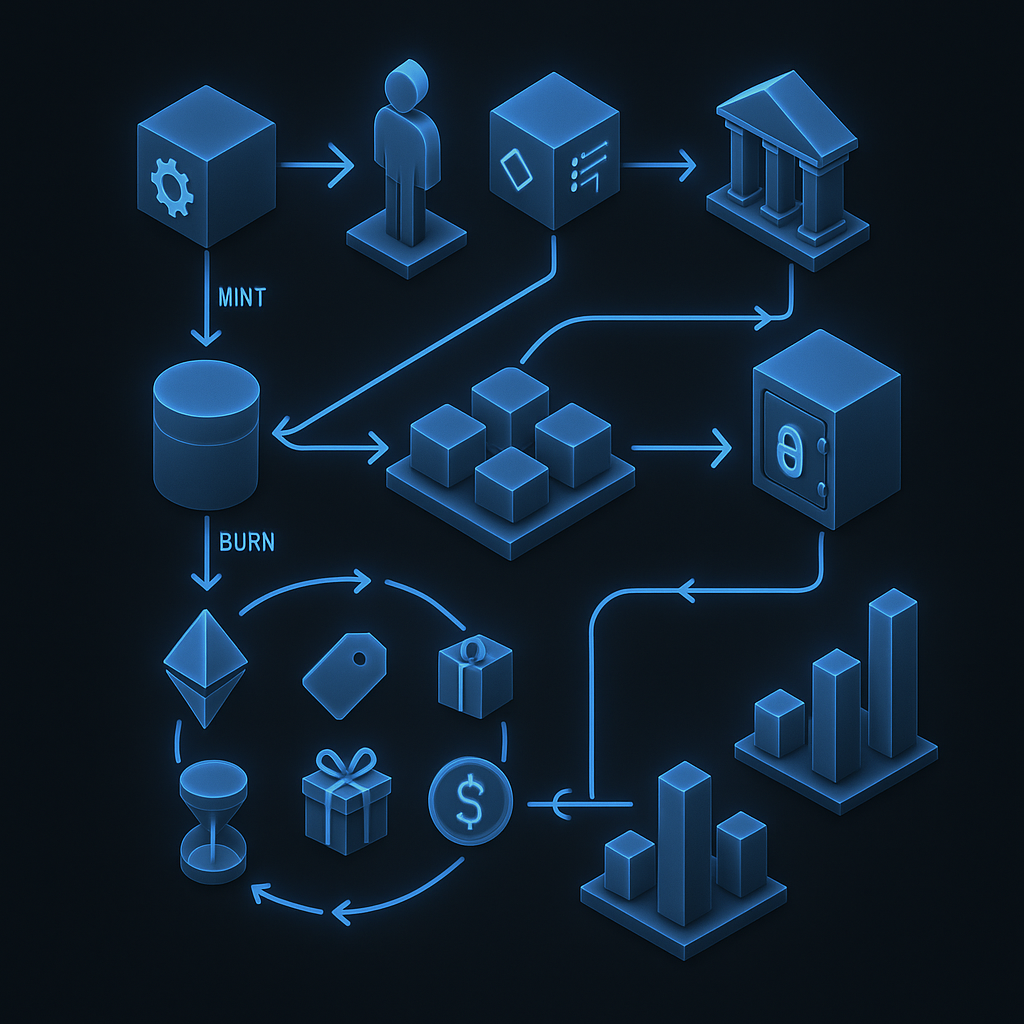
Supply policy covers initial creation, later issuance, and mechanisms that remove units. Document whether issuance is fixed, scheduled, conditional, or controlled by governance. Identify every authority that can mint, burn, freeze, pause, upgrade, or reallocate units, including the process for replacing compromised authority.
Distribution policy should map each recipient category to its economic role, release conditions, transfer restrictions, and disclosure obligations. Team, treasury, participant, and ecosystem allocations need separate rationales. Vesting language should match executable contract logic and treasury procedures.
Demand and circulation rules should identify permitted asset actions and the destination of units after use. Fees may be transferred, retained, redistributed, or removed under the defined mechanism. Each reward needs a named funding source, such as new issuance, operating revenue, or an existing reserve.
Governance and treasury design complete the mechanism. Specify proposal rights, voting authority, execution control, emergency powers, and conflict procedures. Record which parameters governance may change and which remain fixed. Define applicable rules for low participation, concentrated holdings, exhausted reserves, delayed releases, and disputed governance.
Supply, Issuance, Burns, and Vesting
Choose whether supply is capped or uncapped, identify every account or role authorized to mint, and publish issuance and unlock schedules. Track circulating supply, total supply, and maximum supply separately when a cap exists. Model vesting, burns, net supply change, and concentrated unlock periods before deployment.
Maximum supply is the protocol-defined upper limit on units that can ever exist when supply is capped.[1] The Total supply documentation defines total supply as units created minus units verifiably burned; locked or reserved units may remain within total supply. For uncapped designs, document the issuance rule and all minting permissions.
Build the issuance schedule by recipient, release date, amount, and purpose. Separate immediate circulation from cliffs and gradual vesting, then record each unlock date. Future additions to circulating supply should remain distinct from allocations that are not yet transferable.
Count a burn only when existing units are permanently removed and the removal is verifiable. Burns do not replace a defined demand model. For each period, net supply change equals new issuance minus verified burns. Label positive and negative changes consistently within the project model.
For circulating-supply accounting, start with the opening amount, add vested or newly issued units entering circulation, and subtract burns and newly locked units. Keep this calculation separate from total supply. An unlock can change circulating supply without changing total supply, while new minting changes total supply.
| Mechanism | Rule | Authority | Accounting treatment | Suitable use | Review point |
|---|---|---|---|---|---|
| Issuance | Fixed, scheduled, conditional, or governance-controlled | Every account or role permitted to mint | Adds newly created units | Capped or uncapped supply policy | Minting permissions and release schedule |
| Burns | Existing units are verifiably removed | Contract or role permitted to burn | Subtracts verified burns from total supply | Defined supply-removal policy | Transaction record and authorization |
| Vesting | Units follow cliffs or gradual release | Vesting contract or designated administrator | Changes transferability and circulating supply | Contributor, treasury, or community allocations | Recipient, amount, date, and source pool |
How Should Utility, Demand, Incentives, and Value Capture Fit Together?
Connect each asset action to a product right or protocol function, identify who needs that action, specify the incentive budget and funding source, and define each value flow. Model utility, demand, rewards, and value capture separately before reconciling their participants, permissions, sources, and destinations.
For every proposed use, record the user, required action, granted right, applicable restriction, and available alternative. Access, payment, governance participation, collateral, and protocol fees represent different interaction models. A general claim of usefulness does not specify the behavior required by the design.
Demand design should identify why a participant needs the asset and how long that need lasts. Separate transactional demand, where units pass through an activity, from mechanisms that require units to remain committed under defined rules. Exchange availability, promotional attention, and reward distribution are not substitutes for product-linked demand rules.
| Component | Participant action | Rule owner | Funding or value flow | Design fit | Review question |
|---|---|---|---|---|---|
| Demand | Acquire, spend, or commit units for a defined function | Product or protocol rules | Fees or committed units | Product-linked activity | Why and for how long are units required? |
| Incentives | Perform a qualifying contribution | Eligibility and distribution rules | Allocated pool, activity funding, or reserve | Measurable participation | What funds the reward, and what action qualifies? |
| Value capture | Route payments or other defined flows | Contract, treasury, or governance | Named source and destination | Fee or service mechanism | Where does each payment go? |
For incentives, map each reward to a specific contribution, eligibility rule, funding source, distribution condition, and abuse check. Distinguish rewards funded from an allocated pool from those funded through ongoing protocol activity. Rewards available without the intended contribution do not match their stated eligibility rule.
Value capture requires an explicit path. Document whether protocol payments go to service providers, a treasury, participants, or another destination. Requiring payment with the asset describes payment utility, but it does not specify how the payment is retained, distributed, or removed.
Reconcile all actors and flows. Users should receive a defined right, contributors should receive compensation under stated conditions, and every payment or allocation needs a named source and destination. Do not assume demand exists because rewards exist while funding those rewards through the same expected demand.
How Should Governance and Treasury Management Be Designed?
Governance design should assign proposal, voting, delegation, execution, upgrade, and emergency powers to named roles. Treasury design should identify custody, spending authority, permitted assets, approval rules, and reporting records. Mutable parameters need a defined controller, change process, and execution path.
For voting, document how voting power is calculated, whether delegation is permitted, which holdings are eligible, and how conflicts are handled. Record quorum, proposal-submission requirements, voting periods, approval rules, and execution delays as project parameters rather than assumed conventions.
Treasury controls should separate proposal approval from transaction execution. Each expenditure needs a source account, authorized signer or contract, permitted purpose, amount limit, and accounting record. Emergency permissions should state who may act, which actions are available, and how ordinary governance resumes.
Map governance rights against asset distribution and vesting. The review should identify whether administrators, treasury controllers, contributors, or other groups can change issuance, transfers, upgrades, or spending. Record any authority that exists outside asset-holder voting.
How to Design Tokenomics Step by Step
Start with the project function, then define the asset architecture, supply policy, distribution, utility, incentives, governance, implementation, and monitoring. Keep each decision tied to a participant, permission, source of units, destination of value, and change authority.
- Define the project function and the participant action the asset supports. Warning: do not use issuance as a substitute for a product function.
- Choose whether the asset is native to its blockchain or implemented through a smart contract on an existing blockchain. Warning: document dependencies and administrative permissions.
- Set capped or uncapped supply rules, minting authority, burns, and accounting definitions. Warning: do not combine total and circulating supply.
- Allocate units by recipient, purpose, source pool, release date, and transfer condition. Warning: check that the same units are not allocated twice.
- Map utility, demand, incentives, and value flows. Warning: identify rewards funded only through new issuance.
- Assign governance, treasury, upgrade, pause, and emergency powers. Warning: record control that exists outside holder voting.
- Implement contracts, vesting logic, treasury controls, and monitoring fields. Warning: compare deployed behavior with published rules.
- Run base, upside, and downside scenarios before publication. Warning: reassess any case in which obligations exceed available units or authorized treasury balances.
For United States scope, FinCEN Guidance FIN-2019-G001 explains when issuers, administrators, exchangers, hosted-wallet providers, trading platforms, and other convertible-virtual-currency businesses may be money transmitters subject to Bank Secrecy Act obligations.
The Commodity Exchange Act governs commodity derivatives and gives the Commodity Futures Trading Commission enforcement authority over fraud and manipulation involving commodities, including qualifying digital assets. It does not generally regulate ordinary spot commodity markets in their entirety.
In New York, 23 NYCRR Part 200 requires a BitLicense or other appropriate New York authorization for specified virtual-currency business activities involving New York or New York residents. It is a state requirement rather than a nationwide license.
Which Tools Support Tokenomics Modeling, Simulation, and Monitoring?
Use separate tool categories for model construction, scenario execution, contract implementation, and live-data review. Spreadsheet models store assumptions and formulas, simulation engines run defined scenarios, and monitoring dashboards read contract events, balances, and transfers. Connect every monitored metric to a model variable.
Modeling tools should represent supply states, issuance rules, vesting schedules, treasury flows, user actions, and incentive payments. Keep assumptions distinct from formulas and outputs. Record units, time periods, wallet categories, and parameter sources so each output can be traced to its inputs.
Simulation categories include spreadsheet scenario managers, programmable notebooks, system-dynamics software, and agent-based simulation engines. Select a category according to the model’s interaction rules, randomness requirements, execution frequency, and reproducibility requirements.
| Tool category | Function | Inputs | Outputs | Best-fit use | Control |
|---|---|---|---|---|---|
| Spreadsheet model | Stores assumptions, formulas, and dependencies | Supply, vesting, treasury, and activity parameters | Period calculations and scenario comparisons | Model construction | Units, formulas, and version history |
| Simulation engine | Executes defined interaction rules | Scenario parameters, agents, events, or random variables | Run records and state changes | Scenario execution | Reproducible configuration |
| Monitoring dashboard | Reads contract events, balances, and transfers | Contracts, wallets, events, and state variables | Observed metrics and review flags | Live-data review | Scope, calculation rule, and update schedule |
OpenZeppelin Contracts provides reusable and security-focused Solidity implementations for fungible tokens, non-fungible tokens, access control, governance, upgradeability, and related smart-contract components: https://www.openzeppelin.com/news/introducing-openzeppelin-contracts-5.0
Monitoring begins with a metric map. For each tracked value, define the contract, event or state variable, wallet scope, calculation rule, observation period, and update schedule. Dashboard labels should match model terminology so modeled and observed values use the same definitions.
- Modeling: store parameters, formulas, dependencies, and version history.
- Simulation: preserve scenario inputs, run configuration, and output records.
- Monitoring: map on-chain data fields to model variables and review flags.
| Monitoring area | Data-source category | Model variable | Calculation control | Review period | Trigger |
|---|---|---|---|---|---|
| Supply | Contract state and mint or burn events | Total and circulating units | Defined inclusions and exclusions | Project-defined | Difference from modeled state |
| Vesting | Vesting contracts and allocation records | Released and locked units | Recipient and source-pool mapping | Project-defined | Unscheduled or mismatched release |
| Treasury | Designated wallet balances and transactions | Available reserves and distributions | Approved wallet scope | Project-defined | Unapproved or unfunded distribution |
| Incentives | Reward contracts and qualifying-activity records | Claims and remaining pool | Eligibility and funding-source mapping | Project-defined | Claims exceed available allocation |
Worked Example: Building and Stress-Testing a Token Model
Case A tests whether allocation, release, reward, and treasury rules remain internally consistent across base and downside scenarios. The same accounting definitions apply to every case. The review fails when a required distribution exceeds its identified pool or available treasury balance.
Assumptions: maximum supply is 1,000 units, opening total supply is 700, and opening circulating supply is 400. During the period, issuance is 50, vesting unlocks are 30, verified burns are 10, and new lockups are 20. The reward pool contains 60 units, while the downside case produces 70 units of valid claims. The treasury has 40 available units against a planned 50-unit distribution.
- Calculate ending total supply as 700 + 50 − 10 = 740 units. Warning: unlocks and lockups do not create or destroy units.
- Calculate ending circulating supply as 400 + 50 + 30 − 10 − 20 = 450 units. Warning: include only units entering or leaving circulation during the period.
- Compare the 70 units of valid reward claims with the 60-unit reward pool. Warning: do not draw the 10-unit shortfall from another allocation without an authorized transfer rule.
- Compare the planned 50-unit treasury distribution with the 40 units available. Warning: delayed or inaccessible funds cannot be counted as an available balance.
Case A remains below its assumed maximum supply because ending total supply is 740 units against a 1,000-unit cap. It fails the reward and treasury checks: claims exceed the reward pool by 10 units, and the planned treasury distribution exceeds the available balance by 10 units.
Repeat the calculations after changing one assumption at a time, such as issuance, unlock timing, reward claims, burns, lockups, or treasury availability. Keep accounting definitions constant across base, upside, and downside cases so each result can be traced to the changed input.
Tokenomics Design and Risk Review Checklist
Approve the design only when concentration, unlock pressure, issuance, reward funding, legal exposure, and contract implementation meet documented project limits. Assign every failed item an owner and remediation deadline. Treat unbounded minting, undocumented insider control, unfunded obligations, and conflicting contract or allocation records as launch-blocking issues.
- Pass if insider allocations remain within the approved concentration cap and have enforceable lockups and vesting. Fail if either requirement is absent.
- Pass if sellable supply from each major unlock remains within approved liquidity and demand-absorption limits. Fail if an unlock exceeds either limit.
- Pass if net supply growth remains within modeled demand under base and downside scenarios. Fail if issuance exceeds the applicable project limit.
- Pass if rewards correspond to defined network activity, fees, services, or participation. Fail if issuance funds rewards without a qualifying contribution.
- Pass if minting, burning, rebasing, or dual-asset mechanics remain within approved parameters under the downside scenario. Fail if any mechanism becomes unbounded.
- Pass if jurisdiction-specific review is complete and contracts, disclosures, allocation records, and vesting schedules agree. Fail if reviews are missing or records conflict.
- Pass if every failed check has an owner, remediation deadline, monitoring trigger, and launch status. Fail if any deficiency remains unassigned or unresolved.
Conclusion
A tokenomics model should connect asset purpose, supply boundaries, issuance, allocation, vesting, utility, governance, and treasury policy through explicit rules. Each rule needs authorized participants, funding sources, value flows, control rights, and review limits.
Build a spreadsheet model with base, upside, and downside scenarios, then run the checklist before publishing the token design. Document assumptions and test concentration, unlock pressure, issuance, reward funding, treasury conditions, legal exposure, and contract implementation. Revise any mechanism that exceeds its approved limit or depends on unavailable units.
Sources
- support.coinmarketcap.com — Maximum supply
No comments yet. Be the first to comment!