



TL;DR
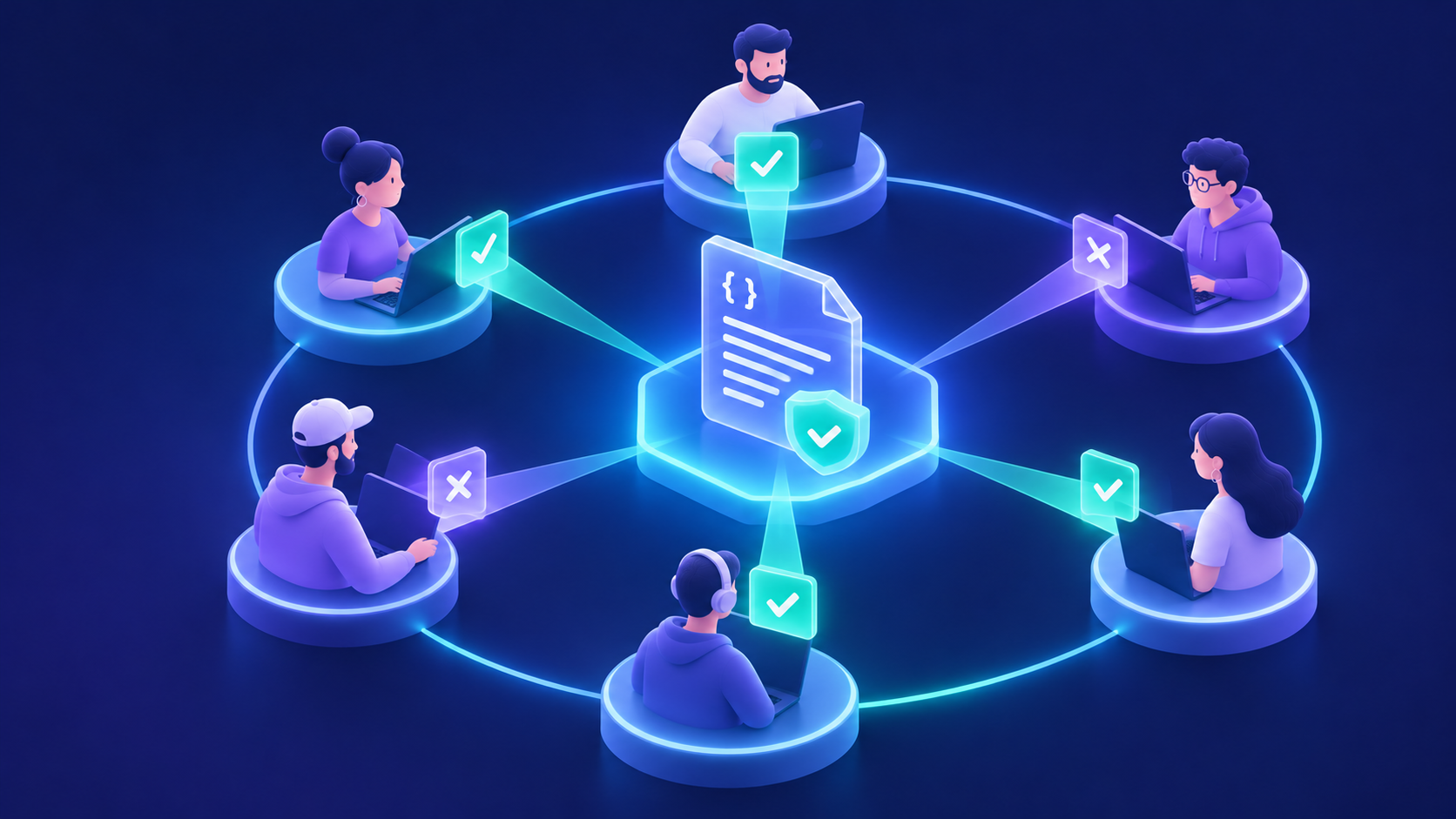
- DAOs fund themselves through venture capital, grants, token sales, crowdfunding, quadratic funding, liquidity incentives — or by pooling capital as an investment DAO.
- Grants and quadratic funding suit early, public-goods projects; VC and token sales suit protocols that need scale fast.
- Treasury management decides survival: a treasury held mostly in its own token can collapse in one downturn.
- Token sales carry the most regulatory and price risk.
Raising Money Is Only Half the Problem
Most guides to DAO funding stop at the moment the money lands. That is the easy part. What a DAO does with its capital afterwards — how it stores it, diversifies it and decides who can spend it — is what determines whether it is still operating after the next market downturn.
There is also no single right way to fund a decentralized autonomous organization. The right method depends on the DAO’s stage, its purpose, and how much control it is willing to trade for capital. A venture-backed DeFi protocol and a volunteer-run public-goods collective face very different trade-offs.
This guide is for founders choosing how to fund a new DAO and for existing DAOs deciding how to manage a treasury they already hold. It covers traditional funding methods, investment DAOs, crowdfunding and token sales, quadratic funding, liquidity incentives, DAO treasury management and the tools behind it, and five real examples.
Traditional Funding Methods for DAOs
DAOs can use the same four routes as conventional startups — venture capital, grants, loans and revenue-based financing — but each works differently when there is no CEO, no board and often no legal entity. The table below compares them; the sections that follow explain where each fits.
| Method | How It Works | Main Trade-off |
|---|---|---|
| Venture capital | VCs invest in exchange for equity in a legal wrapper or, more often, governance tokens | Fast, sizeable capital — but real centralization risk if investors hold too much voting weight |
| Grants | Foundations and protocols fund DAOs aligned with their mission (e.g. the Ethereum Foundation) | No repayment or dilution — but competitive, and the scope must match the grantor’s goals |
| Bank loans | The DAO borrows from a financial institution | Rarely available — no legal personality and no credit history make approval hard |
| Revenue-based financing | The investor is repaid as a percentage of future revenue instead of fixed interest | Flexible, performance-linked repayment — but needs a predictable revenue stream to qualify |
Venture capital
Venture capital is the fastest way for a DAO to raise a large sum, usually by selling governance tokens to funds at a discount with a vesting schedule. Crypto-native funds also bring market-making contacts, exchange relationships and hiring networks.
The cost is control. If a handful of funds hold a large share of the voting supply, proposals pass or fail on their say, and the “decentralized” label becomes hard to defend. Founders should cap investor allocations, lock tokens for a meaningful period, and publish the cap table so the community can see who holds what.
A typical VC process for a DAO still mirrors startup funding rounds: a small early round to build the protocol, then larger rounds as usage grows. The difference is that the asset sold is usually a token, which becomes liquid on public markets far earlier than startup equity would.
Grants
Grants are non-dilutive money from foundations, ecosystem funds and other DAOs that want a specific problem solved. Layer-1 and layer-2 networks, large DeFi protocols and dedicated grant DAOs all run programs.
Grants work best for open-source tooling, research and education — work that benefits an ecosystem but has no obvious business model. They are competitive, usually milestone-based, and the grantor’s priorities shape the roadmap. Treat them as a way to start, not as permanent income.
Bank loans
Traditional bank loans are rarely an option. A bank needs a borrower it can identify, sue and assess, and most DAOs offer none of those. DAOs that do borrow usually do so through a legal wrapper — a foundation, LLC or cooperative — or borrow on-chain against crypto collateral, which carries liquidation risk if prices fall.
Revenue-based financing
Revenue-based financing suits DAOs that already earn steady fees, such as a protocol charging for swaps or loans. The investor receives a fixed share of revenue until a repayment cap is reached, so payments shrink in weak months instead of becoming a fixed burden. Because protocol revenue is visible on-chain, investors can verify it directly — one of the few areas where DAOs are easier to underwrite than startups.
What Is an Investment DAO?
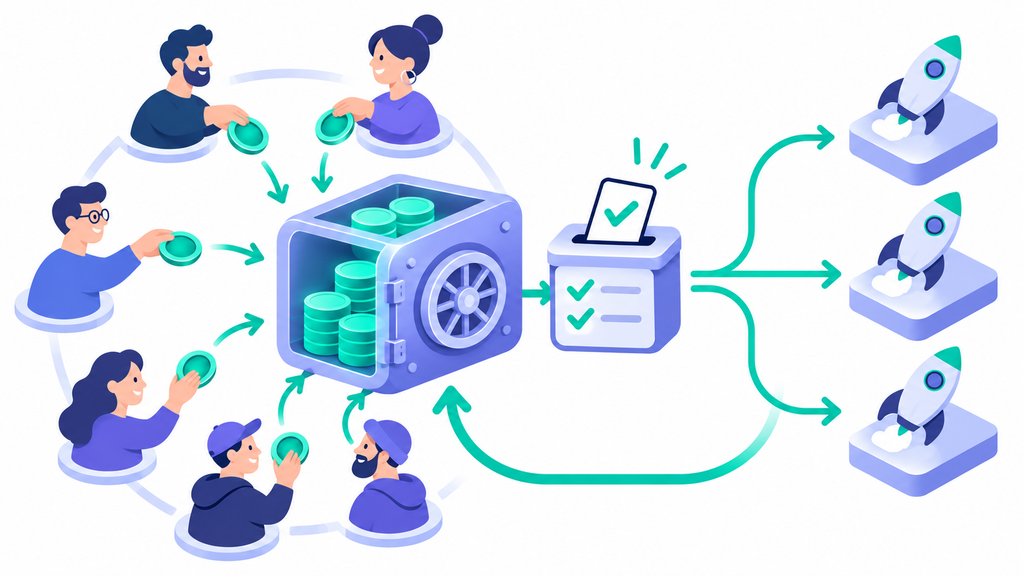
An investment DAO is a DAO whose whole purpose is to pool members’ capital and invest it in other projects, rather than to raise money for its own operations. It works like a venture fund or investment club, except that members vote on every deal and the treasury sits in a shared on-chain wallet.
How an investment DAO works
- Members join by contributing capital — usually ETH or stablecoins — to the shared treasury and receive shares or tokens in return.
- A member proposes an investment: a token round, an early-stage startup, an NFT, a liquidity position.
- Members vote, typically weighted by their stake.
- If the vote passes, the treasury sends funds directly to the target, and any returns flow back to the treasury.
- Many frameworks let members “rage-quit” — leave and withdraw their proportional share — if they disagree with a decision.
How it differs from the other methods on this page
A VC-funded DAO is on the receiving end of capital. An investment DAO is the fund itself: it is a source of funding for other DAOs and startups. For a founder, that makes investment DAOs a fourth category of backer alongside VCs, grant programs and the crowd — usually smaller cheques, but with a community of experienced builders attached.
Examples
- MetaCartel Ventures — a for-profit venture DAO that came out of the MetaCartel community and went public at ETHDenver 2020 to back early-stage decentralized applications. Its members have included contributors from several major DeFi protocols, and its proposals ran through DAOhaus.
- DAOhaus — not an investment DAO itself but the no-code toolkit many of them are built on. It lets a group launch a pooled-capital DAO with share-based voting and rage-quit in a few clicks.
- Syndicate — popularised “web3 investment clubs” from 2022, letting a group turn an Ethereum wallet into an investment DAO with on-chain cap-table tracking and optional legal wrappers (US clubs were capped at 99 members). Syndicate Labs has since announced it is winding down operations, which is a useful reminder that DAO tooling choices need a migration plan.
- Raid Guild — a sister organisation from the same MetaCartel network, structured as a service DAO (a decentralized dev shop) rather than a fund. It shows how the same pooled-treasury model can back members’ work instead of outside deals.
Investment DAOs carry real legal questions: in many jurisdictions, pooling money and sharing profits looks like a collective investment scheme or a security. Most serious investment DAOs operate behind a legal wrapper and limit membership accordingly.
Crowdfunding and Token Sales
Crowdfunding and token sales both raise money from a broad public rather than a few large backers. The difference is what contributors get back: in DAO crowdfunding it is usually membership or a governance token tied to a shared goal; in a token sale it is a tradable asset with an expected market price.
DAO crowdfunding
DAO crowdfunding runs on smart contracts instead of platforms like Kickstarter. Contributors send crypto to a contract, receive tokens that record their share, and can see every inflow and outflow on-chain. If the goal is not met, the same contract can handle refunds.
The best-known example is ConstitutionDAO. In November 2021 it raised roughly $47 million in ETH in about a week, from more than 17,000 contributors with a median contribution of around $200, to bid on a first-edition copy of the US Constitution at Sotheby’s. It collected funds through the Juicebox protocol, which issued contributors PEOPLE tokens in proportion to their ETH. The DAO lost the auction to a $43.2 million bid and offered refunds through the same Juicebox contracts.
Two lessons carry over to any DAO crowdfund. First, on-chain infrastructure can coordinate thousands of strangers in days. Second, gas fees and refund mechanics must be designed before launch — small ConstitutionDAO contributors lost a meaningful share of their money to transaction costs.
Token sales (ICO, IDO and community sales)
A token sale sells a DAO’s governance or utility token directly to the public. Formats include initial coin offerings (ICOs), initial DEX offerings (IDOs) on decentralized exchanges, and launchpad or community sales with allowlists and contribution caps.
Token sales can raise large sums quickly and distribute ownership widely. They are also the highest-risk funding method on this page: regulators may treat the token as a security, prices often fall sharply once trading begins, and a treasury funded only in its own token is exposed to that drop.
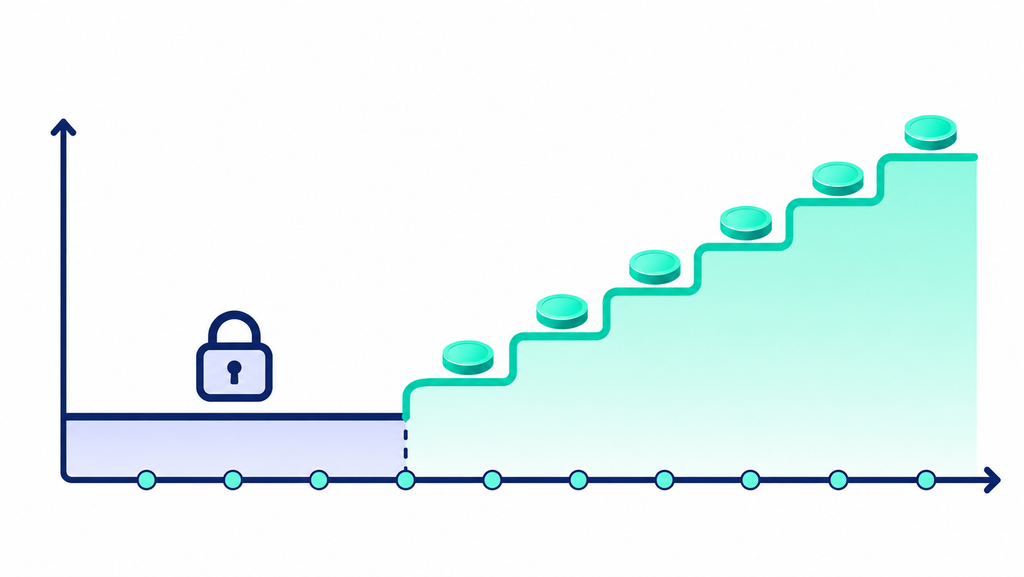
The detail most guides skip is the vesting period. Tokens sold to insiders, early backers and the team should unlock gradually — often a one-year cliff followed by monthly releases over two to four years. Vesting stops early holders from dumping on new buyers, and it signals that the people running the DAO plan to stay.
Quadratic Funding — DAOs’ Own Funding Mechanism
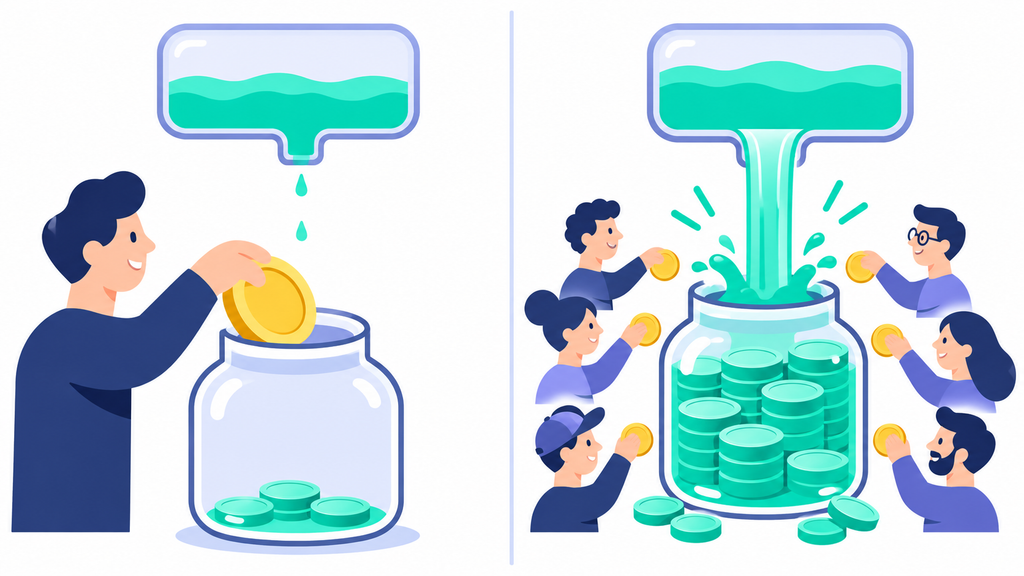
Quadratic funding is a way of distributing a matching pool so that the number of people who back a project counts more than the size of their donations. It was designed for public goods — open-source code, research, community infrastructure — that VCs and traditional grants undervalue because there is no equity to sell.
How the matching works
A sponsor — a foundation, protocol or DAO — puts money into a matching pool. During a funding round, anyone can donate directly to the projects they like. When the round closes, the pool is split according to a formula that rewards breadth of support:
\text{Match}_p \propto \left(\sum_{i} \sqrt{c_{i,p}}\right)^2 - \sum_{i} c_{i,p}Here c is each individual contribution to project p. Take the square root of every donation, add them up, square the total, and subtract what was actually donated. The result is each project’s claim on the pool.
A simple comparison shows the effect. One donor giving $100 gives a project a raw score of 100 and a matching claim of zero. A hundred donors giving $1 each also total $100, but their score is (100 × 1)² = 10,000, leaving a matching claim of 9,900. Same money, far more matching — because a hundred people signalled that the project matters.
Why it exists, and its weak spot
Quadratic funding turns small donations into a voting signal for where shared money should go. That makes it a fit for ecosystems that want their community, not a grants committee, to decide what gets built.
Its weak spot is fake identities. If one person can split $100 across a hundred wallets, they capture the matching meant for genuine broad support. Every serious quadratic funding round therefore runs Sybil-resistance checks — identity scoring, passport-style credentials, or reviews of suspicious wallets.
Gitcoin: the flagship implementation
Gitcoin has run quadratic funding rounds for Ethereum public goods since 2019 and remains the best-known implementation. Its approach has since broadened: Gitcoin Grants 24, held in October–November 2025 as the first round under its “Gitcoin 3.0” model, distributed about $1.8 million across six domains using quadratic funding alongside retroactive funding, conviction voting and other mechanisms. The Gitcoin case study below covers what this means for a DAO’s funding strategy.
Liquidity Mining and Yield Farming
Liquidity mining and yield farming fund a DAO through its own protocol activity rather than a one-off raise. Liquidity mining pays users in tokens for supplying capital; yield farming is the DAO itself putting treasury assets to work in DeFi to earn a return.
Liquidity mining
In a liquidity mining program, the DAO distributes its governance token to users who deposit assets into its pools or markets. The protocol gets the liquidity it needs to function, and users become token holders with a say in governance.
It is a growth tool more than a fundraising tool: no cash comes in directly, and emissions dilute existing holders. Programs that pay out too generously attract “mercenary” capital that leaves the moment rewards drop. Effective programs set a fixed budget, taper rewards over time and measure how much liquidity stays after incentives end.
Yield farming
Yield farming turns idle treasury assets into income. A DAO might lend stablecoins on a money market, stake ETH, or provide liquidity to a trading pair and collect fees. The income can cover contributor salaries and grants without selling the native token.
The risks are smart-contract exploits, impermanent loss on liquidity pairs, and the temptation to chase high yields with money the DAO cannot afford to lose. Treasury policies should cap how much can go into any single protocol and require governance approval for new strategies — which leads directly into treasury management.
DAO Treasury Management: What Happens After the Funding Round
DAO treasury management is the ongoing work of storing, diversifying, deploying and reporting on the assets a DAO holds. Once the funding round is over, it is treasury management — not the funding method — that decides whether a DAO survives a downturn.
The stakes are large. DAO treasuries collectively hold tens of billions of dollars, yet many are managed by part-time volunteers with no written policy on what to hold, how much to spend or who can move funds.
The native token paradox
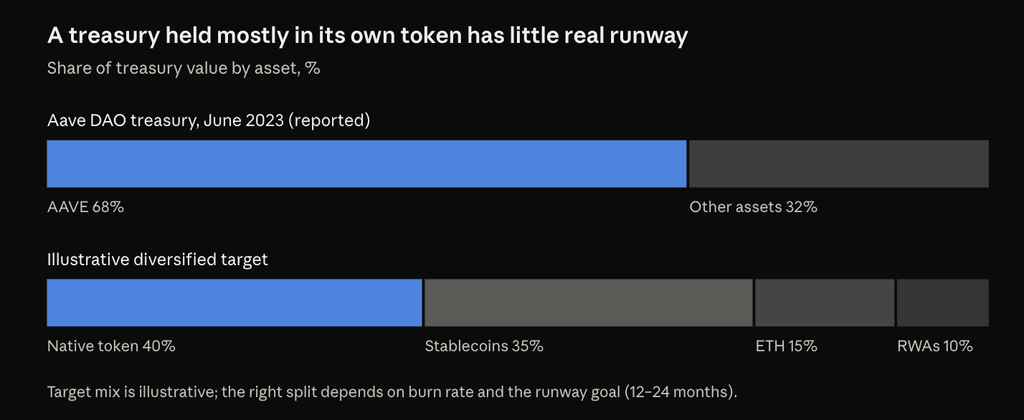
Most DAOs end up holding the bulk of their treasury in their own governance token, because that is what they minted and what they received from token sales. On paper the treasury looks large. In practice it is not real runway.
The reason is correlation. When the market falls, the native token usually falls faster than everything else — exactly when contributions slow and the DAO most needs to pay its contributors. Selling the token to raise cash pushes its price down further, so the treasury shrinks twice. A DAO holding $50 million in its own token may struggle to turn even a fifth of that into stablecoins without crashing the market.
Even well-run DAOs face this. Llama’s June 2023 financial report for Aave DAO put its treasury at $122.9 million, with 68% of it in AAVE.
Treasury diversification
Treasury diversification means converting part of the native-token holdings into assets that hold value independently of the DAO’s own fortunes. The usual building blocks are:
- Stablecoins (USDC, USDS and others) — pay salaries, grants and audits without exposure to market swings.
- ETH or other blue-chip crypto — liquid, widely accepted, and less tied to any single protocol.
- Tokenized real-world assets (RWAs) — on-chain versions of US Treasury bills, money-market funds or bonds that pay a yield on otherwise idle stablecoins. Sky Protocol (formerly MakerDAO) shows how far this can go: by early 2026 RWA income made up more than 60% of its protocol revenue.
A common rule of thumb is to hold enough non-native assets to cover 12–24 months of operating costs regardless of what the native token does. Calculate the monthly burn rate first, then size the stable reserve from it.
How a DAO diversifies matters as much as whether it does. Dumping tokens on the open market hurts holders and the price. Better options include over-the-counter sales to long-term investors, gradual automated sales, and token swaps with aligned DAOs. Each should be approved by a governance vote with a published rationale.
Who controls treasury spending
Diversification only works if the right people can move funds — and nobody else can. Most DAOs custody their treasury in a multi-signature wallet and route larger spending through token-holder votes executed by a governor contract. Who signs, what thresholds apply and when a vote is required are governance decisions; see our DAO governance guide for how multi-signature approval and on-chain voting work in practice.
Treasury Management Tools DAOs Actually Use
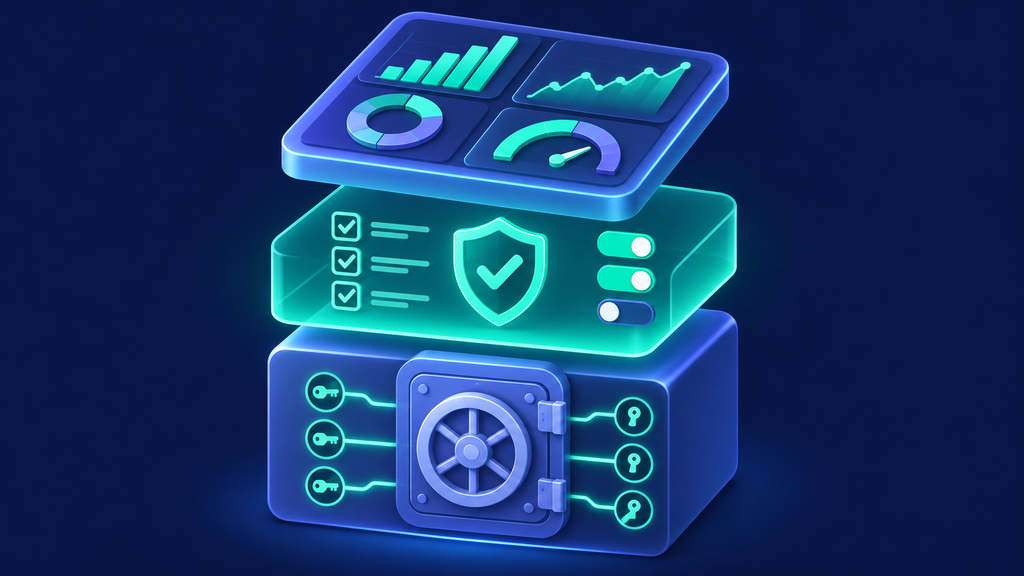
Most DAO treasuries run on three layers: a custody wallet that holds the assets, a permissions layer that controls what can be done with them, and a reporting layer that shows members where the money is. Some DAOs add a professional manager on top.
| Tool | What It’s For |
|---|---|
| Safe{Wallet} (formerly Gnosis Safe) | The standard multi-signature wallet most DAO treasuries are custodied in. Transactions need M-of-N signer approval. |
| Zodiac Roles Modifier | Permissions module for Safe that lets a DAO pre-approve exactly which transactions a manager or bot may execute, without handing over custody. |
| kpk (formerly karpatkey) | Professional, non-custodial treasury management service: diversification, DeFi yield strategies and risk monitoring executed through Safe and Zodiac. |
| Llama | Pioneered DAO treasury reporting and financial analytics (Aave, Gitcoin and others); now an on-chain governance and access-control framework, acquired by River in 2024. |
| DefiLlama treasury dashboards | Free public tracker showing the size and asset mix of many DAO treasuries — useful for benchmarking. |
Karpatkey (kpk) DAO treasury management in practice
Karpatkey began in 2020 as GnosisDAO’s in-house treasury team, was spun off as its own DAO in 2024, and now operates under the kpk brand. Its model is non-custodial: the client DAO keeps its assets in its own Safe, and governance grants kpk a narrow set of permitted actions through the Zodiac Roles Modifier. kpk can rebalance and farm yield within that policy but cannot withdraw funds elsewhere.
Over the years it has worked with treasuries including Balancer, Aave, Uniswap and Nexus Mutual. Pricing in published proposals has followed a fund-style structure — for example, a 0.5% management fee on assets plus a 20% performance fee on yield in its proposal to Nexus Mutual.
Mandates also end. GnosisDAO voted in November 2025 to terminate karpatkey’s services after community debate over performance and cost, and SafeDAO’s engagement ended in February 2026. For a DAO choosing a treasury manager, the lesson is to write measurable targets, fee caps and an exit process into the mandate from day one.
Best Practices for Financial Management
Good DAO financial management comes down to four habits: budget in the open, report on-chain, get independent checks, and never depend on a single source of money. Diversifying the treasury’s assets is covered in the section above; the practices below cover how money is planned, tracked and audited.
- Transparent budgeting. Publish an annual or quarterly budget per working group, approved by governance vote. Contributors know what they can spend; token holders can see where money is going before it is gone.
- On-chain financial reporting. Because every transaction is public, a DAO can publish monthly reports that reconcile directly to wallet balances: treasury size, asset mix, income, expenses and runway in months. Reports should be readable by a non-specialist member, not just a data analyst.
- Third-party audits. Audit every smart contract that holds or moves treasury funds before deployment and after significant changes. For larger DAOs, an annual financial review by an outside firm adds credibility with partners, exchanges and regulators.
- Diversified funding sources. A DAO that relies on one grant, one investor or one token sale is fragile. Combine at least two income streams — for example protocol fees plus grants, or yield on reserves plus a community round — so one drying up does not stop operations.
- Written treasury policy. Document target asset allocation, maximum exposure to any single protocol, signer rules and an emergency procedure. A policy turns treasury decisions from one-off debates into routine execution.
This kind of openness is also what keeps contributors and token holders engaged over the long term — see our guide to building a DAO community for how transparency translates into trust.
Real DAO Funding & Treasury Examples in Action
Five DAOs show how the methods above work in practice — each one is the clearest example of a different funding model.
| DAO | Main Funding Model | What It Shows |
|---|---|---|
| Sky Protocol (formerly MakerDAO) | Protocol revenue from a stablecoin system, increasingly from RWAs | A treasury can be funded by its own product and diversified into real-world yield |
| Gitcoin DAO | Quadratic funding and multi-mechanism grants | How a DAO can distribute money as well as raise it |
| Aave DAO | Token sale, then protocol fees and liquidity incentives | Revenue-funded treasury, with native-token concentration to manage |
| Yearn Finance DAO | Yield farming fees from vault strategies | Recurring income from DeFi activity instead of one-off raises |
| ConstitutionDAO | On-chain crowdfunding via Juicebox | Speed and scale of crowdfunding — and the cost of refunds |
Sky Protocol (formerly MakerDAO)
MakerDAO, the DAO behind the DAI stablecoin, rebranded to Sky Protocol in August 2024. Its governance token MKR is being upgraded to SKY at 1 MKR = 24,000 SKY, and SKY has since become the protocol’s sole governance token. DAI is being upgraded 1:1 to the new USDS stablecoin; both still circulate and can be converted either way, and major exchanges migrated DAI balances to USDS during 2025–2026.
The funding lesson is in where the money comes from. Sky earns interest from users who mint stablecoins against collateral, and a growing share comes from tokenized real-world assets such as T-bills. By early 2026 RWA income made up more than 60% of protocol revenue, and USDS had grown to roughly $7.9 billion in market capitalisation. Few DAOs show more clearly how treasury diversification can become a revenue engine.
Gitcoin DAO
Gitcoin DAO is the clearest real-world example of quadratic funding in action (the mechanism is explained above). Since 2019 its grants rounds have sent tens of millions of dollars to open-source software and public goods, with early support for projects that later became core Ethereum infrastructure.
Gitcoin’s recent evolution is the useful part for DAO founders. Gitcoin Grants 23 ran quadratic and retroactive funding in parallel, and Gitcoin Grants 24 (October–November 2025) combined six mechanisms across six themed domains, with roughly a third of its ~$1.8 million coming from external co-funding partners. A single mechanism rarely fits every type of project; mature DAOs match the mechanism to the problem.
Aave DAO
Aave started life as ETHLend, which raised its initial capital through a 2017 token sale. Today the Aave DAO treasury is funded mainly by protocol revenue: a share of the interest paid by borrowers flows to the DAO as a reserve. AAVE token holders vote on how that treasury is spent and on protocol parameters, and liquidity incentive programs have been used to bootstrap new markets and chains.
Aave also illustrates the native token paradox: in mid-2023, about two-thirds of its treasury value sat in AAVE itself. Its governance forum has been one of the most active venues for debating how much a DAO should diversify, and who should manage the process.
Yearn Finance DAO
Yearn launched its YFI token in 2020 with no pre-mine or private sale — tokens went to users who provided liquidity. The DAO then funded itself through yield farming: its vaults automatically move deposited assets between DeFi strategies, and Yearn takes fees on the yield generated. Treasury income is therefore recurring and tied to usage, not to the success of a fundraising event.
The trade-off is that income depends on DeFi yields, which fall in bear markets, and on the security of every protocol its strategies touch.
ConstitutionDAO
ConstitutionDAO is the strongest example of DAO crowdfunding. Using the Juicebox protocol, it raised about $47 million from more than 17,000 contributors in roughly a week in November 2021 — a scale and speed no traditional crowdfunding campaign of that age could match.
It lost the Sotheby’s auction and dissolved, offering refunds through the same Juicebox contracts. Gas fees reduced what small contributors got back, and the PEOPLE token lived on as a community-traded asset. For any DAO planning a crowdfund, it is a ready-made checklist: define the goal, the refund path and the fate of the token before the first contribution arrives.
Conclusion: Plan for the Raise and Everything After It
Funding is an event; treasury management is a discipline. A DAO may raise money once, or a few times, but it manages that money every day until it shuts down — and the DAOs that last are the ones that plan for both.
Choose the funding method that fits your stage and how much control you are willing to give up. Then, before the money arrives, decide how much will sit in stable assets, how runway will be measured, and how often members will see a report.
Who gets to approve treasury spending is ultimately a governance question — see our DAO governance guide. And transparent, well-managed funding is also what keeps a community’s trust — see our DAO community guide.
Structuring a DAO’s treasury or auditing the smart contracts that hold it? Talk to the Peiko Web3 team
No comments yet. Be the first to comment!