



TL;DR
- DAOs run on four core governance models: token-based, reputation-based, liquid democracy, and multi-signature.
- Token-based is the most common: voting power equals tokens held, which is simple but invites whale control and flash-loan attacks.
- Reputation-based models reward contribution; liquid democracy lets members delegate votes; multisig puts execution in a few trusted signers.
- Most DAOs combine models: off-chain votes on Snapshot, on-chain execution via a Governor contract or a multisig.
A DAO’s governance model decides who actually holds power, not just how votes get counted. Two DAOs can both claim to be “community-run” while one is steered by three whales and the other by its most active builders. The difference sits entirely in the governance design.
There is no one-size-fits-all model. The right structure depends on the DAO’s size, its purpose, and whether members are invested financially, reputationally, or both. A 10-person grants collective and a protocol with 50,000 token holders need very different rules.
This guide is for founders designing DAO governance from scratch and for existing DAOs hitting the limits of their current setup. It covers the four core DAO governance models, what a governance token does, how DAO voting works on-chain and off-chain, the tools that run it, real examples, and a framework for choosing.
What Actually Determines Power in a DAO’s Governance Model?
Every DAO governance model answers one question differently: what gives a member the right to decide? The answer is almost always one of three things: tokens held, reputation earned, or trust placed in a small group of signers.
That single axis is the most useful way to compare DAO governance structures. Vote-counting rules, proposal thresholds, and tooling all sit on top of it. If voting power comes from tokens, capital steers the DAO. If it comes from reputation, contribution steers it. If it comes from a fixed set of keys, a handful of people steer it, whatever the governance forum says.
Most real DAOs mix these sources. A protocol might let token holders vote on Snapshot, route binding decisions through an on-chain Governor contract, and keep a multisig for emergencies. Understanding each pure model first makes those hybrids much easier to design.
The 4 Core DAO Governance Models
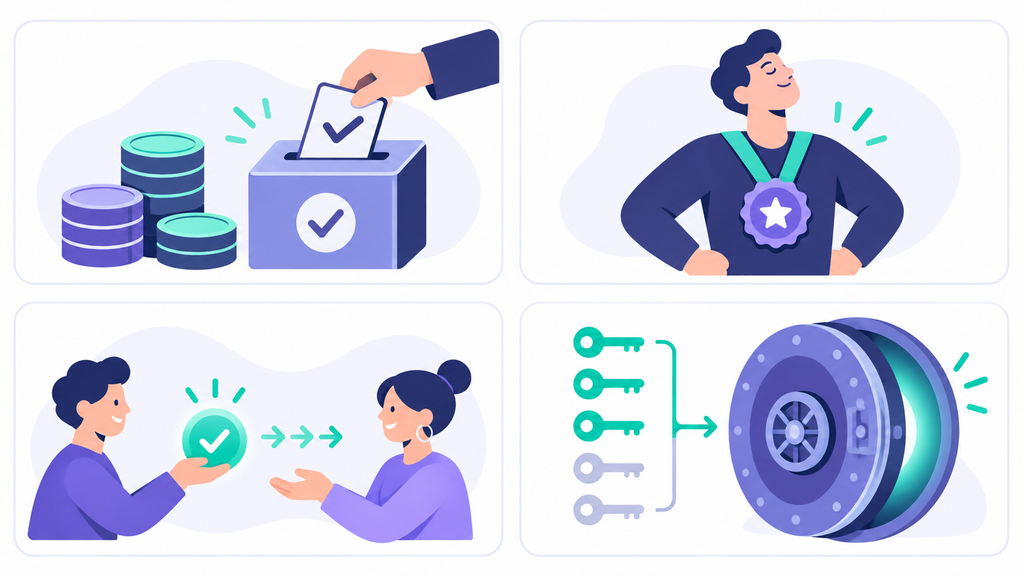
The four core types of DAO governance are token-based, reputation-based, liquid democracy, and multi-signature. Each assigns voting power differently, and each fails in a different way.
| DAO governance model | How voting power is determined | Best for | Main risk |
|---|---|---|---|
| Token-based | One token = one vote; power scales with holdings | Protocols with a liquid token and many holders | Whale capture, flash-loan attacks, low turnout |
| Reputation-based | Non-transferable points earned through contribution | Contributor collectives, research and grants DAOs | Gatekeeping over who awards reputation |
| Liquid democracy | Members vote directly or delegate to anyone, revocable at any time | Large DAOs with mostly passive holders | Power concentrating in a few popular delegates |
| Multi-signature | M-of-N named keyholders approve each transaction | Small teams, treasuries, emergency and execution roles | Signer collusion or key compromise |
Token-Based Governance
In token-based DAO governance, voting power equals the number of governance tokens a wallet holds or has been delegated. It is the default for DeFi protocols because it is simple, permissionless, and ties influence to economic stake.
The trade-off is concentration. Early investors, the core team, and exchanges often hold large balances, so a few wallets can decide outcomes. Turnout is usually low, which lowers the real cost of capturing a vote.
The sharpest risk is the flash-loan governance attack. An attacker borrows a huge amount of tokens, votes or executes a malicious proposal, and repays the loan in the same transaction. Beanstalk lost about $182 million this way in April 2022 (CertiK). Defences are covered in the benefits and challenges section below.
Quadratic voting is a common token-based variant. The cost of each extra vote rises quadratically, so 10 votes cost 100 tokens. It dampens whale power but only works with reliable identity checks, since one holder can otherwise split tokens across many wallets.
Reputation-Based Governance
In reputation-based governance, voting power comes from non-transferable reputation earned through work: shipped code, reviewed proposals, completed bounties. Reputation cannot be bought or sold, which makes the DAO resistant to capital capture.
The weak point is the issuer. Someone has to decide what counts as contribution and how much reputation it earns. If that process is controlled by early members, reputation-based DAOs can become closed clubs. Reputation that never decays can also lock in the influence of people who stopped contributing years ago.
Liquid Democracy
Liquid democracy lets each member either vote directly or delegate their voting power to someone they trust, and take it back at any time. It sits between direct and representative democracy: expert delegates do most of the voting, but holders keep the final say.
In practice, most large token-based DAOs run a form of liquid democracy through delegation. ENS, Uniswap, and Arbitrum all let holders delegate on-chain to public delegates. The risk is that delegation clusters around a few well-known names, recreating the concentration it was meant to solve.
Conviction voting is a related but distinct mechanism. Instead of fixed voting windows, members stake tokens on proposals continuously, and their weight grows the longer the tokens stay staked. It was pioneered by Commons Stack and 1Hive and runs in production on 1Hive’s Gardens platform, where it allocates funds from shared pools (Gitcoin). It rewards sustained support over last-minute vote swings.
Multi-Signature Governance
Multi-signature governance requires M of N named signers, for example 3 of 5, to approve a transaction before it executes. It is less a voting system than an execution and custody layer, and it is the most common way DAOs hold treasury assets.
Multisigs are fast and simple, which suits small teams and emergency actions. They are also the most centralized model: the signers can act without, or against, a community vote. Many DAOs pair a multisig with off-chain voting. Signers commit to executing whatever passes on Snapshot, which works only as long as the signers stay honest and available.
What Does a Governance Token Actually Do?

A DAO governance token is the credential that proves a wallet may take part in governance and sets how much weight its vote carries. In many DAOs it also carries economic rights, such as a share of protocol fees or control over protocol parameters.
What holding a governance token lets you do
- Propose. Most DAOs require a minimum balance to submit a proposal. ENS, for example, has required 10,000 ENS for a social vote on Snapshot and 100,000 ENS for an executable on-chain vote (ENS forum).
- Vote. Each token typically adds one unit of voting weight, measured at a fixed block so balances cannot be shuffled mid-vote.
- Delegate. Holders can assign their voting power to another address without transferring the tokens themselves.
Governance token vs. utility token
A utility or payment token is spent inside a product: to pay fees, buy services, or access features. A governance token is held to steer the protocol. Some tokens do both, but the distinction matters for design. If a token’s only role is voting, holders have little reason to pay attention, and turnout suffers.
Why some DAOs separate governance and economic rights
Some DAOs split voting rights from economic rights on purpose. MolochDAO v2, for instance, issues voting shares alongside non-voting loot, which carries a claim on the treasury but no vote. This lets a DAO pay contributors or investors without handing them control.
Others keep both in one token. The argument is security: if a governance token captures real value, attacking the DAO costs more than the treasury is worth. ScopeLift CEO Ben DiFrancesco made exactly this case in October 2026, arguing that fee-generating protocols should show how value reaches their governance token (Crypto Briefing). For many teams, the choice comes down to legal advice in their jurisdiction.
How Does DAO Voting Actually Work?
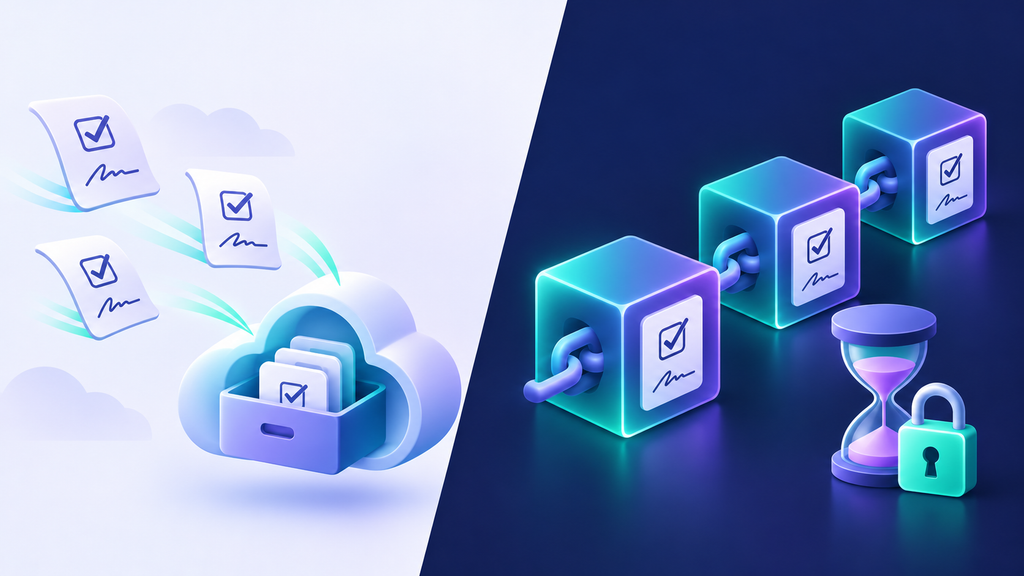
DAO voting works in three steps: a proposal is posted, eligible holders vote with weight fixed at a snapshot block, and a passed proposal is executed, either automatically by a smart contract or manually by trusted signers. Where the vote happens, on-chain or off-chain, decides most of the trade-offs.
On-chain vs. off-chain voting
| Off-chain voting | On-chain voting | |
|---|---|---|
| How a vote is cast | Signed wallet message, stored on IPFS | Blockchain transaction |
| Cost to voters | Free (gasless) | Gas fee per vote |
| Execution | Not self-executing; a multisig or bridge carries it out | Self-executing through the governance contract |
| Typical tool | Snapshot | OpenZeppelin Governor with Cactus (formerly Tally) as front end |
| Best for | Signalling, temperature checks, frequent low-risk decisions | Treasury moves, contract upgrades, parameter changes |
Off-chain voting is fast and cheap, so turnout is higher. Its weakness is enforcement: the result only becomes real when someone executes it. On-chain voting removes that trust assumption, but every vote costs gas and the process is slower. Most mature DAOs use both: an off-chain temperature check first, then an on-chain vote for anything that moves money or code.
Quorum and delegation
Quorum is the minimum voting power that must participate for a vote to count. Without it, a small group could pass proposals while everyone else is offline. ENS, for instance, has required 1 million ENS in support for an executable proposal to pass (ENS forum).
Quorum creates a new problem: most holders never vote. Delegation solves it. Inactive holders assign their power to an active delegate, so their tokens still count towards quorum without them following every proposal. Keeping delegates engaged is a community governance challenge as much as a technical one.
Timelocks
A timelock is a smart contract that holds a passed proposal for a set delay before it can execute. The delay gives members time to spot a malicious proposal and exit, or for guardians to cancel it. Timelocks, together with voting power measured at a past block, are the main defence against flash-loan attacks: borrowed tokens did not exist in the voter’s wallet when the snapshot was taken, and the attacker cannot hold a loan across a multi-day delay.
Governance Tools and Platforms DAOs Actually Use
Most DAOs run governance on a small stack: Snapshot for off-chain votes, an OpenZeppelin Governor contract for on-chain votes, a front end such as Cactus (formerly Tally) to use it, and a forum or aggregator for discussion. The tooling market changed in 2026, so check current status before you commit.
| DAO governance tool | What it’s for | Voting type | Status (Nov 2026) |
|---|---|---|---|
| Snapshot | Gasless proposal voting with signed messages stored on IPFS; Snapshot X adds on-chain voting | Off-chain (plus on-chain via Snapshot X) | Active |
| Cactus (formerly Tally) | Dashboard to create, vote on, delegate and execute Governor proposals | On-chain | Active; Tally shut down in March 2026 and ScopeLift took over, renaming it Cactus |
| OpenZeppelin Governor | Audited smart-contract framework most on-chain DAOs build on, with timelock and quorum modules | On-chain | Active |
| Agora | Governance front end and delegate platform; absorbed Boardroom’s aggregator and API in January 2025 | Both | Active |
| Common (formerly Commonwealth) | Token-gated discussion forum with Snapshot integration | Both | Active, verify before publishing |
The 2026 Tally shutdown is worth knowing about. Tally, used by more than 500 DAOs including Uniswap, ENS and Arbitrum, announced its shutdown on March 17, 2026 (The Block). ScopeLift took over operations two weeks later and relaunched the platform as Cactus (ScopeLift). The lesson for founders: build on open contract standards like Governor, so your DAO can switch front ends if a vendor disappears.
Benefits and Challenges of Each Governance Model
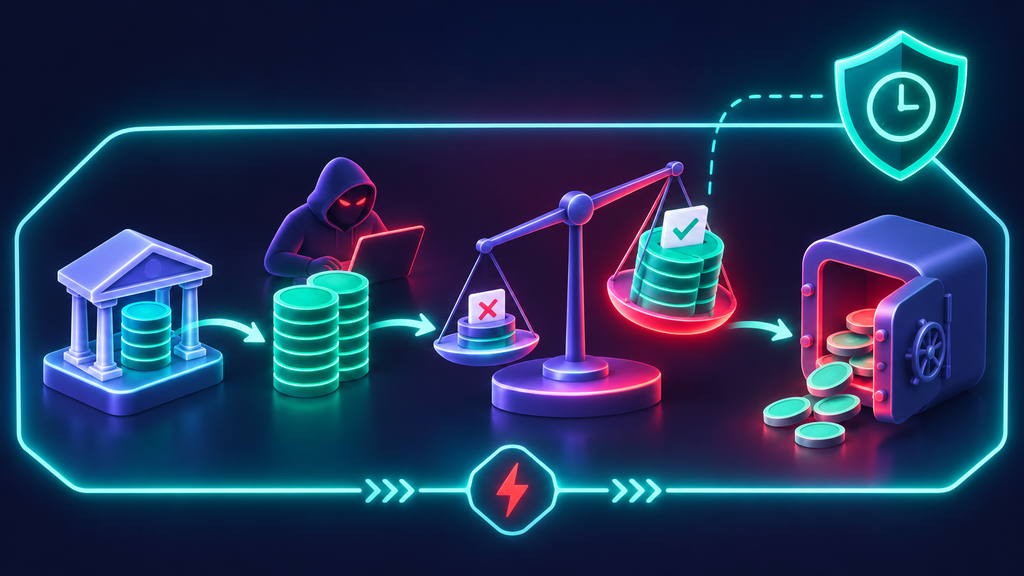
Every DAO governance model trades decentralization against speed and security. The table below shows where each one gains and where it breaks.
| Model | Main benefit | Main challenge | Typical mitigation |
|---|---|---|---|
| Token-based | Permissionless, easy to understand, aligns votes with economic stake | Whale control, low turnout, flash-loan attacks | Past-block vote snapshots, timelocks, quorum, delegation |
| Reputation-based | Influence tracks real contribution and cannot be bought | Subjective issuance, gatekeeping, stale reputation | Transparent issuance rules, reputation decay |
| Liquid democracy | Expert voting with full holder control; keeps quorum reachable | Delegation clusters around a few names | Delegate statements, accountability dashboards, delegate rotation |
| Multi-signature | Fast, cheap, simple to operate | Centralized; signers can override the community | Combine with community votes, rotate signers, publish signer identities |
The flash-loan governance attack in detail
A flash-loan governance attack happens when voting power is read from the current block. The attacker borrows tokens, gains enough votes to pass or execute a proposal, drains funds, and repays the loan, all in one transaction.
In the Beanstalk exploit of April 17, 2022, the attacker used a flash loan to acquire governance power and pushed through a malicious proposal via an emergency-execution function. The protocol lost about $182 million in value, and the attacker kept roughly $76–80 million (CertiK, Cointelegraph).
Three design rules close this gap:
- Measure voting power at a past block, as OpenZeppelin’s ERC20Votes and Governor do with checkpoints.
- Add a voting delay between proposal creation and voting, so tokens bought at the last minute do not count.
- Put every passed proposal behind a timelock, and avoid emergency functions that skip it.
The same logic explains why the multisig risk in the table is about people, not code. A 3-of-5 multisig cannot be flash-loaned, but it can be phished. How those signers move treasury funds deserves as much scrutiny as the voting rules.
Real DAO Governance Models in Action
The clearest way to see DAO governance models at work is to look at DAOs that have run them for years. These four show token-based voting with delegation, modular tooling, member shares with an exit right, and reputation-based voting, along with what went wrong.
ENS DAO: token-based governance with delegation
ENS DAO governs the Ethereum Name Service with the $ENS token, using a three-layer process. Ideas start as discussion on the governance forum. Social proposals then go to an off-chain vote on Snapshot, weighted by delegated ENS. Executable proposals go to an on-chain vote through the DAO’s Governor contract, accessed via Cactus (formerly Tally) (ENS docs).
Delegation is central. Holders assign voting power to public delegates or keep it themselves, and delegates publish statements so holders can choose (ENS forum). The model shows both sides of liquid democracy: it keeps quorum reachable, and the community still debates how to reward active delegates and fight voter fatigue.
Aragon: modular governance tooling
Aragon builds the infrastructure DAOs run on rather than one DAO. Its Aragon OSx framework uses plugins, so a DAO can switch between token voting, multisig, or custom rules without redeploying everything (Aragon blog).
Aragon is also a cautionary tale. In November 2023 the Aragon Association, the Swiss non-profit holding the treasury, dissolved and let ANT holders redeem tokens for ETH. Token holders had pushed for control, and the DAO later voted to sue the association (The Defiant). The lesson: a governance token means little if a legal entity outside the DAO controls the money.
MolochDAO: member shares and ragequit
MolochDAO, launched in 2019, funds Ethereum public goods with a deliberately minimal design. Members contribute assets in exchange for voting shares, vote on grant proposals, and can ragequit: burn their shares and withdraw their proportional slice of the treasury before a proposal they oppose executes (Gitcoin).
Ragequit protects the minority from a 51% majority, which pure token voting does not. MolochDAO v2 added non-voting “loot” shares and multi-token treasuries, and the framework was forked widely by grant and investment DAOs.
DAOstack: reputation-based voting at scale
DAOstack combined non-transferable reputation with holographic consensus, a prediction-market layer where members stake tokens to “boost” proposals they expect to pass. Boosted proposals can pass with a relative majority, so large DAOs do not need full turnout on every vote (P2P Models).
Research on 22 DAOstack DAOs found the mechanism worked mainly in larger communities. DAOstack is no longer active: a 2025 peer-reviewed postmortem tracks its seven-year rise and decline (PeerJ). It remains the best-documented example of reputation-based governance in production.
How to Choose the Right Governance Model for Your DAO
Choose a DAO governance model by matching it to three things: how big the DAO is, how members are invested (financially or through contribution), and how fast decisions must move. The decision tree below turns those into three yes/no questions.
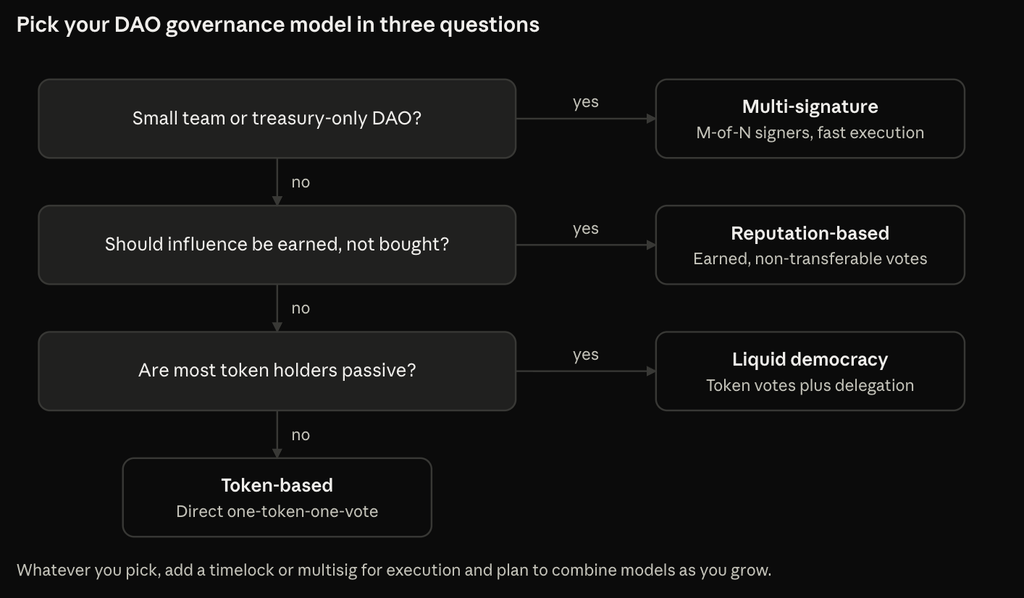
Read it top to bottom and stop at the first “yes”. The result is a starting point, not a final answer.
- Size. Under roughly ten core members, a multisig is usually enough and far cheaper to run. Past a few hundred holders, you need open voting with delegation, or quorum becomes unreachable.
- Purpose and investment. A protocol with a traded token and fee revenue fits token-based governance. A research collective or grants DAO, where members contribute work rather than capital, fits reputation-based or share-based designs like MolochDAO.
- Speed and risk. Frequent, low-risk decisions belong off-chain on Snapshot. Treasury transfers and contract upgrades belong on-chain behind a timelock.
Plan for change. Most DAOs start with a multisig, add Snapshot voting as the community grows, and move high-stakes decisions on-chain later. Build on upgradeable, standard contracts such as OpenZeppelin Governor so each step does not require a full migration.
Conclusion
There is no universally best DAO governance model. The right one depends on your DAO’s size, whether members are invested financially or through contribution, and how fast decisions need to move.
Token-based governance is the most common and the easiest to launch, but it needs past-block snapshots, quorum and timelocks to stay safe. Reputation-based and share-based designs protect against capital capture at the cost of openness. Liquid democracy keeps large DAOs functional, and multisigs keep small ones fast. Most successful DAOs combine several of them.
Two things decide whether any model works in practice. First, a governance model only works if members actually show up to use it; see our guide to DAO community governance. Second, multi-signature governance also decides how treasury funds move; see our guide to DAO funding and treasury management.
Building or auditing DAO governance smart contracts? Talk to the Peiko Web3 team about Governor setups, timelocks and multisig architecture.
No comments yet. Be the first to comment!