

















Artificial intelligence is changing the trading process in financial markets. Now, instead of relying on uncertain human judgment, traders utilize AI to process information, recognize trading patterns, and make decisions at lightning speed. With AI systems, it’s possible to examine historical trends, automatically execute trades in real-time, and much more.
AI enhances the accuracy of trading predictions, minimizes emotional bias, and accelerates decision-making. This makes the technology a good investment. Companies that integrate AI stay ahead in an increasingly fast-moving market.
In this article, you will discover more about the huge impact of AI on financial markets, what the benefits of implementing AI are, and what the future holds for this technology.
Key takeaways
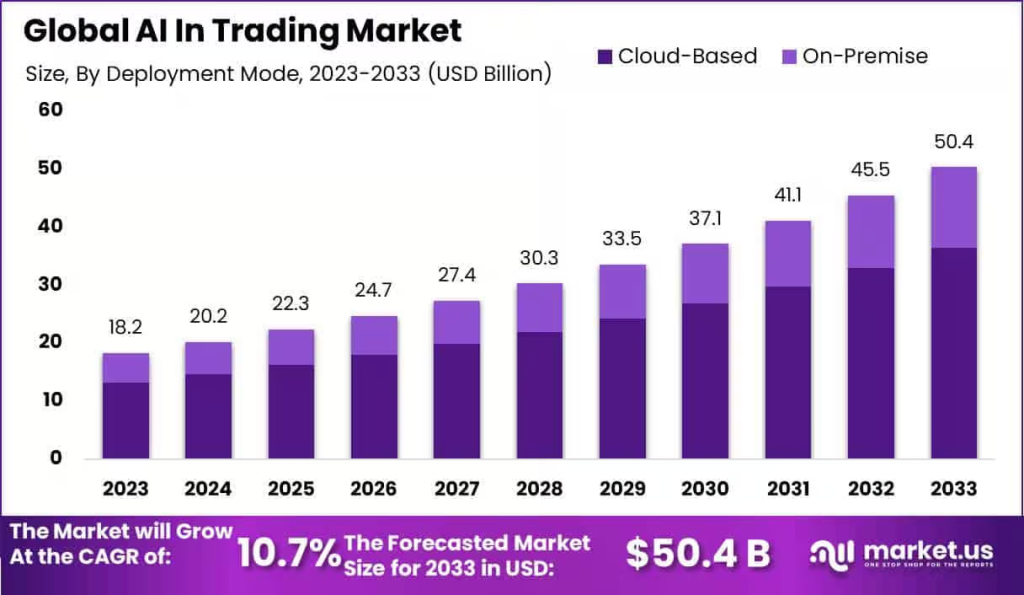
- The global AI-in-trading market is projected to reach $50.4 billion by 2033 at a 10.7% CAGR, but most institutions still keep AI in an assistive role rather than letting it make final trading decisions.
- AI’s biggest proven advantages are speed, pattern recognition, and 24/7 monitoring — not replacing human judgment, but processing more information faster than a person can.
- Even leading firms like Citadel and JPMorgan use AI to accelerate research and execution while keeping humans responsible for final decisions and risk oversight.
- The main risks aren’t just technical (data quality, latency, black-box models) — AI adoption can also amplify market-wide risk if many firms converge on similar strategies.
- Building a production-grade AI trading system requires a mix of ML engineering, financial domain expertise, and compliance-aware architecture from day one.
A New Era in Finance: Recent Advancements in AI Trading Technology
Recent forecasts show that the global AI-based trading market is set to reach approximately US$50.4 billion by 2033. This growth reflects a strong compound annual growth rate (CAGR) of 10.7% (from 2024 to 2033).
In 2025 and beyond, the demand for AI-driven tools is expected to continue growing. This technology enhances trading models, improves the customer experience for institutional clients, and manages risks more effectively than traditional methods (manual analysis, fixed-rule strategies).
What is fueling the development of AI in the trading sector? The explosion of data at hand, advances in machine learning (ML) algorithms, and huge investments. AI is already at the center of automated wealth management, fraud detection, credit scoring, and real-time trading. Billions flow into AI research and fintech startups by investment industry leaders — for example, Bridgewater launched a $2 billion fund through its AIA Labs division in 2024, where AI serves as the primary decision-maker in a macro investing strategy, with humans overseeing risk management and execution.
What is AI trading algorithm technology?
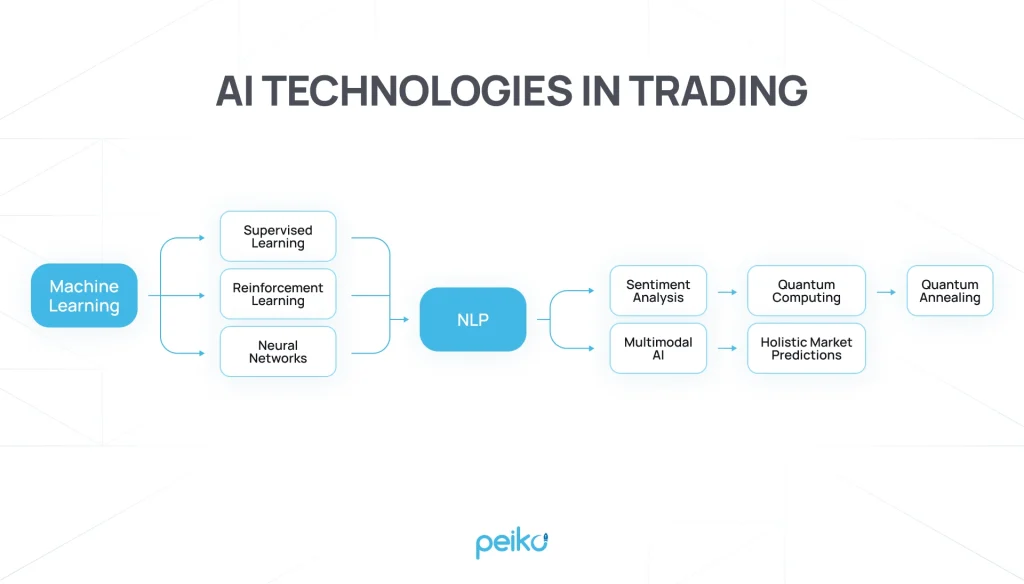
We talk about solutions based on machine learning, deep learning, natural language processing (NLP), and predictive analytics, and these ai technologies support modern trading systems. All these key components refine investment decisions.
Compared to traditional algorithmic trading with strictly pre-coded instructions, artificial intelligence for trading continually adjusts itself to new conditions, helping identify patterns and optimize trading strategies as markets shift. Its flexibility is ensured by techniques like trend reversal detection algorithms and reinforcement learning.
Some trading platforms even incorporate robotic process automation to deal with compliance activities and back-office tasks, increasing efficiency.
In the future, AI systems will handle much of the world’s trading volume. They drive faster trade execution, cut slippage, and make advanced strategies accessible to retail investors that were once reserved for institutions.
AI Trading Glossary: Key Terms Explained
| Term | Simple definition |
|---|---|
| Algorithmic trading | Executing trades automatically based on pre-set rules, without AI’s ability to adapt those rules over time. |
| Reinforcement learning | A machine learning approach where a system learns by trial and error, improving its strategy based on rewards and penalties from past outcomes. |
| NLP (Natural Language Processing) | AI’s ability to read and interpret human language — used here to scan news, earnings calls, and social media for market-moving information. |
| Sentiment analysis | Using AI to gauge whether news or public commentary about an asset is positive, negative, or neutral, and how that might affect its price. |
| High-frequency trading (HFT) | Trading strategies that execute a very large number of orders in fractions of a second to capture tiny, short-lived price differences. |
| Edge AI | Running AI computations physically close to the data source (e.g., near an exchange’s servers) instead of in a distant cloud data center, to cut latency. |
| RegTech | Technology — often AI-powered — used to help financial firms stay compliant with regulations and detect suspicious activity automatically. |
| Explainable AI (XAI) | AI designed so humans can understand and audit why it made a particular decision, rather than treating the model as a “black box.” |
| Agentic AI | AI systems that can plan and carry out multi-step actions toward a goal with limited human involvement, as opposed to simply answering a single query. |
| Quantum annealing | A quantum computing technique specialized in solving optimization problems (like portfolio allocation) faster than some classical methods. |
Main drivers behind the rise of AI in trading
Why is AI developing so quickly? The answer is simple: the explosion of available data, combined with breakthroughs in machine learning and high levels of market volatility. Together, these factors form the demand for faster, smarter decision-making – and that’s what AI delivers.
1. A flood of fast-moving financial data
There’s only so much a human trader can process in real time. AI systems can scan market data on a millisecond scale, picking out forecasting signals before human eyes can.
2. Machine learning & reinforcement learning advances
Sophisticated methods like deep reinforcement learning allow systems to learn policies through iterative training. Thus, the systems can adapt better to turbulent market changes and help predict market trends as conditions shift. Also, event-based models can capture price dynamics more accurately than traditional time-based approaches.
3. Sentiment analysis and NLP integration
Modern NLP technology can read millions of financial news articles, earnings calls, and social media posts. This lets AI platforms track investor sentiment and news impact as they happen — turning qualitative, hard-to-quantify information into trading signals a model can actually act on.
4. Increased access & lower costs
Previously, only huge financial institutions used to have access to high-frequency trading (HFT) infrastructure, but open-source AI platforms are lowering the bar and helping broaden access while reducing trading costs. Retail platforms now offer robo-advisors and onboarded AI assistants that assist investors with AI-generated trade ideas, providing access to intelligent trading strategies for individual investors and retail traders.
5. Institutional acceptance and increased efficiency
Major asset managers and banks are increasingly adopting AI-driven platforms to support trading activity, execute orders, and surface operational insights. For example, firms like AQR Capital employ AI for trading decisions as adoption spreads across the financial sector. Bank of America is implementing generative AI tools like Maestro, Client360, or AskResearchGPT to drive efficiency and decision-making.
How AI is reshaping financial markets
AI is not making trading better; it’s transforming the way financial markets operate. Artificial intelligence, by 2025, has evolved from a support tool to the main engine behind market behavior – from price discovery to liquidity provision.
AI rewrites the rules of the market
Perhaps the biggest shift is in the creation of advanced adaptive algorithms that track market trends as they change. These AI systems can now forecast results with improved prediction precision, optimize execution for more rational trading strategies, and even influence market sentiment. For instance, AI systems can recognize a pattern in worldwide news, provide trading signals based on these insights, and execute thousands of trades before the human analysts have even absorbed the headlines.
The new role of artificial intelligence in finance
Sophisticated trading software (historically limited to hedge funds and investment banks) is now being utilized on a growing scale within retail platforms. Robo-advisors, AI-driven ETFs (exchange-traded funds), and intelligent trading assistants now provide advanced strategies for individual investors across multiple asset classes. This means that financial markets become more accessible, automated, and personalized.
AI is rebuilding financial markets from within
Even regulatory technology (RegTech) is powered by AI, with large language models helping firms stay compliant by automatically detecting suspicious activity and adapting compliance workflows to new laws in real time. AI’s impact goes beyond just profits. The implementation of AI helps to boost transparency, security, and fairness in the markets, benefiting market participants as well.
Benefits of artificial intelligence trading technology
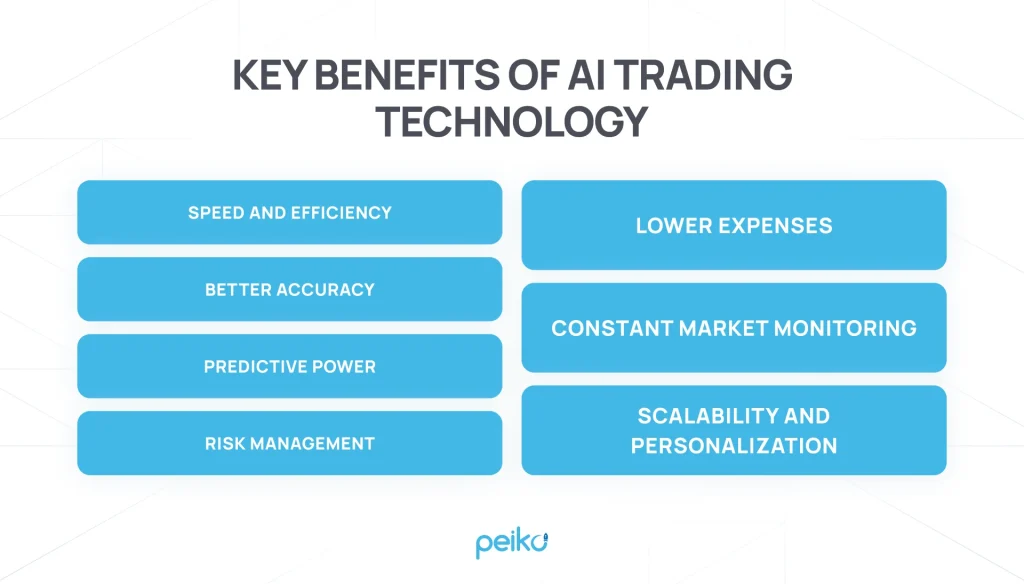
This technology boasts a wide range of benefits, and is one of the most valuable innovations in modern finance. Some of the most valuable advantages are:
Speed and efficiency
AI can handle millions of data points, use real time data analysis, and execute trades in milliseconds far beyond human capabilities. Efficiency means reacting to shifts in the market fast enough to seize trading opportunities before they disappear, which is especially valuable for active traders.
Better accuracy
AI algorithms reduce the influence of human biased judgment and human mistakes. By utilizing data and patterns, AI systems support more consistent and reliable decision-making, leading to rational trading strategies. This is especially important in volatile and fast-changing markets.
Predictive power
Machine learning and deep learning models within AI are able to detect subtle signals in stock prices, other financial metrics, sentiment, and macroeconomic variables. This allows traders to forecast trends rather than respond to them.
Risk management
Artificial intelligence in trading enables assessing risk in real time, and thus, tailoring trading strategy to changing market conditions. AI cautions against possible losses before they occur and suggests hedging or position rebalancing of assets as required.
Lower expenses
AI-driven research, automated trade execution, and even compliance activities lower operational expenses. It also eliminates most of the inefficiency and delays that come with manual processes.
Constant market monitoring
Markets like forex and crypto are open 24/7. AI platforms never need downtime – 24/7, they can monitor global events, social sentiment, and technical trends, never ever missing a chance.
Scalability and personalization
AI tools can be configured for different asset classes, types of risks, and trading goals. It may be a $1,000 or a $1 billion portfolio – a tailored AI tool scales up or down as per the goal.
Use cases: AI-powered trading in action
Artificial intelligence trading is an evolving technology that is already transforming the financial industry today. Let’s look at some examples of AI in action in 2025.
Citadel Securities
One of the leading US market makers, handling a wide range of stock trades, this company uses advanced AI-driven algorithmic trading systems to manage stock market activities, process vast amounts of data, and trade high-frequency with ultra-low latency.
Citadel CTO Umesh Subramanian, speaking at the Milken Conference, described AI’s role at the firm as accelerating research rather than replacing human judgment: AI tools, including an internal chatbot, help portfolio managers process filings, transcripts, and market signals faster — but the firm deliberately avoids letting AI make trading decisions on its own, keeping final judgment with human traders.
BlackRock
Another example is BlackRock, one of the world’s largest asset management firms. This company is actively using AI-powered tools used by stock traders in the stock market to trade stocks and improve investment decisions, including analysis of financial metrics. By leveraging AI-powered sentiment analysis (with NLP technologies), BlackRock tracks news, earnings calls, and social media to get insights about market sentiment in real time.
Challenges and risks to consider
Thinking about creating an AI algorithmic trading system? It is important to be aware of potential hurdles. You may also be interested in whether it’s possible to overcome them.
Market risk and correlated failures
Challenge: AI trading systems can amplify, not just reduce, market risk. If many firms deploy similar AI models trained on similar data, their strategies can converge — leading to correlated selling or buying that intensifies volatility rather than dampening it, a dynamic regulators have flagged as a systemic concern as AI adoption grows. Unlike a single trader’s mistake, an AI model’s error can replicate across thousands of trades in seconds before anyone notices.
Solution: Diversify model architectures and training data rather than relying on off-the-shelf approaches everyone else uses. Set hard circuit breakers and position limits that operate independently of the AI’s own risk assessment, and stress-test models against scenarios where multiple market participants behave the same way simultaneously.
Data quality and accessibility
Challenge: Financial AI models need high-quality data to operate. Incomplete or inaccurate data usually leads to poor predictions.
Solution: It is recommended to collaborate with trusted vendors, use automated data-cleaning software, and diversify sources. Merging structured (price feeds) and unstructured (news, social media) data makes the model more reliable.
Poor real-world performance
Challenge: Most AI models perform well on historical data, but when they are used for real-time trading, they make mistakes due to overfitting (meaning the model distinguishes noise instead of learning patterns).
Solution: Skilled developers like the Peiko team use proper validation techniques for model testing. We also use strategy testing across different market regimes (bull, bear, sideways) so models don’t become brittle.
Black-box decision making
Challenge: Deep learning models are usually hard to interpret, resulting in trust and compliance issues. This is a serious problem, especially if transparency is needed by regulators or stakeholders.
Solution: Incorporate explainable AI (XAI) methods for interpreting and visualizing model outcomes. Tools like SHAP or LIME allow developers and compliance staff to see and comprehend why an AI choice was arrived at.
Latency and execution delays
Challenge: High-frequency trading or real-time configurations in ai trading systems, and high-end AI models add latency. This impacts profitability and leads to slippage.
Solution: Make models efficient (tip: use narrow architectures where possible). Utilize colocated servers near exchanges, employ inference engines, and use hardware acceleration so lower latency supports faster trade execution. GPUs (Graphics Processing Units) or FPGAs (Field-Programmable Gate Arrays) are required.
Security and intellectual property risks
Challenge: AI models are valuable IP that can be hacked or stolen. Model poisoning or adversarial inputs are also a risk.
Solution: It is essential to encrypt models and datasets, and implement access controls. Isolate sensitive systems into sandbox environments. Monitor for abnormal behavior or unauthorized access.
Skill and knowledge gaps
Challenge: Developing AI for trading requires a unique combination of domain knowledge in finance, machine learning, and software engineering.
Solution: Hire a team with engineers, finance specialists, and data scientists who have experience building AI solutions, a reputation for excellence, reviews on leading review platforms, and case studies to demonstrate.
The future of AI in trading: Emerging trends for 2025 and beyond
There is no longer any doubt that the implementation of AI trading algorithms will only gain momentum in the future. Everything from quantum hardware-enabled optimization to advanced sentiment analysis – all new trends are aimed at improving AI technology.
Quantum annealing portfolio optimization
Quantum annealing (quantum hardware-enabled optimization with AI) is already being experimented with in finance. CaixaBank, a leading bank in Spain, partnered with D-Wave to apply quantum hybrid solvers to investment portfolio optimization and hedging calculations — reporting up to a 90% reduction in time-to-solution compared to their previous approach, along with improved bond portfolio returns. The technology is still early-stage: independent research suggests today’s quantum solutions are approaching, rather than consistently beating, the performance of classical solvers — but the speed gains alone make it a trend worth watching.
Sentiment-driven & custom automated platforms
Automated investment platforms increasingly combine real-time sentiment monitoring — from news, social media, and earnings calls — with quantitative signals. Used by firms like BlackRock and specialist fintech companies, these systems generate trade signals across different market conditions, reacting to shifts in sentiment as they emerge.
Custom-built AI solutions for specific asset classes or currencies (like crypto and commodities) give organizations a unique edge.
Edge AI and low-latency execution
In high-frequency trading, where milliseconds equal money, AI models are increasingly being deployed at the edge. That is, physically closer to the source of trading activity, often within or near exchange data centers, rather than in distant cloud servers. This setup reduces latency and enables ultra-fast decision-making.
With edge computing, trading firms can run AI inference locally — cutting latency, speeding up execution, and keeping sensitive data closer to home. Co-located servers near major exchanges like the NYSE or CME enable real-time analytics and decisions without the need to constantly transfer data to and from the cloud.
Autonomous trading agents
Agentic AI refers to autonomous AI agents that not only make decisions but execute them with minimal or no human intervention. Think about it: self-correcting, adaptive ai trading bots that loop and optimize in real time.
It’s worth noting that even industry-leading systems are still cautious about full autonomy. JPMorgan’s LOXM, for instance, uses deep reinforcement learning to optimize how large trades are executed — but the system itself makes no trading decisions and every trade still requires trader approval. This reflects a broader pattern: most institutions are moving toward AI that acts with tight human oversight rather than full independence, even as the underlying technology becomes more capable of true autonomy.
Explainable AI (XAI) & real-time risk monitoring
Regulatory authority has required explainable AI. These are models that provide transparent, auditable justification for actions taken in the market. Simultaneously, risk-management systems powered by AI are moving from passive alerts to predictive forecasting of volatility, market movement, and portfolio risk.
Peiko is a trusted partner to build AI trading platforms
The development of AI automated trading solutions requires the rare combination of deep tech, domain knowledge, and startup agility. Peiko has all three. We support fintech founders in advancing innovative concepts from initial discovery to live product launch. We bring fintech innovation to life.
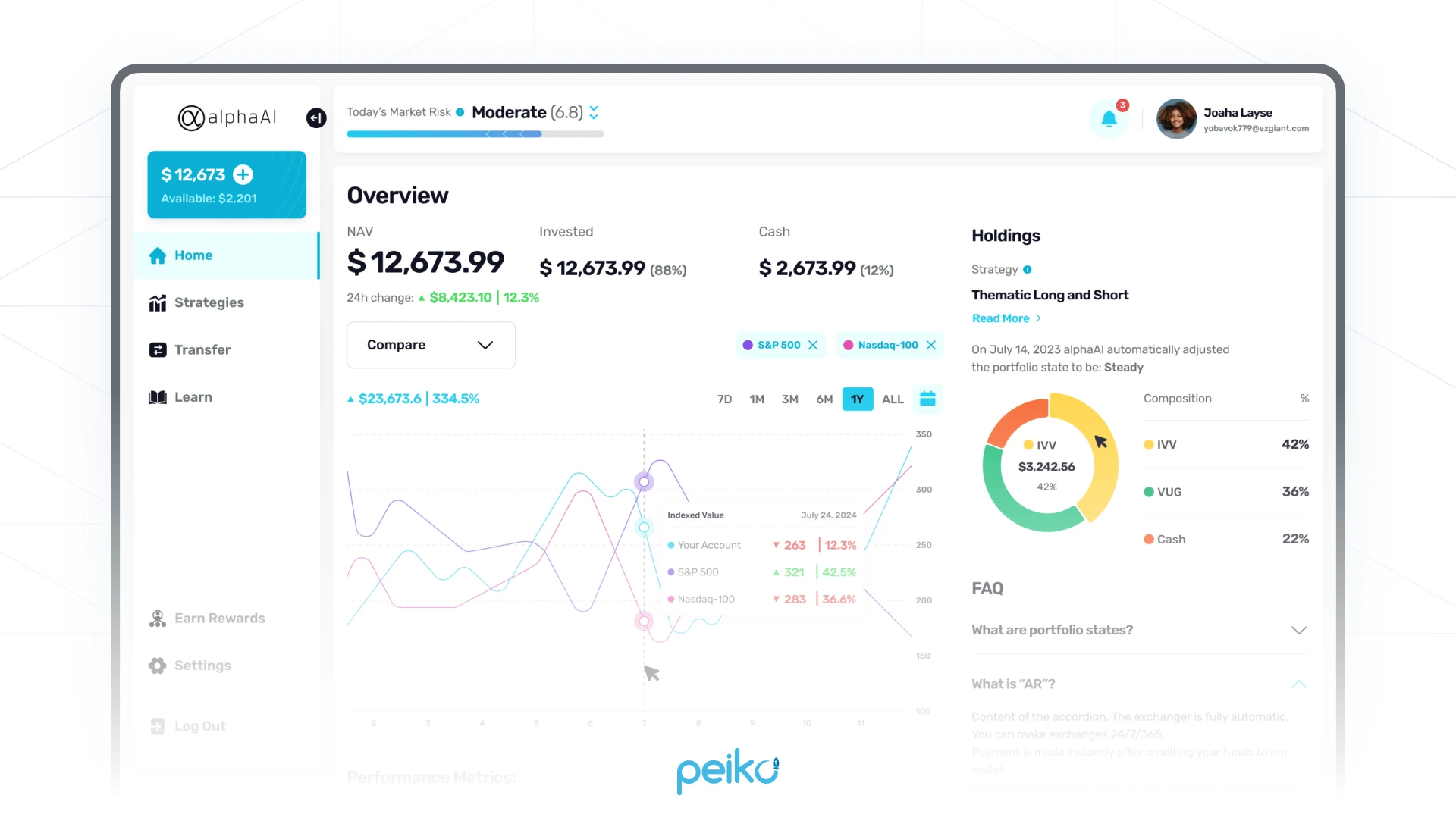
One of them is alphaAI Capital – a U.S. based start-up transforming retail investing with AI.
Case Study: alphaAI Capital
alphaAI Capital is an innovative platform that allows retail investors to design, test, and execute self-executing ETF strategies via artificial intelligence. The client came to us with a bold vision – and a partially completed codebase we went on to replace it for future-proof scalability.
We launched a secure, modular, AI-driven fintech product from scratch, yet remained flexible enough to pivot our product weekly.
What the client got
With our AI development services, the alphaAI Capital team was provided with a fully ready, AI-powered ETF trading platform that is appropriate for the needs of retail investors. We did not just deliver the product, but a scalable technology base that is suited for long-term growth. The client got:
- A production-ready, secure MVP delivered within 6 months
- An AI-powered ETF trading platform with real time analysis and < 200ms response time
- Seamless onboarding and compliance infrastructure (KYC, 2FA, audit trails)
- Integration with primary services like Alpaca, Elastic, Plaid, Mailchimp, SendGrid and PostHog
- Modular, containerized architecture that supports rapid iteration and scaling
- An adaptive Agile workflow that allowed for constant product development based on user and investor input
This enabled the client to introduce early adopters, to move quickly with iterations, and to advance confidently toward financing and market expansion with a stable, investor-proven product.

Conclusion: A market reinvented
Artificial intelligence is no longer just complementing trading. AI is transforming the market itself. From lightning-fast algorithmic execution, real-time sentiment analysis, to adaptive AI-powered portfolio strategies, AI provides exclusive speed, accuracy, and scalability.
Trends like autonomous trading agents, quantum optimization, and explainable AI are shaping the next generation of financial technology. At the same time, even retail investors can now have access to tools that were once reserved for hedge funds – thanks to user-friendly, AI-driven platforms.
For entrepreneurs and fintech innovators, this is a golden opportunity: the market is hungry for smarter, more convenient trading technology. If you’re thinking of building a trading product, act now.
Need an expert team to build your AI trade platform? Contact us and we will help transform tricky fintech ideas into scalable, real-time solutions – secure, compliant, and ready for growth.
No comments yet. Be the first to comment!