
















Disclaimer: The information below is for informational purposes only and is not legal advice. Always consult with a certified legal professional who specializes in digital assets and regional financial regulations before launching your product to align with strategic compliance OKRs.
By its concept, the prediction market is a platform that allows users to trade contracts based on the outcome of future events. Recently, such services have seen a significant increase in popularity and have extended their direction from narrow-oriented academic experiments into a financially and culturally widespread product for any market segment.
However, as it happens with any growing market, it becomes more and more followed by a pressing question for any founder and business owner planning to operate within this market: Is it legal to build a prediction market?
Generally, the best answer would be: It depends heavily on the local jurisdiction of the operation’s state, the type of the listed events, and the platform’s financial architecture. In 2026, the regulatory landscape will be strictly formed by the state gaming commissions’ activity, shifting CFTC regulations, and international frameworks like MiCA. The process of managing these regulations is complex but navigable. In this article, we will describe the areas where prediction markets are legally complicated and outline the safe paths for building a legally stable product.
Why Prediction Markets Are Legally Complicated
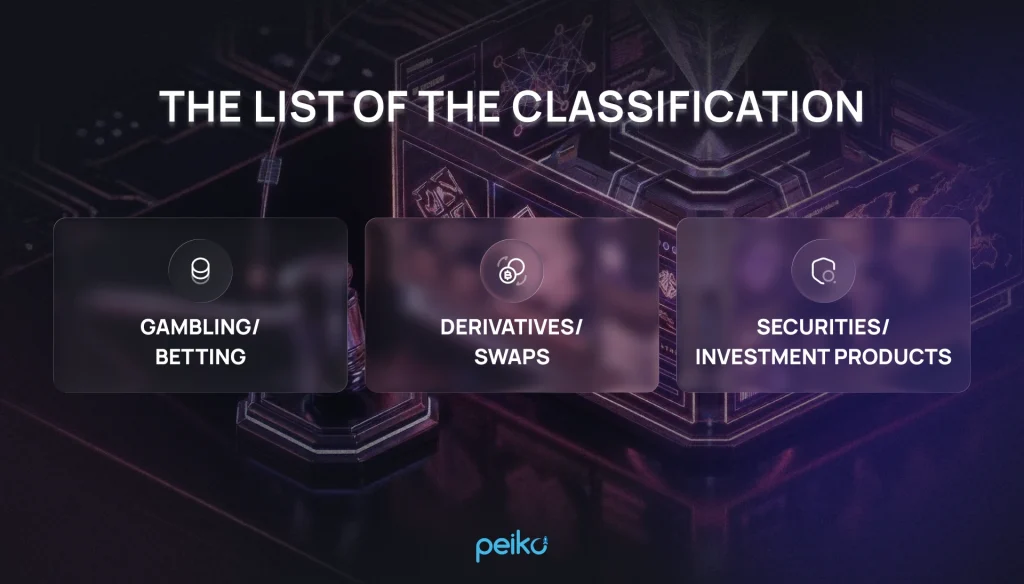
Regulators do not have a single “Prediction Markets” label on the products of this type. Instead, because they include the mechanics of trading and forecasting, these platforms often fall into multiple, sometimes conflicting, regulatory definitions. Typically, the regulators use the following classification for prediction markets:
- Gambling/Betting: Considering the users are risking (betting) money on an uncertain future outcome, many state and national regulators view this as sports betting or casino gaming.
- Derivatives/Swaps: Because users are trading contracts that derive their value from an external event, financial regulators (like the CFTC in the US) often classify them as commodity derivatives or binary options.
- Securities/Investment Products: If the platform promises a return on investment, or if the underlying asset is tied to traditional securities, it triggers SEC (or international equivalent) oversight.
This uncertainty is the root of the legal risk for the prediction markets. That is why there are real risks that a platform built perfectly to comply with the commodities law might be simultaneously sued by a state gaming commission for unlicensed gambling.
The 5 Factors That Determine Whether a Prediction Market Is Legal
While conducting a legal review of the prediction market platform architecture, they will evaluate your product design against five key factors. These decisions directly dictate your legal risk profile. As a business owner or a responsible stakeholder, it is worth assigning a proper expert team that will map these legal constraints into explicit software requirements (such as documented requirements for compliance blocks, KYC flows, and automated reporting) during the pre-development stage (for example, during the Discovery phase). Failing to translate legal limits into technical architecture often leads to massive refactoring post-launch.
1) Jurisdiction Geo (Product Operations vs Users Activity)
Your legal focus is defined both by where the platform is incorporated and which state the Users belong to as residents.
- Company Location: Operating offshore does not provide a magical shield if you solicit customers in highly regulated zones.
- Users’ Location: If a platform allows U.S. or EU residents to utilize the product, it is subject to U.S. or EU legislation. Geo-fencing and strict IP blocks are standard architectural requirements.
- Payment Processing: Banks and payment gateways enforce their own compliance. Using traditional payment flows requires strict adherence to the laws of the jurisdiction where the bank operates.
From a product architecture perspective, this means the platform’s legal compliance cannot rely on just a simple pop-up asking “Are you a US resident?”. The system must have advanced VPN detection integration, residential address verification via third-party KYC providers, and continuous behavioral monitoring. In the EU, the Markets in Crypto-Assets (MiCA) regulation enforces uniform rules, meaning a license in one member state can be passported, but failing to secure it blocks the entire platform. Startups attempting “regulatory arbitrage” set up in a lax jurisdiction while silently running marketing campaigns targeting tier-1 users and are caught by their digital metadata footprint.
2) Real Money vs Play Money
From the financial side, this is one of the most defining factors of your legal status.
- Deposits / Withdrawals: As soon as a user can deposit fiat or cryptocurrency, trade, and withdraw winnings, the platform is operating a regulated financial or gaming entity.
- Cash-Out Rules: If users buy tokens or internal currency credits but cannot ever cash them out for real-world value, the legal regulation level drops exponentially (often shifting to sweepstakes or pure gaming laws).
To have this area implemented properly, many platforms work with the “dual-currency sweepstakes” architecture, similar to modern social casinos, users buy a non-redeemable virtual currency for fun and receive a secondary “sweeps” token as a free bonus, which can be traded and redeemed. Alternatively, in B2B enterprise environments, “play money” prediction markets are used to crowdsource employee insights on internal sales targets or product launch dates.
3) The Events Listed
Even if the platform can have a unified technology and interface, from the legal side, not all events are treated equally by the law.
- Politics and Finance: In the United States of America, the CFTC has historically taken a very hard line against political event contracts, citing concerns over election integrity. While 2026 has seen some court battles regarding political futures, it remains high risk.
- Sports: Listing sports outcomes almost universally triggers sports betting regulations. Gaming commissions at the state level actively defend their authorized sportsbooks against unregulated rivals in the prediction market.
- Restricted Categories: Markets on assassinations, terrorism, or illegal events are obviously banned and will trigger immediate criminal liability.
As a founder, the market management functionality within the admin panel must have hardcoded category restrictions and compliance approval workflows. Entertainment and pop culture markets are crossing a line closer to a legal gray area but are generally tolerated if the stakes are low. Furthermore, financial regulators often evaluate the “economic purpose” of a market. A market predicting whether a specific hurricane will hit the coast acts as a legitimate insurance hedge for local businesses, making it more correct to regulators than a market predicting the color of a red carpet celebrity dress.
4) Centralized vs Decentralized Platforms
A common misperception in building a Web3 application is that building a decentralized protocol frees one from legal liability.
- Decentralization is not an escape from liability: Regulators in 2026 have already clarified that by building the front-end interface, platform promotion, or taking a fee from the smart contracts, the platform receives the role of an operator.
- Control and Fees: The more control a core team has over the protocol (admin keys, resolution powers, fee collection), the easier it is for regulators to assign liability.
This reality has led to the architectural pattern of “front-end separation.” The protocol itself might exist as immutable smart contracts on Ethereum or Solana, but the web interface operated by the founding team actively blocks sanctioned wallets and specific IP ranges to comply with local laws. Furthermore, if you implement a DAO (Decentralized Autonomous Organization) to vote on market resolutions or treasury spending, members with significant voting power can sometimes be treated by courts as members of an unregistered general partnership. Thus, it is worth remembering that decentralization is a technical architecture choice, not a legal defense.
5) Custody, Payments, and Settlement
The way the service handles user capital forms the financial compliance burdens.
- Holding User Funds: Acting as a custodian for user funds triggers strict capital reserve and money transmitter laws.
- Payout Mechanism: Automated settlement via smart contracts (non-custodial) can shift some custodial risk, but fiat-to-crypto onramps still require heavy compliance.
If your backend database directly updates and holds user balances, you are operating an internal financial ledger. This means you must acquire Money Transmitter Licenses (MTLs) in almost every U.S. state you operate in, or a VASP (Virtual Asset Service Provider) registration in the EU. For the non-custodial architectures, where users trade directly from their personal Web3 wallets and funds are locked in audited, trustless escrow contracts, it drastically reduces this specific burden. To maintain a Web2-like user experience without touching the money, modern 2026 platforms often utilize “Account Abstraction” (ERC-4337), allowing users to log in with email while a smart contract securely handles the self-custody seamlessly in the background.
Common Legal Classifications (And What They Mean)
Depending on the prediction market legalization factors, your platform will likely belong to one of the following classifications:
Gambling / Betting Platform
If classified as gambling, the platform must receive licenses to be eligible to operate in every specific jurisdiction.
- Licensing Concept: Gambling licenses are known for their high cost of obtaining and long duration of acquisition, and are followed by heavy taxation.
- Requirements: The service must have strict age restrictions (21+ in many places) and implement responsible gaming requirements (deposit limits, self-exclusion tools).
Derivatives / Financial Instrument
If the platform is regulated as a financial exchange, for example, under the CFTC:
- Regulated Markets: This requires immense institutional compliance, capital requirements, and routine audits.
- Reporting: Platforms must maintain a constant and deep market surveillance to prevent insider trading and market manipulation.
Securities / Investment Product
If your tokens or markets are registered as securities.
- Investments: If users are expecting profits primarily from the efforts of your team, the product will be under the securities legislation.
- Risk Disclosures: Needs extensive filings of prospectuses, screening of accredited investors, and stringent restrictions on advertising.
Prediction Market Compliance Requirements in 2026
If the business is developing a product under a real-money prediction market platform compliance in 2026, it demands that specific features be implemented directly into the software architecture.
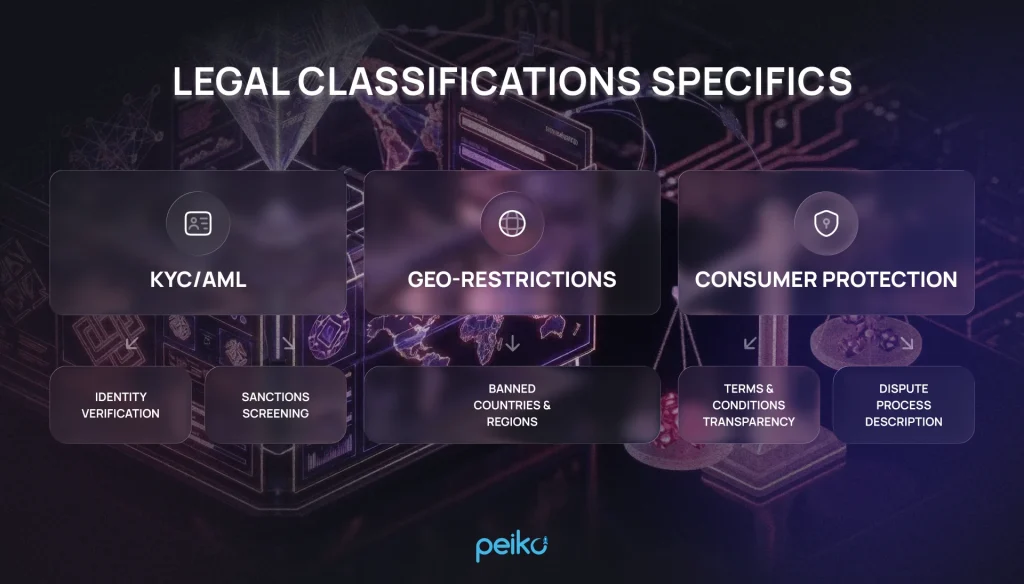
KYC/AML
- Identity Verification: Anonymous trading is mostly a forbidden action. Integration with tools that verify government IDs and facial biometrics is mandatory.
- Sanctions Screening: Your system must automatically check users’ identities against global AML (Anti-Money Laundering) and OFAC sanctions lists.
Geo-Restrictions
- Banned Countries & Regions: Your application must prevent access from prohibited jurisdictions using advanced IP tracking, VPN detection, and residential address verification.
Consumer Protection
- Terms and Conditions Transparency: The platform shall contain clearly explained rules on how markets are resolved, the fee structure, and the mathematical models used for pricing.
- Dispute Process Description: A clear, documented path for users to process a market resolution before funds are permanently settled.
Legal Risks for Decentralized Prediction Markets (Web3)
While building Web3 decentralized prediction market apps, the team may face unique challenges that can appear only in this area.
Smart Contracts Don’t Eliminate Liability
- Front-End Operators: Regulators frequently target the web hosting and front-end domains of DeFi protocols. If you provide the User Interface for U.S. users to access unregulated smart contracts, it is a risky action that could have long-term consequences.
- DAO Governance Risks: Token holders who actively vote on market resolutions or fee structures may be viewed as part of an unincorporated general partnership, carrying potential joint liability.
Oracles & Dispute Resolution
- Responsibility for Outcomes: If a decentralized oracle provides incorrect data and user funds are lost, it is crucial to have a technical and legal answer to who is responsible for that. Consumer protection agencies are increasingly interested in the mechanisms of Web3 dispute resolution as a compliance tool.
Safe Product Models to Avoid Licensing
If the regulatory burden of a real-money, public prediction market is too high for the startup’s runway, consider these safer product architectures.
Play-Money Markets
- Concept: Users trade using virtual credits or “sweep coins.” There is no fiat cash-out.
- Use Case: Highly effective for building a trustworthy user community, lead generation, or educational platforms without triggering financial regulations.
Internal Corporate Forecasting Markets (B2B)
- Concept: Enterprise software sold to corporations. Employees use virtual credits to bet on internal company metrics.
- Use Case: This is purely a business intelligence tool and carries almost zero regulatory risk regarding gambling or finance.
Subscription-Based Forecasting (No Trading)
- Concept: Users pay a monthly SaaS fee to access the platform. They can make predictions and rank on a leaderboard, but they are not risking capital per prediction.
- Use Case: Gamified analytical platforms.
| Product Choice | Legal Risk | Compliance Complexity | Notes |
| Play-Money (No Cashout) | Low | Low | Focus shifts to standard data privacy (GDPR/CCPA). |
| Internal Corporate B2B | Low | Low | Closed ecosystem; no public retail harm possible. |
| Crypto Settlement (DeFi) | High | Very High | Scrutinized heavily for AML evasion and unregistered derivatives. |
| Real Money (Sports/Politics) | Very High | Extreme | Requires millions in legal counsel and licensing fees. |
How to Approach Legal Strategy – Recommendation
Do not treat compliance as an afterthought. It must be integrated into sprint zero.
- Get comprehensive legal consulting in target jurisdictions: Before launching the development process, get a legal opinion on your exact user flows.
- Decide on Market Categories: Restrict your MVP to lower-risk categories (e.g., tech milestones) and avoid Sports and Politics categories until you have regulatory clearance.
- Define Compliance Stack: Choose your KYC, AML, and geofencing API providers early.
- Build an MVP with Geo + KYC from Day 1: Do not launch the beta with an “open” status and add the KYC later. Regulators suspiciously assess the retroactive compliance.
- Prepare Audit Logs: Ensure your database architecture features append-only audit logs for every transaction and resolution, providing transparency to supervisory authorities.
Compliance Features to Build Into the Platform:
- KYC/AML Verification Gateways
- Strict Geofencing and VPN Detection
- Append-only Audit Logs for all trades
- Documented Dispute Resolution Mechanisms
- Responsible Gaming Controls (Deposit limits, timeouts)
Key Takeaways
- Legality depends heavily on jurisdiction, what you allow users to bet on, and how money flows.
- Introducing real-money deposits and withdrawals increases architectural complexity and legal risk dramatically.
- Building a decentralized or Web3 platform does not absolve front-end operators or core teams from regulatory oversight.
- Compliance is not just paperwork; it is a core part of your software product architecture.
Conclusion
The prediction market industry is a comprehensive technological and financial business goal, but it is bound by strict, evolving regulations. If you are planning to build a prediction market platform, consider deep expertise and a consultation from a legal expert early, and design compliance directly into your technical architecture from day one.

Our team can help with product architecture and technical implementation.
With deep expertise in blockchain, custom software development, and complex Web3 architectures, Peiko is prepared to help you build a secure, compliant, and scalable platform that meets modern regulatory realities.

No comments yet. Be the first to comment!