



TL;DR
- A DAO’s community is the organization itself: without active members, proposals stall and votes miss quorum.
- Give people a clear reason to show up and a visible path from newcomer to contributor.
- Pair recognition with real stake (roles, tokens, vesting) instead of one-off payouts.
- Measure voting and contribution, not Discord noise.
Most writing on the importance of community in DAOs treats it as a support function, something you staff after the smart contracts ship. That gets it backwards. In a DAO, the community is the organization: the people who write proposals, vote on them and do the work those proposals fund.
The last few years made this hard to ignore. DAOs that ran community as “a Discord server and good vibes” mostly stalled when the market cooled. In March 2026 even Tally, the governance platform behind 500+ DAOs, announced it was shutting down as demand for DAO tooling faded. The communities still active built structure early: roles, onboarding and incentives tied to real contribution.
This guide is for founders setting up a new DAO’s community layer and for core teams trying to revive participation. Still at the setup stage? Start with our step-by-step guide to creating a DAO. It covers why community drives everything else in a DAO, including governance and funding, the tools and structures that work, the mistakes to avoid, and three real communities worth studying.
Why Does Community Determine Whether a DAO Survives?
A DAO with no active community can’t reach quorum or staff its own proposals, so it stalls no matter how good its contracts or treasury are. Code can enforce a vote; it can’t make anyone show up to cast one. Community is what turns a set of smart contracts into an organization that makes decisions and gets work done.
It improves decisions, not just speed. More active members means more people reading a proposal before it passes. A developer spots a contract risk, a community manager flags how a change will land with newcomers, a treasury contributor asks about runway. A small, quiet voter base pushes proposals through faster, but it also lets weak ones through.
It’s the DAO’s feedback loop. A DAO has no CEO checking in with customers. Its early-warning system is the community: forum sentiment, how many people comment on a proposal, who stops showing up to calls. When those signals drop, it usually means the DAO is drifting from what its members want, well before it shows up in token price or treasury numbers.
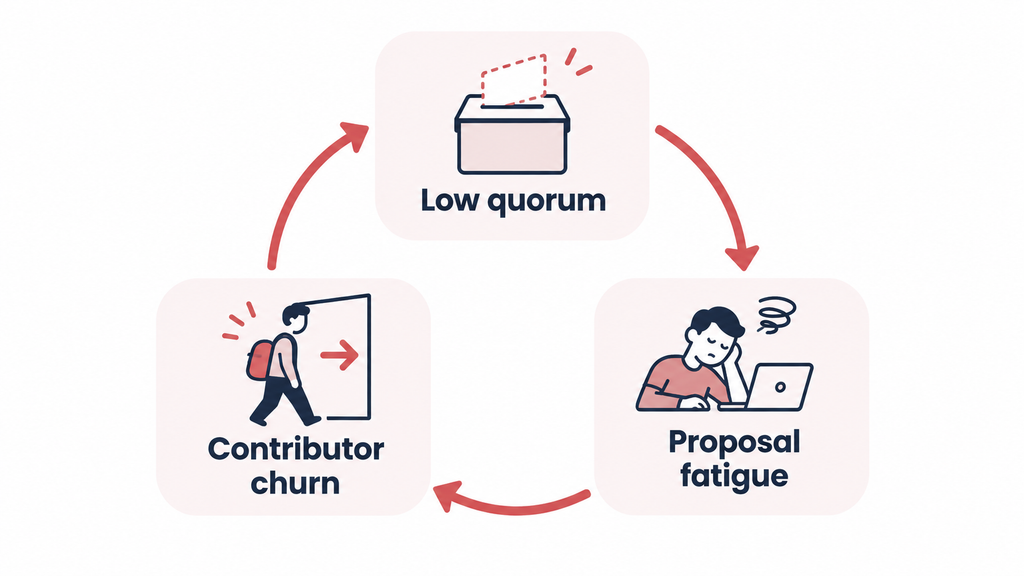
Without it, three failure modes appear. They tend to arrive together:
- Low quorum. Votes fail or get extended because too few tokens participate, and decisions pile up.
- Proposal fatigue. The same handful of people write, review and vote on everything until they burn out.
- Contributor churn. New members join, find no clear role, and leave within weeks. The DAO keeps “onboarding” without ever growing.
The practical takeaway: community isn’t a growth channel you add later. It’s the operating layer that governance and funding both run on.
How Do You Actually Build a DAO Community? (Foundations)
Start with a clear purpose and a role structure, then pick tools. Tools don’t fix an unclear reason to show up; they just make the confusion more visible. These four foundations come before any bot, dashboard or reward program.
Define a mission members can rally around
A DAO’s mission should answer one question: what will members do here that they can’t do alone? “Build the future of finance” is a slogan. “Fund and ship open-source tooling for Solana developers” tells people whether they belong and what work counts. A specific mission also makes later decisions easier, because proposals can be judged against it.
Structure tiered membership and a real onboarding flow
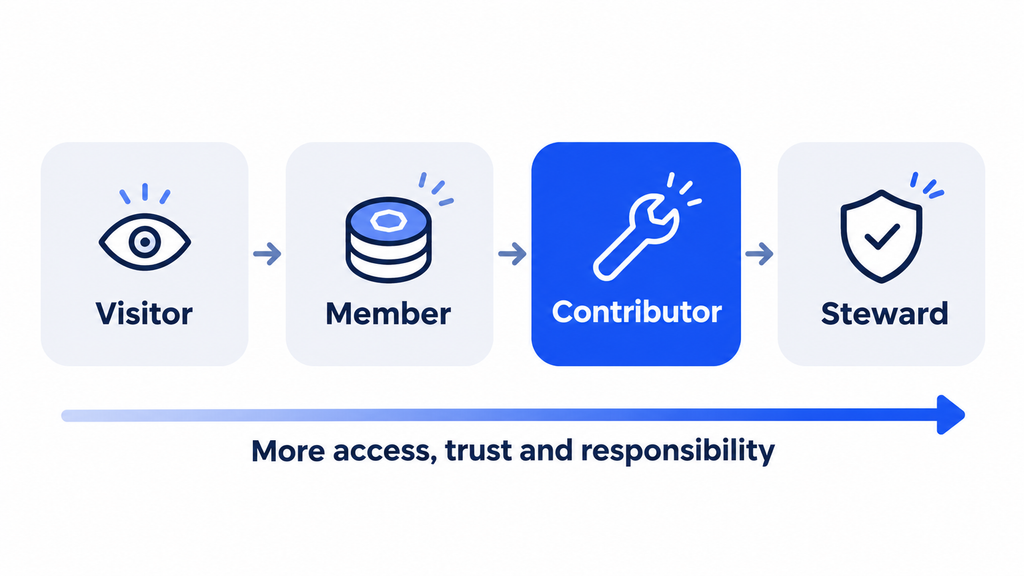
Tiered membership gives people a path from first visit to real responsibility, with each step unlocking more access and more trust. “Join the Discord” is not an onboarding flow. A working flow tells a newcomer where to start, what a first contribution looks like and how to move up.
The diagram below shows a typical four-tier path. The names vary from DAO to DAO; what matters is that each step is visible and earned.
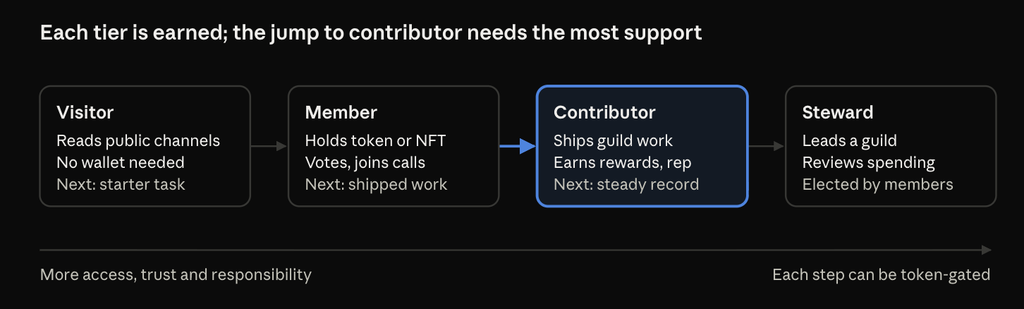
Access widens at each step; the member-to-contributor jump is where a starter task and a named mentor matter most.
Split into working groups or guilds as you grow
Once a DAO passes a few dozen active contributors, one big channel stops working. Working groups (often called guilds) split the DAO into sub-teams around a skill or a stream of work, such as writing, development or treasury. Each group gets its own scope, coordinator and often its own budget. Members get a smaller room where their work is noticed, and the DAO gets accountability it can actually track.
Token-gate access so permissions match contribution
Token-gating ties Discord or Telegram roles to what a member holds or has done on-chain. Tools like Guild.xyz and Collab.Land check a connected wallet and assign roles automatically. Guild.xyz can combine several requirements, such as a token balance plus a GitHub account, while Collab.Land focuses on token and NFT ownership. Used well, gating keeps spam out of contributor channels and makes each tier in your onboarding flow enforceable rather than honor-based.
Which Tools and Platforms Actually Run DAO Communities?
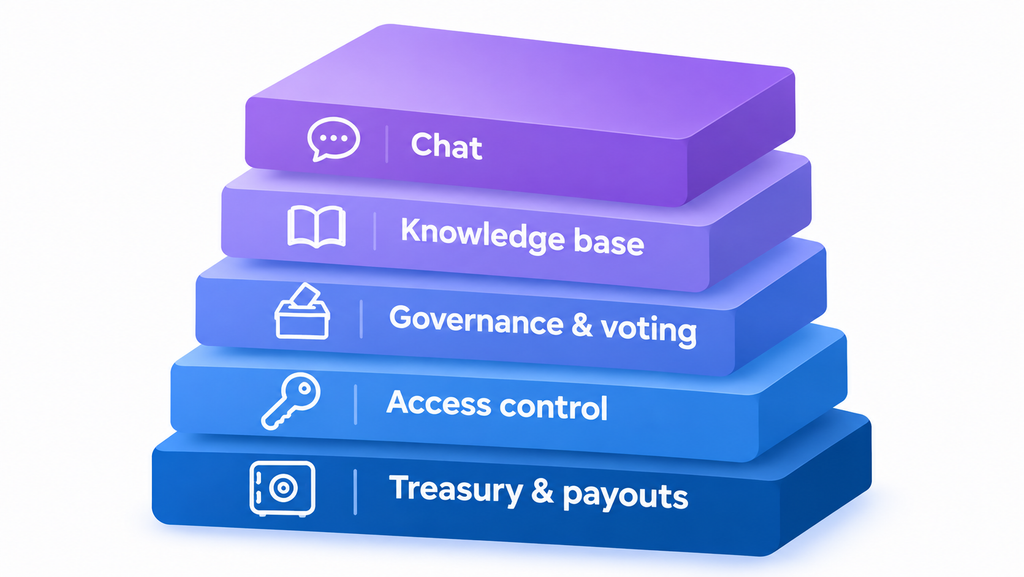
Most DAO communities run on a stack of five layers: chat, a knowledge base, a governance forum and voting tool, access control, and a way to pay contributors. No single platform covers all five, and the stack has changed a lot since 2022, so check each tool’s status before you commit to it.
| Tool | What it’s for | Status (Nov 2026) |
|---|---|---|
| Discord | Day-to-day chat, voice calls, role-based channels | Active; the default for most DAOs |
| Telegram | Announcements and fast chat, common in trading-heavy communities | Active |
| Notion | Wiki, onboarding guides, meeting notes, project boards | Active |
| Snapshot | Gasless off-chain voting weighted by token holdings | Active |
| Cactus (formerly Tally) | On-chain governance: proposals, delegation, execution | Tally shut down in March 2026; ScopeLift took over and relaunched it as Cactus |
| Discourse | Long-form governance forum for drafting and debating proposals | Active |
| Common (formerly Commonwealth) | Crypto-native forum with wallet login and built-in voting | Active, though some DAOs, such as 1inch, moved back to Discourse in 2025 |
| Guild.xyz | Rule-based roles across Discord, Telegram, GitHub and more | Active |
| Collab.Land | Token and NFT verification for Discord and Telegram roles | Active |
| Safe (formerly Gnosis Safe) | Multisig wallet that holds the treasury and pays contributors | Active; rebranded from Gnosis Safe in 2022 |
| Coordinape | Peer-allocated contributor rewards | App sunset in 2025 |
| SourceCred | Algorithmic contribution scoring | Organization wound down; code still open source |
Communication: Discord and Telegram. Discord remains the home base because roles, threads and voice channels map well onto tiers and guilds. Telegram works better for announcements and for communities whose members already live there. Many DAOs run both, with Discord for work and Telegram for reach.
Knowledge base: Notion. A Notion wiki is where onboarding actually happens: what the DAO does, how to claim a first task, who leads each guild. If a newcomer has to ask the same question in chat that ten people asked before, the wiki is failing.
Governance and voting: Snapshot, Cactus, Discourse and Common. Discussion usually starts in a forum, moves to a Snapshot signal vote, and ends on-chain for anything that moves treasury funds. The forum is where community and governance meet, which is why participation there is a good early signal of health. For how those votes are structured, see our guide to DAO governance.
Reputation and contribution tracking: what SourceCred taught. SourceCred scored contributions algorithmically across GitHub, Discord and Discourse and paid out in its own token. The project lost funding and the team disbanded, and users found that automated scoring rewarded noise. The lesson still holds: automated scores are a useful input, not a verdict.
Contributor rewards: peer allocation and Safe. Coordinape gave every circle member a fixed budget of GIVE tokens to hand out to teammates, and each person’s share of the reward pool matched what peers gave them. At its peak, 500+ DAOs ran GIVE circles before the app closed in 2025. The model of peers deciding who gets paid is still worth copying, whether through a successor tool or a simple spreadsheet round. The payout itself usually comes from a Safe multisig, so several signers must approve every transfer. For how DAOs size and protect those budgets, see our guide to DAO funding and treasury management.
What Actually Gets Members to Participate? (Incentives & Engagement)
Incentives that combine recognition with real stake (tokens, roles, vesting) outperform either one alone. Recognition without stake fades once the novelty wears off. Stake without recognition attracts people who farm rewards and leave. The engagement tactics below work best as a system, not as one-off campaigns.
- Gamification with a purpose. Points, badges and leaderboards help when they track work the DAO actually needs, such as reviewing proposals or answering newcomer questions. They backfire when they reward message count.
- Mentorship. Pair each new contributor with someone a tier above them for their first few tasks. A named person to ask is one of the most direct fixes for the member-to-contributor drop-off.
- Public recognition. Shout-outs in community calls, a monthly contributor spotlight and visible role upgrades all cost nothing and signal that work gets noticed.
- Events and AMAs. Regular community calls and Ask Me Anything sessions with core contributors keep the DAO’s direction visible. Record them for members in other time zones.
- A resource library. Guides, templates and past proposals in one place let members contribute without waiting for someone to explain the basics.
- Cross-DAO collaboration. Joint events or shared guilds with aligned DAOs bring in new contributors who already understand how DAOs work.
- Feedback surveys. A short survey each quarter, or a community Net Promoter Score, catches dissatisfaction before it turns into churn.
Use vesting so rewards favor long-term contributors
Immediate, one-time rewards attract mercenaries: people who complete a task, collect the tokens, sell them and move on. Vesting releases rewards over a period, often with a cliff before the first unlock, so contributors only collect the full amount if they stay. That one change shifts who your incentive program attracts. Pair vesting with roles that build over time, such as steward seats or guild budgets, and contributors have reasons to stay beyond the token price.
Track community health metrics
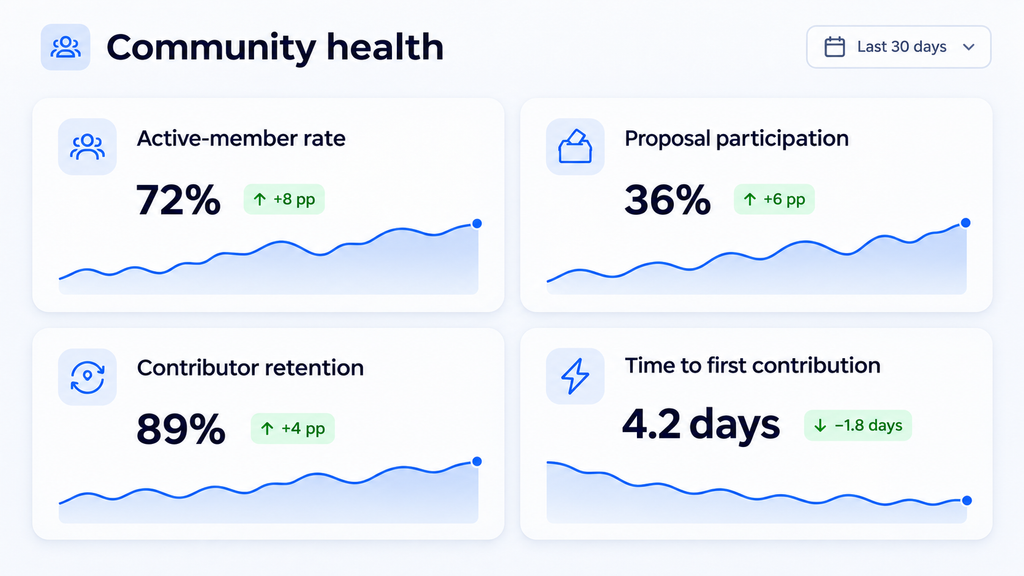
You can’t improve participation you don’t measure. These four metrics show more about community health than member counts or Discord message volume:
| Metric | How to measure it | What it tells you |
|---|---|---|
| Active-member rate | Members who voted, posted in the forum or shipped work in the last 30 days, divided by total token-gated members | Whether your community is real or mostly dormant wallets |
| Proposal-participation rate | Unique voters per proposal, divided by eligible voters | Whether decisions reflect the community or a small inner circle |
| Contributor retention | Contributors active this quarter who were also active last quarter | Whether onboarding and incentives keep people beyond their first task |
| Time to first contribution | Days from joining to first completed task or merged pull request | Whether your onboarding flow actually works |
Set a baseline, review it every season and tie changes in your onboarding or reward design to movement in these numbers.
DAO Community Best Practices (Common Mistakes to Avoid)
Most struggling DAO communities make the same handful of mistakes, and nearly all of them come from measuring the wrong thing or leaving the path to contribution unclear. Avoid these five and you’ll be ahead of most DAOs that launched in the last cycle.
- Treating Discord activity as engagement. A busy general channel is not an engaged community. If hundreds of people chat daily but a few dozen vote, your real community is the few dozen. Track voting and shipped work instead of message volume.
- Leaving no path from member to contributor. People join, read the channels and never find a role. Publish a list of starter tasks, name who reviews them and make the next tier visible from day one.
- Rewarding volume over quality. Paying per proposal, comment or post invites spam built to farm incentives. Reward outcomes, cap what unverified accounts can earn and let peers or guild leads review contributions before payout.
- Ignoring time zones. A DAO whose calls all happen at 5 p.m. New York time quietly excludes Asia and much of Europe. Rotate call times, record everything and make sure key decisions happen asynchronously in the forum, not live on a call.
- Building on a single tool you can’t replace. Coordinape’s app closed in 2025 and Tally announced its shutdown in 2026. Keep your member lists, contribution records and governance history exportable, so a vendor change is an inconvenience, not a crisis.
Real DAO Communities Worth Learning From
Three DAOs show the foundations above working in practice: BanklessDAO for guild structure, Developer DAO for onboarding, and Friends With Benefits for tiered, curated membership. Each solved a different community problem, which is why they’re worth studying side by side.
BanklessDAO: guilds as talent pools
BanklessDAO launched on May 4, 2021 when the Bankless founders airdropped 35,000 BANK tokens to each premium newsletter subscriber, then stepped back. It organizes contributors into 13 guilds, from writing and design to development and legal. Work runs in roughly three-month seasons, so priorities and budgets reset on a predictable rhythm.
What stands out for community builders is how guilds handle people, not just tasks. Under member-based guild funding, guilds could choose to be funded by their number of active members, which made recruiting and retaining talent part of each guild’s job. The DAO also ran a monthly community Net Promoter Score survey and broke results down by contributor level, a working example of the health metrics above.
Developer DAO: onboarding built for scale
Developer DAO is a community of Web3 developers, designers and marketers. Its Discord is token-gated by a membership NFT, with free NFTs available through a scholarship, so cost isn’t the only way in.
As it grew, new members were dropped into too many channels at once. The team rebuilt onboarding with Guild.xyz as the permission layer: newcomers start in a small space and opt into interest groups when they’re ready. More than 6,000 members went through that flow, with about 1,000 more each month. The team also launched a re-onboarding program for members who had drifted away. Its open-source D_D Academy gives members a learning path, and its early-contributor reward round capped what unverified contributors could receive, a direct fix for reward farming.
Friends With Benefits: curated membership and identity
Friends With Benefits (FWB) started as a token-gated Discord and became a social DAO for Web3’s creative community. Joining has required both a written application reviewed by the community and a minimum $FWB holding. The bar is deliberate: members are vetted, so the community keeps its identity as it grows.
FWB also shows that tiers are a live design decision. Its members voted to remove the cheaper local tier, a move some members warned would push out people outside its core cities. On the other side, its Event Keys program has supported 250+ member-led events in more than 40 countries, and FWB FEST has become an annual in-person anchor. In 2025 FWB paused new applications to redesign membership around builder programs, so check its current model before citing specifics.
Conclusion
Community isn’t a support function of a DAO; it’s the mechanism that makes governance and funding actually work. A clear mission, a visible path from visitor to steward, incentives that reward lasting contribution and a few honest metrics will do more for participation than any new bot. And a community with no way to vote or get paid won’t stay engaged for long, so see how DAO governance and DAO funding fit into this picture.
Building DAO tooling for your community, from token-gated onboarding to governance and contributor reward contracts? Talk to the Peiko team about DAO development.
No comments yet. Be the first to comment!